

On this page
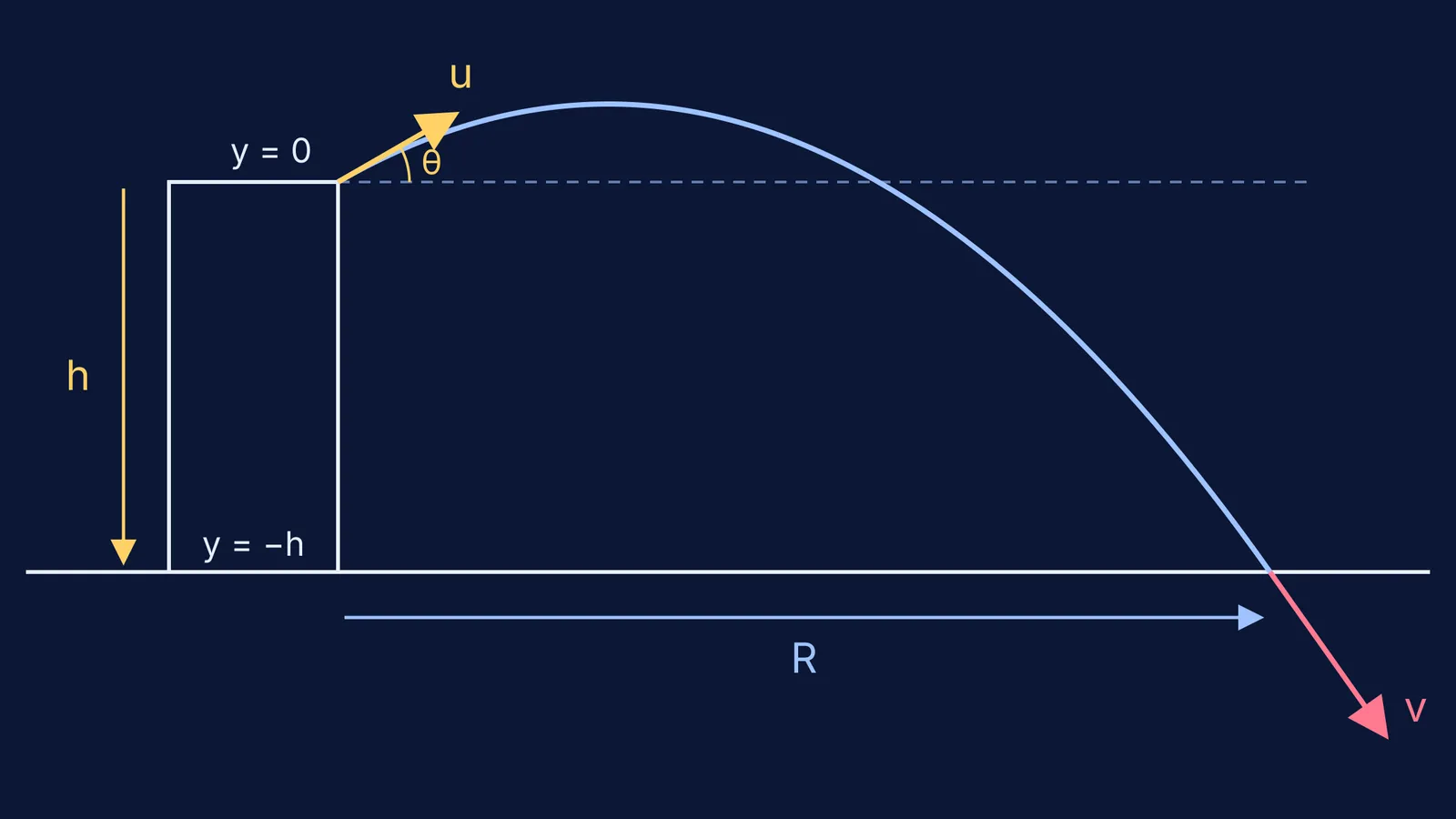
A ball thrown at an angle from the top of a building is a standard projectile question in Class 11 physics and JEE Main practice. The physics is the same as on level ground. What changes is the landing condition, and that turns the time of flight into a quadratic with a sign trap built in.
Why does the usual range formula fail from a building?
The NCERT Class 11 chapter Motion in a Plane gets the time of flight T = 2u sin θ/g by setting y = 0, meaning the projectile lands at the height it was launched from. The range formula u² sin 2θ/g comes from that same assumption. From a rooftop, the ball keeps falling past launch height until it reaches the ground, so it stays in the air longer and travels further.
OpenStax University Physics says the range equation is valid only for launch and impact on a horizontal surface, so it cannot be used when the landing point is below the launch point.
How do you set up the quadratic for time of flight?
NCERT's key idea is that motion in a plane can be treated as two separate one-dimensional motions: horizontal with a_x = 0, and vertical with a_y = −g, ignoring air resistance. So fix your signs once and then follow them:
Put the origin at the point of release. Up is positive, along the throw is positive.
Split the launch velocity: u_x = u cos θ and u_y = u sin θ. If the ball is thrown below the horizontal, u_y = −u sin θ.
The ground is h below the origin, so the landing condition is y = −h. It is never +h.
Write −h = u_y t − ½gt², rearrange to ½gt² − u_y t − h = 0, and solve.
Keep the positive root. The quadratic always has one positive and one negative root, because their product, −2h/g, is negative.
The same one-origin habit fixes most common kinematics sign mistakes.
Worked example: a ball thrown at 30° from a 25 m building
A ball is thrown at u = 20 m/s, 30° above the horizontal, from the top of a building 25 m high. Find the time of flight, the range and the impact speed. OpenStax uses g = 9.8 m/s²; here we take g = 10 m/s² so the arithmetic stays clean.
Components: u_x = 20 cos 30° ≈ 17.32 m/s and u_y = 20 sin 30° = 10 m/s.
Landing condition: −25 = 10t − 5t², which gives t² − 2t − 5 = 0.
Roots: t = 1 ± √6, so t ≈ 3.45 s or t ≈ −1.45 s. Keep T ≈ 3.45 s.
Range: R = u_x T ≈ 17.32 × 3.45 ≈ 59.7 m.
Wrong-formula check: u² sin 2θ/g = 400 × 0.866/10 ≈ 34.6 m. That is where the ball passes roof level again, not where it lands.
The negative root is when the same parabola, traced backwards, would have crossed ground level. OpenStax handles a similar two-root case by keeping the root that fits the physical situation; see also why a projectile is at one height at two times.
How do you find the impact speed and angle?
The horizontal velocity never changes, so at impact v_x is still 17.32 m/s. NCERT gives the vertical velocity as v_y = u sin θ − gt:
v_y = 10 − 10 × 3.45 ≈ −24.5 m/s. The minus sign means it is moving downward.
Speed: v = √(17.32² + 24.5²) = √(300 + 600) = 30 m/s.
Angle below horizontal: tan φ = 24.5/17.32 ≈ 1.41, so φ ≈ 54.7°.
To check, square the components: v² = u² + 2gh = 400 + 500 = 900, so v = 30 m/s. Notice that θ has dropped out. Thrown up, flat or down at the same speed from the same roof, the ball lands at the same speed. If your two answers disagree, look for a sign error.
What should you check before moving on?
Is the landing y negative when you start from the roof?
Did you keep the positive root, and does T come out longer than 2u sin θ/g?
Did you avoid u² sin 2θ/g for unequal heights?
Does v from the components match √(u² + 2gh)?
Once this works, try a version with an obstacle in the way, such as a projectile clearing a wall, which uses the same signed y-equation with a different target height. To practise more variations, the Fermi Problem Library has worked problems with a step-by-step solver that explains the reasoning rather than printing an answer, so you can see exactly where your setup differs.


