

On this page
If you regularly set up a kinematics problem, plug the numbers into your equations, and get an answer with the wrong sign—or a completely impossible result—you are not alone. Kinematics equations are straightforward, but the physical concepts underneath them trip up the majority of learners.
What are the common mistakes in kinematics numericals?
According to a 2021 study by researchers at the State University of Malang, published in the *Journal of Physics*, the average correct answer rate for conceptual kinematics questions was only 30.47% (Source). Students stumble not on the algebra, but on three core physical ideas: failing to set a strict sign convention, incorrectly treating changing acceleration as a constant, and swapping distance for displacement.
How do you choose the correct sign convention?
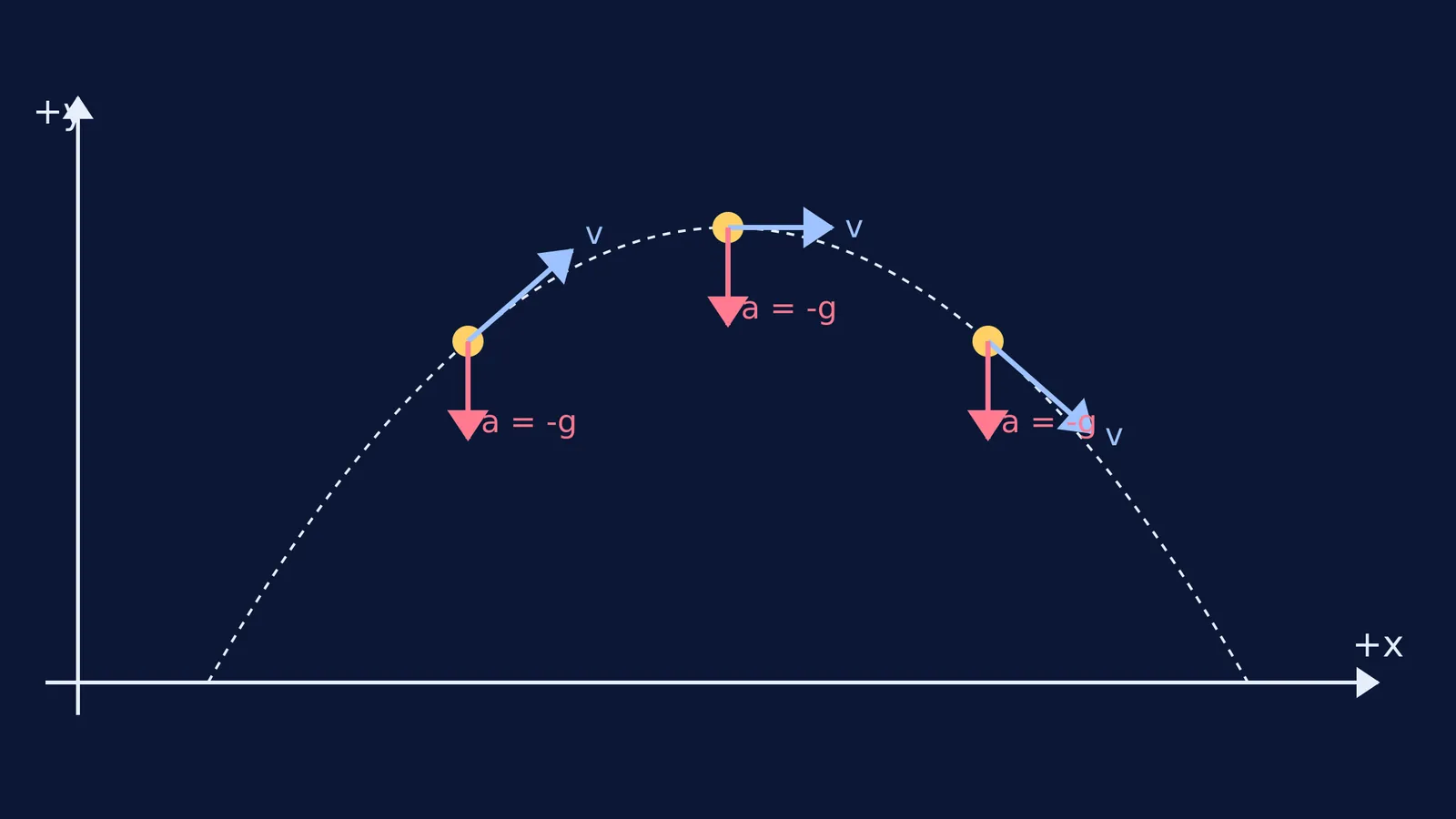
Kinematics equations only work when you pick a single direction as positive and stick to it for every vector in the problem. If you decide upward is positive, a ball thrown at 10 m/s has an initial velocity of +10 m/s. Because gravity always pulls down, its acceleration must be written as −9.8 m/s².
The most frequent error is changing the sign mid-flight. A classic 1981 study by David Trowbridge and Lillian McDermott in the *American Journal of Physics* found that students incorrectly equate zero velocity with zero acceleration (Source). When an object reaches its highest point, its velocity is momentarily zero, but its acceleration is still 9.8 m/s² downwards. Gravity does not turn off just because the object stopped moving upward.
If you need practice tracking these signs across a whole calculation, the Fermi Problem Library has worked problems with a step-by-step solver that explains the reasoning rather than printing an answer.
Why does changing acceleration break v = u + at?
The "Big Four" kinematics equations—such as v = u + at and s = ut + ½at²—are derived under a strict condition: acceleration must be constant. Gravity near the Earth's surface provides a constant acceleration.
However, if you are dealing with a spring force that changes as it stretches, or air resistance that increases with speed, you cannot use these standard formulas. In these cases, you must integrate the acceleration function. If you try to force a variable acceleration into v = u + at, your answer will be fundamentally wrong.
For example, when an object falls from a very high altitude, air resistance grows proportional to the square of its speed. This means the downward acceleration is no longer a constant 9.8 m/s², but a value that steadily decreases until it reaches zero at terminal velocity. Students who try to calculate the time to hit the ground using s = ut + ½at² will severely underestimate the time because the formula assumes the acceleration remains constant at its initial maximum value for the entire fall. For more on the calculus approach, see how to handle a variable acceleration function of v or x.
How is distance different from displacement in equations?
Distance is the total path travelled, like the reading on a car's odometer. Displacement is the straight-line vector from the start to the end point. In standard kinematics equations, the variable s always stands for displacement, not distance.
A 2021 study by Jufriadi et al. revealed that initially none of their students could correctly distinguish between the two concepts, often attempting to calculate distance using equations meant for displacement (Source). If you throw a ball up and catch it at the exact height you released it, its displacement is zero. If you plug s = 0 into the equations, they will tell you the total time of flight perfectly. If you try to track the path up and the path down as "distance," you will likely tie yourself in knots.
Consider a stone thrown upwards from a 50-metre cliff. If it rises 10 metres before falling 60 metres to the ground, its total distance travelled is 70 metres. However, if you define the starting point as the origin and downwards as the positive direction, its final displacement is simply +50 metres. Plugging the 70-metre distance into the kinematics equations instead of the 50-metre displacement will yield an incorrect time of flight, because the equations only track the net change in position.
A quick checklist for kinematics numericals
Before you pick an equation, write down these four things to avoid the most common errors:
The positive direction: Draw an arrow on your page. If you choose "up" as positive, label it.
The signs of your given values: If "up" is positive, an initial velocity thrown upward is positive. Gravity is pulling down, so acceleration is negative.
Is acceleration constant? Check if a spring or air resistance is involved. If they are, you cannot use v = u + at.
Are you tracking distance or displacement? If the object reverses direction, remember that s gives you the net change in position, not the total length of the journey.
If you are struggling to spot whether a problem needs the total path or just the final position, Fermi's AI tutor can work out what you already know and build a plan for the session, so you sit down to a clear next step.
When you master the rules—keeping your signs strict, checking if acceleration is constant, and using displacement correctly—problems like finding the equation of trajectory of a projectile or the distance in the nth second become reliable and mechanical.


