

On this page
Why does a projectile reach the same height twice?
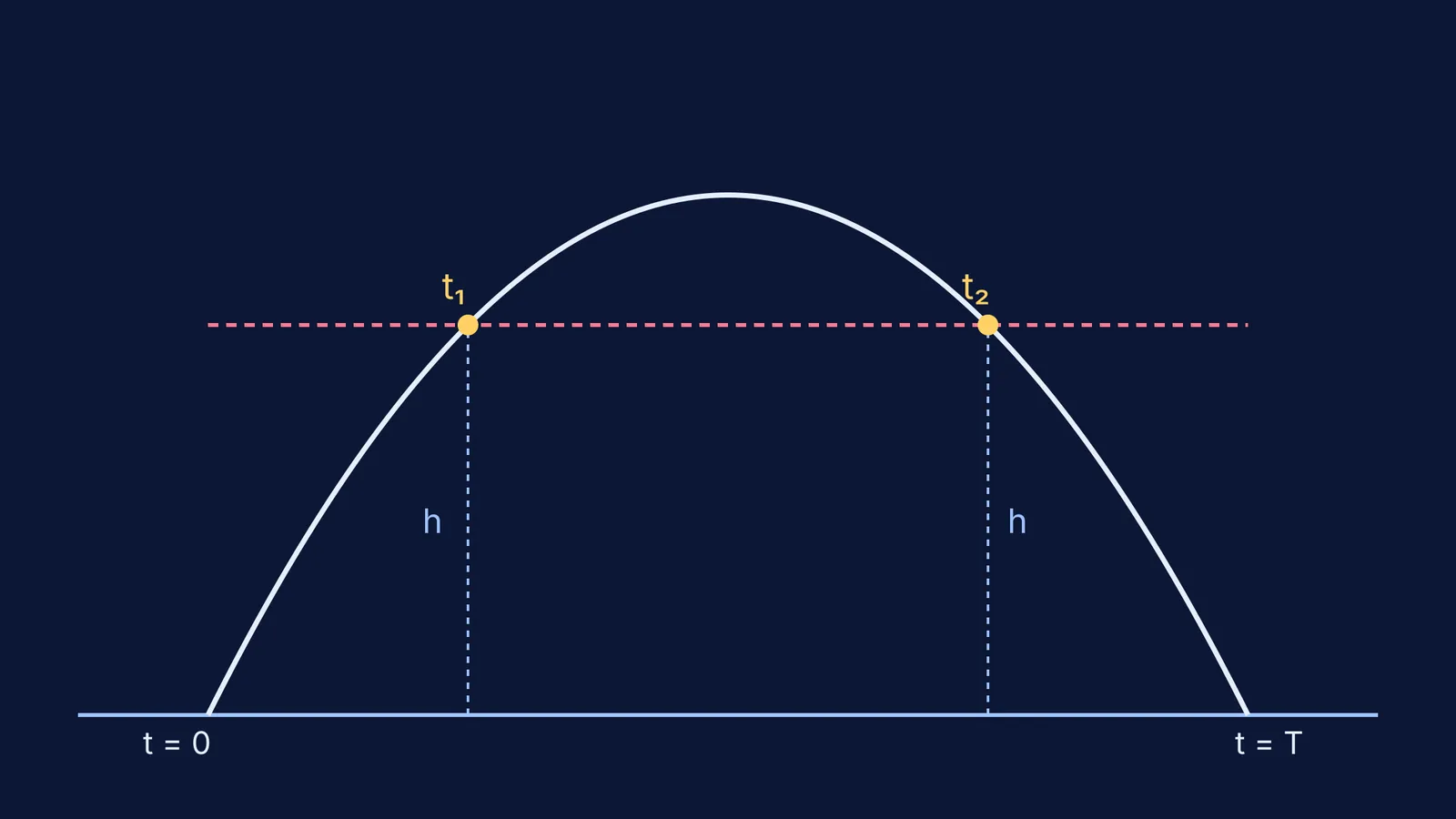
When you throw a ball at an angle, its motion is split into horizontal and vertical components that act independently. Gravity only affects its vertical motion, pulling it steadily downwards at 9.8 metres per second squared 1. Because of this, the projectile crosses a specific height h on its way up (at time t₁), reaches its maximum height where its vertical velocity momentarily becomes zero, and falls back down, passing through that same height h again (at time t₂).
The equation for vertical displacement over time is a standard kinematic equation: h = (u sin θ)t − (1/2)gt²
By rearranging this into a standard quadratic form, we get (1/2)gt² − (u sin θ)t + h = 0. Because it is a quadratic equation in time (t), it yields two roots for any height below the maximum, which correspond exactly to t₁ and t₂.
What does t₁ + t₂ tell us?
The properties of quadratic equations (known as Vieta's formulas) state that the sum of the roots is the negative of the middle coefficient divided by the leading coefficient. When we add t₁ and t₂, we get a very clean result.
t₁ + t₂ = (u sin θ) / (g/2) = 2(u sin θ) / g
This exactly matches the standard formula for the total time of flight (T) of a projectile that launches from and returns to the flat ground. So, simply adding the upward time and the downward time for any arbitrary height h gives you the entire time the object spends in the air.
How do you find the height from t₁ and t₂?
The product of the roots in our quadratic equation gives us another extremely useful relationship. Multiplying the two times eliminates both the initial velocity (u) and the launch angle (θ) entirely.
t₁ × t₂ = h / (g/2) = 2h/g
You can rearrange this equation to solve directly for the height: h = (1/2)g × t₁ × t₂. This is a powerful shortcut for physics problems. It means you can determine how high an object was just by knowing the two times it passed a particular mark, using only the constant acceleration of gravity.
What does the time difference t₂ − t₁ tell us?
You can also use these roots to find the duration the projectile spent flying above the window or mark. The time spent above the height h is simply the difference between the second time and the first time: t₂ − t₁.
Using standard algebraic identities, you can rewrite this difference purely in terms of the sum and product of the roots: t₂ − t₁ = √((t₁ + t₂)² − 4t₁t₂). Substituting our previous findings, this becomes √(T² − 8h/g). This formula lets you calculate the time spent above a certain height directly from the total time of flight and the height itself, completely bypassing the need to calculate the initial vertical velocity.
Worked example: solving height and speed questions
Physics exam questions frequently use this symmetry to test your algebraic reasoning rather than just your memory of standard formulas. If a theoretical question states that a ball passes a balcony at one second and again at three seconds 2, you can find all the key kinematics without setting up simultaneous equations.
Find the total time of flight: The time of flight is simply the sum of the two times. T = 1 + 3 = 4 seconds.
Find the initial vertical velocity: Since T = 2(u sin θ) / g, we have 4 = 2(u sin θ) / 9.8. Solving this gives an initial vertical velocity of 19.6 metres per second.
Find the balcony's height: Using the product rule, h = (1/2)g × t₁ × t₂ = 0.5 × 9.8 × 1 × 3 = 14.7 metres.
If you are struggling to map these algebraic roots onto a complex word problem, Fermi's AI tutor can work out what you already know and build a plan for the session to guide you through the math. For a step-by-step breakdown of a specific past paper question, you can paste it into the Fermi Problem Library to see the exact reasoning unfold without skipping steps.
These quadratic shortcuts apply widely across kinematics problems. Whether you are finding the equation of trajectory of a projectile or calculating the time and drop for a horizontal projectile from a cliff, the mathematical symmetry of vertical motion under gravity remains exactly the same.


