On this page
Acacia gum, sold as gum arabic, is a dried tree exudate used in food as a thickener. The Indian Standard for food-grade acacia gum, IS 6795:2007, allows gum from two trees, Acacia senegal and Acacia seyal. To tell them apart it asks you to read one thing on a polarimeter: the sign of the rotation. Then it checks which sugars the gum breaks down into. Both checks are Class 12 stereochemistry.
What does IS 6795 ask the polarimeter to show?
Clause 4.2.1 of the standard reads, in short:
Dissolve 10 g of sample (dry basis) in 100 mL of water, filtering if needed.
Read it in a 200 mm tube.
Gum from A. senegal: aqueous solutions are levorotatory.
Gum from A. seyal: aqueous solutions are dextrorotatory.
That is all. BIS gives the sign only, with no number and no limit. The same wording, with the same 10 g in 100 mL and 200 mm tube, appears in the international JECFA specification for gum arabic that the 2007 revision drew on.
The standard gives no reason for the opposite signs. The rotation of a big polysaccharide depends on its whole structure: which sugars, which ring forms and how they are linked. You cannot predict it from the list of monomers, so the sign works as a fingerprint.
What do "200 mm tube" and "10 g per 100 mL" mean in the formula?
Specific rotation is [α] = α / (l × c), with l in decimetres and c in g/mL. How the instrument gives you α is explained in how a polarimeter measures optical rotation.
200 mm tube: 200 mm = 20 cm = 2 dm, so l = 2.
10 g in 100 mL: c = 10 ÷ 100 = 0.100 g/mL.
So l × c = 2 × 0.100 = 0.200, and α = 0.2 × [α] under the IS conditions.
"Dry basis" matters because the gum holds water; Table 1 allows loss on drying up to 15% for granular gum. At 15% moisture you would weigh 10 ÷ 0.85 = 11.76 g of gum to get 10 g of dry gum.
Worked example: from rotation to tree, and back
The specific rotations below are illustrative model values for practice. BIS gives none for either gum; do not quote them as measured.
Example 1. Predict the reading. Take a model gum with [α] = −30°.
Write α = [α] × l × c.
Put in l = 2 dm and c = 0.100 g/mL: α = −30 × 2 × 0.100.
α = −6.0°. The sign is negative, so the gum is laevorotatory, which IS 6795 links to A. senegal.
A model gum with [α] = +50° would read +50 × 0.200 = +10.0°, dextrorotatory, so A. seyal.
Example 2. Reverse it. A sample made up under the IS conditions reads −5.5°.
[α] = α / (l × c) = −5.5 / (2 × 0.100).
[α] = −5.5 / 0.200 = −27.5°.
Negative, so laevorotatory: A. senegal by the standard's rule.
If your book writes c in g per 100 mL, the formula becomes [α] = 100α / (l × c) = 100 × (−5.5) / (2 × 10) = −27.5° again.
Example 3. Why the sign test is robust. Suppose you forget the dry basis and weigh 10 g of gum holding 15% water. The real dry concentration is 0.085 g/mL. The model gum (−30°) then reads −30 × 2 × 0.085 = −5.1°, and dividing by 0.200 gives −25.5° instead of −30°. The number is off by 15%, but the sign does not change. The strong solution also helps: at 1 g per 100 mL the same model gum would read only −0.6°, ten times smaller and harder to read.
Which sugars must the gum contain, and which must be missing?
Clause 3.1 says the gum is mainly high molar mass polysaccharides as calcium, potassium and magnesium salts, which on hydrolysis give arabinose, galactose, rhamnose and glucuronic acid. Clause 4.2.2 says a paper chromatogram of the hydrolysate must show these four and must show no spots for mannose, xylose or galacturonic acid. The salts fit: glucuronic acid carries a COOH group, whose carboxylate holds Ca²⁺, K⁺ and Mg²⁺.
The standard does not say D or L. Arabinose and rhamnose are among the few sugars found in nature mainly in the L form (Wikipedia: Rhamnose), while galactose and glucuronic acid occur as D sugars. Arabinose even takes its name from gum arabic, where it was first found (Wikipedia: Arabinose). So the forms usually drawn for this gum are L-arabinose, L-rhamnose, D-galactose and D-glucuronic acid. Rhamnose is 6-deoxy-L-mannose: L-mannose with its CH₂OH end reduced to CH₃ (PubChem: L-rhamnose).
Why are the excluded sugars a stereochemistry exercise?
Each banned sugar is a close stereoisomer of something allowed. Two compounds that differ in configuration at just one of several stereocentres are epimers; see epimers and anomers explained if the term is new.
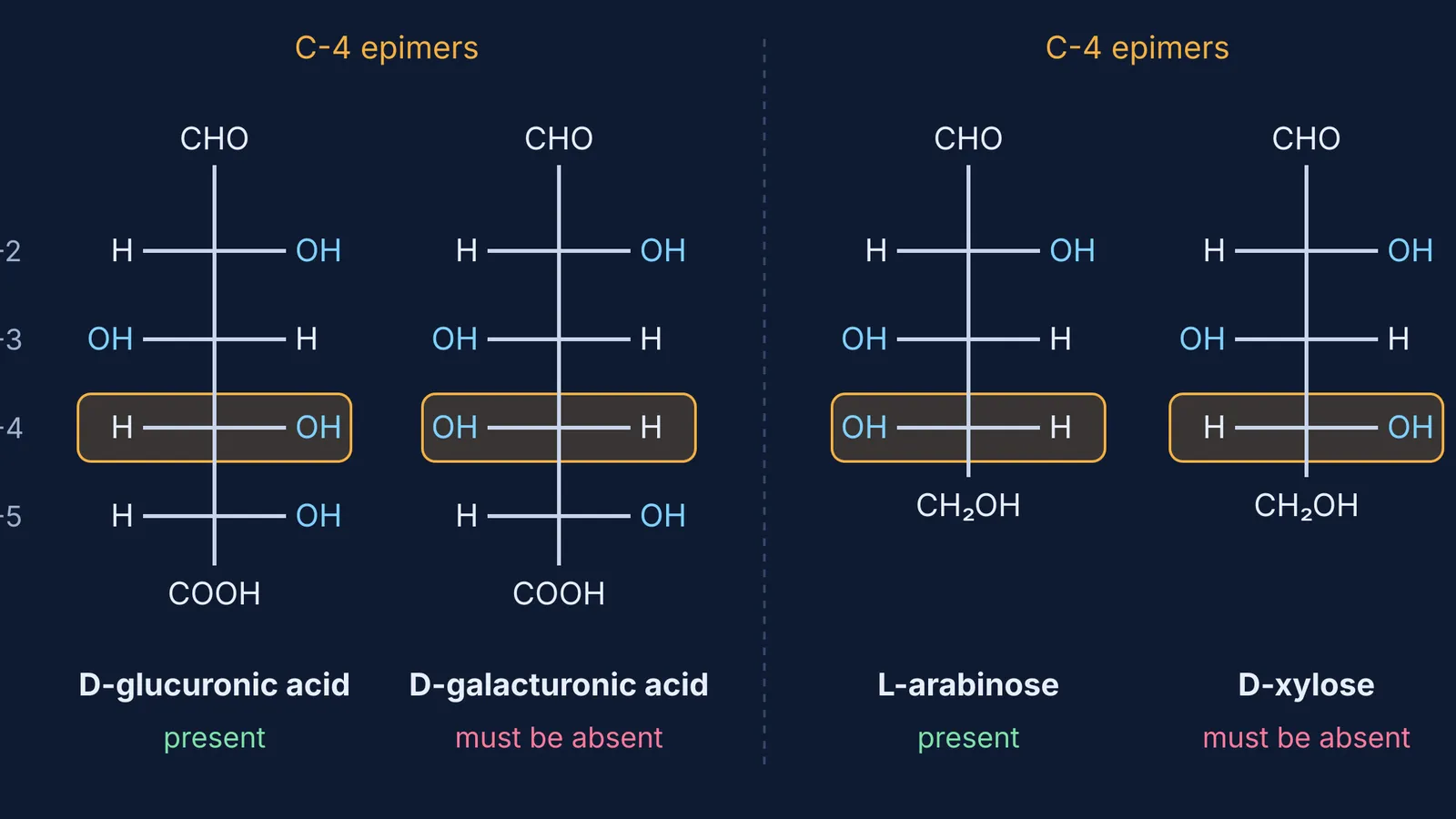
List the OH sides in each Fischer projection, CHO at the top, from C-2 down (R = right, L = left). These match PubChem's stereodescriptors.
D-glucose: R, L, R, R.
D-galactose: R, L, L, R. Differs from glucose only at C-4, so galactose is the C-4 epimer of glucose.
D-mannose: L, L, R, R. Differs from glucose only at C-2: the C-2 epimer.
D-glucuronic acid: R, L, R, R with COOH at C-6. It is glucose with C-6 oxidised from CH₂OH to COOH.
D-galacturonic acid: R, L, L, R with COOH at C-6. Same oxidation of galactose, so it is the C-4 epimer of glucuronic acid (PubChem: D-glucuronic acid, D-galacturonic acid).
L-arabinose (a pentose, C-5 is CH₂OH): R, L, L.
D-xylose: R, L, R. Compare with L-arabinose: only C-4 differs (PubChem: L-arabinose, D-xylose).
So the test keeps glucuronic acid but bans its C-4 epimer, and keeps L-arabinose but bans its C-4 epimer, D-xylose. For a pentose, C-4 is the stereocentre furthest from CHO, so here one flipped OH also flips D to L. Galacturonic acid is the main unit of pectin; see how pectin's galacturonic acid is titrated. If you want to drill more Fischer projections like these, the Fermi Concept Library has each carbohydrate idea with its own lesson.
Where does this appear in the JEE and NEET syllabus?
Class 12 Biomolecules: D and L configuration, Fischer projections, oxidation of glucose and polysaccharides. Epimers are a common JEE extension.
Class 12 Haloalkanes and Haloarenes: optical activity, dextro and laevo, and the polarimeter.
Numericals: [α] = α / (l × c) with unit conversions for tube length and concentration.
If you are revising these chapters for the exam, Fermi Test Prep is built for JEE Main and Advanced preparation, with an AI tutor.
Quick checklist
IS 6795: 10 g dry gum per 100 mL, 200 mm tube; A. senegal (−), A. seyal (+).
BIS gives the sign only. Any specific rotation you use is a model value.
200 mm = 2 dm; 10 g/100 mL = 0.100 g/mL; α = 0.2 × [α].
Required sugars: arabinose, galactose, rhamnose, glucuronic acid. Absent: mannose, xylose, galacturonic acid.
Galactose is the C-4 epimer of glucose; galacturonic acid is the C-4 epimer of glucuronic acid; D-xylose is the C-4 epimer of L-arabinose.
D/L is not the sign of rotation.