On this page
NCERT says a reaction's rate roughly doubles for every 10 °C rise. In 1887 the Liège chemist Walthère Spring timed marble dissolving in five strong acids at 15, 35 and 55 °C and found the rate doubled only every 20 °C. He also found that every strong acid at the same molar strength dissolved marble at the same rate. Both results are worth knowing, and the first lets you practise getting an activation energy from two rates.
The paper is W. Spring, "Über den Einfluss der Temperatur auf die Geschwindigkeit der Einwirkung der Mineralsäuren auf Marmor", Z. phys. Chem. 1 (1887) 209–220, put into German by the editor, Wilhelm Ostwald, from Spring's manuscript (scan on the Internet Archive). Translations are ours; the numbers were checked against the page images. Spring, a professor at the University of Liège, also did early experiments in mechanochemistry (Wikipedia).
What was wrong with earlier marble experiments?
Boguski, and later Boguski with Kajander, had found that marble's rate with HCl is proportional to the acid's concentration, and that equal molar strengths of HCl, HBr and HNO₃ act equally fast. Spring listed problems. The marble's surface shrank during a run. The solution filled up with calcium salt. Nobody had asked whether the rate is fastest at the very start. And nobody had varied the temperature.
How did Spring keep the surface area constant?
He ground blocks of Carrara marble flat and covered five faces of each with wax. The sixth face, exactly 19 × 16 mm = 304 mm², stayed bare. Hung vertically in acid, the block dissolves in parallel layers, so the reacting area does not change.
He made acids of equal molar strength: 5% HCl matched 11.09% HBr, 17.53% HI, 8.63% HNO₃ and 13.76% HClO₄. Each run used enough acid to give 500 cm³ of CO₂ measured at 0 °C, which he states as 522 cm³ at 15 °C. (A plain Charles's law conversion gives about 527 cm³; the paper does not say where the difference comes from.) The reaction is
CaCO₃ + 2H⁺ → Ca²⁺ + H₂O + CO₂
with 1 Ca, 1 C, 3 O, 2 H and a charge of 2+ on each side.
A chronograph timed every 25 cm³ of gas, and his "rate" was 25 divided by those seconds. Five acids, three temperatures, five agreeing runs each: 75 series in all.
Did the type of acid matter?
His first result: "For all mineral acids investigated, the reaction rate is the same at the same temperature." At 35 °C the five acids' times to the first 100 cm³ were 187 to 212 seconds.
Acetic acid was much slower: an early rate of 0.0212 against 0.440 for the mineral acids, "about 1/20". He warned against trusting it, because organic acids "flake the marble and do not dissolve it regularly."
Spring blamed "geometric or mechanical factors". The modern reading is simpler: HCl, HBr, HI, HNO₃ and HClO₄ are all strong acids, fully ionised, so equal molar strength means equal [H⁺]. Acetic acid is weak and supplies far less H⁺. Arrhenius's theory of ions appeared later in the same volume of the journal.
How did the rate change during a run?
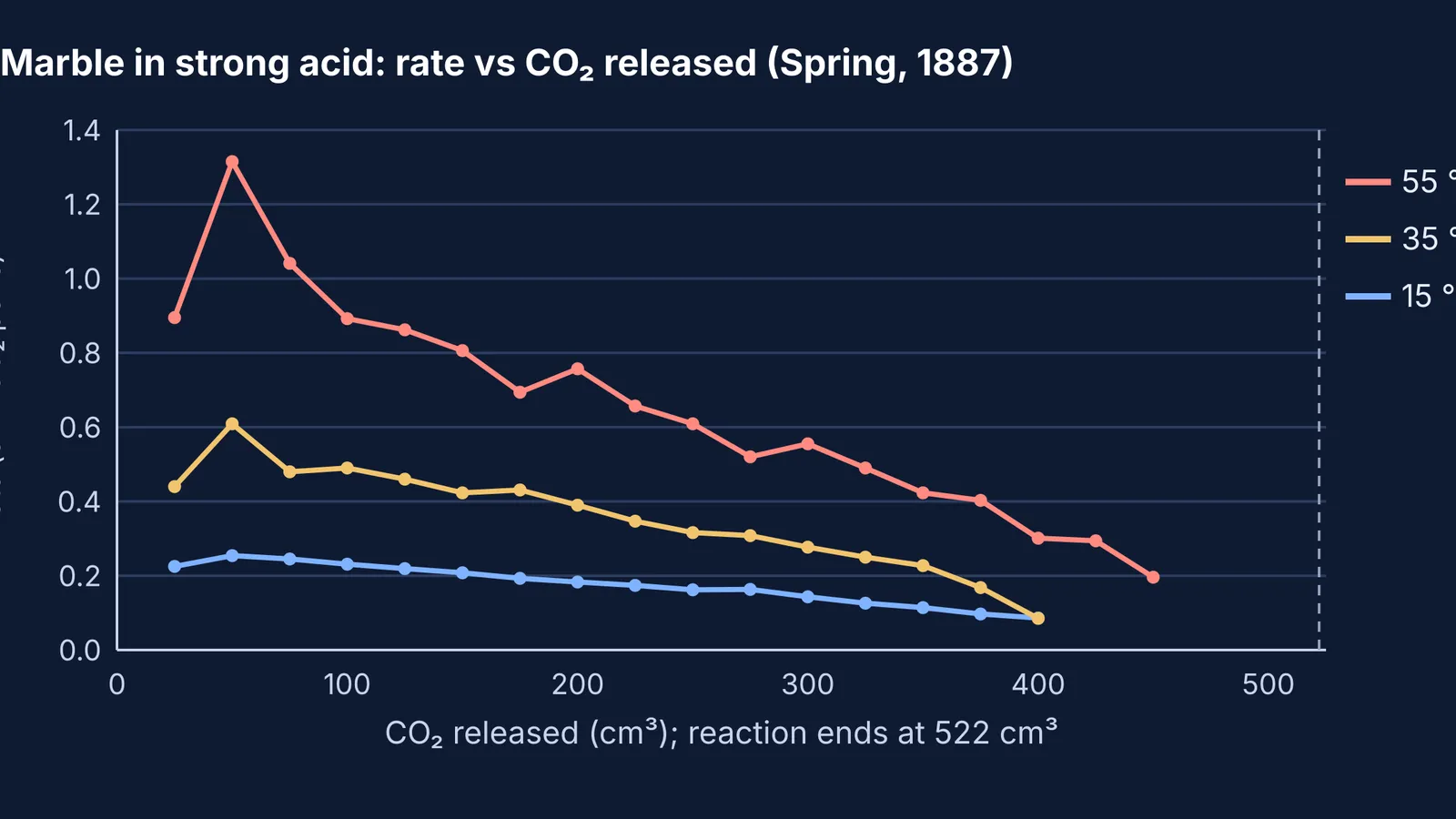
The rate did not start at its highest. It rose "from zero to about 50 cm³" because "the chemical process must first get going", even when he lifted the marble out and put it back. From 50 to about 300 cm³ his plot of rate against gas volume was a straight line, which he extended to the axis at exactly 522 cm³, the end of the reaction. So the rate was proportional to the acid left. Beyond 300 cm³ the rate ran above the line, perhaps because of the calcium salt.
Our check on his 15 °C averages: rate ÷ (522 − volume) stays between 0.54 and 0.57 (×10⁻³) from 50 to 200 cm³, then creeps up, as he described. For the same idea with chips and powder, see how surface area changes the rate of marble and acid.
How much faster was it at 35 and 55 °C?
Between 50 and 350 cm³ he divided the rate at 35 °C by that at 15 °C, and at 55 °C by that at 35 °C, point by point. The means were 2.05 and 1.90, and the overall mean was 1.98: "for every 20° of temperature difference the rates change very nearly as one to two." He wrote the law v = k·2^(t/20). A doubling per 20 °C is a factor of √2 ≈ 1.41 per 10 °C, well below the textbook 2.
Worked example: activation energy from Spring's ratio
Use ln(k₂/k₁) = (Ea/R)(1/T₁ − 1/T₂). Spring gave no activation energy; Arrhenius's equation came in 1889. These are our numbers.
T₁ = 288.15 K, T₂ = 308.15 K. 1/T₁ − 1/T₂ = 2.252 × 10⁻⁴ K⁻¹.
ln 1.98 = 0.683.
Ea = 8.314 × 0.683 ÷ (2.252 × 10⁻⁴) = 25 kJ mol⁻¹.
His separate means: 2.05 for 15→35 °C gives 26.5 kJ mol⁻¹; 1.90 for 35→55 °C gives 27.0 kJ mol⁻¹.
Compare the 10 °C rule: a factor of 2 between 298 and 308 K means Ea = 8.314 × 0.693 ÷ (1.090 × 10⁻⁴) = 53 kJ mol⁻¹. With 53 kJ mol⁻¹, going from 15 to 35 °C would multiply the rate by 4.2, not 2.
The derivation of the 53 is in why rates double every 10 °C.
Why would a surface reaction have such a low Ea?
This part is modern reasoning, not Spring's. At a solid surface, H⁺ has to reach the marble through a thin layer of liquid next to it. If that transport is slow, it sets the rate, and diffusion in water speeds up only gently with temperature. A diffusion coefficient goes roughly as T/η, where η is water's viscosity, about 1.00 mPa s at 20 °C and 0.65 at 40 °C (approximate table values). That gives (313/293) × (1.00/0.65) ≈ 1.6 per 20 °C, or about 19 kJ mol⁻¹.
Spring's 25 kJ mol⁻¹ sits between that and a typical chemical step. It is consistent with transport of acid to the surface limiting the rate, at least partly; it does not prove it. Spring had the same hunch: the rate may depend on how many molecules "penetrate an infinitely thin layer of the liquid medium", an idea he left for later work.
Where does this come up in JEE and NEET?
Class 12 Chemical Kinetics: factors affecting rate (concentration, temperature, surface area), temperature coefficient, and Ea from rates at two temperatures with the Arrhenius equation.
Strong acids are fully ionised, so equal concentrations give equal [H⁺].
To see how temperature changes the share of fast collisions, try the Simulation Lab, with interactive simulations for ideas that are easier to see than read. For JEE-style kinetics practice, Fermi Test Prep covers JEE Main and Advanced preparation with an AI tutor.
Quick checklist
Constant area: a waxed marble block with one 304 mm² face.
Five strong acids at equal molar strength gave equal rates; acetic acid about 1/20.
Rate proportional to acid left, between 50 and about 300 cm³ of CO₂.
Rate ×1.98 per 20 °C, so Ea ≈ 25 kJ mol⁻¹, against 53 kJ mol⁻¹ for the 10 °C rule.
A low Ea at a surface fits, but does not prove, partial diffusion control.