On this page
A runner carries a pole 6 m long at 0.8 times the speed of light towards a barn 4 m long. The barn has a door at each end. The farmer says the moving pole is contracted to 3.6 m, so it fits inside, and both doors can be shut at the same moment with the whole pole in the barn. The runner says the barn is the thing that is moving, so the barn is contracted to 2.4 m, and a 6 m pole cannot possibly fit. Who is right? Both are, and the reason is the idea that two events at the same time for one observer happen at different times for another.
Special relativity is beyond the NCERT syllabus and is not in the JEE Main or NEET syllabus, so treat this as enrichment. You meet E = mc² in the Class 12 chapter on nuclei; this is part of the theory it comes from.
What is the pole and barn paradox?
It is a thought experiment, also called the ladder paradox. A pole of rest length 6 m moves at v = 0.8c through a barn of rest length 4 m. Each door is shut for an instant and then opened again, so nothing ever crashes into a closed door. The question is whether the pole is ever completely inside the barn with both doors shut.
The paradox looks like a contradiction because each observer applies the same rule, "moving things are shorter", and reaches the opposite conclusion. The way out is not to decide which observer is wrong. It is to notice that "both doors shut at the same time" means different things to them.
How long is the pole, and how long is the barn?
First find the Lorentz factor:
γ = 1/√(1 − v²/c²) = 1/√(1 − 0.64) = 1/0.6 = 5/3
Length contraction says a length measured along the motion, in a frame where the object moves, is its rest length divided by γ (OpenStax University Physics, Volume 3, section 5.4).
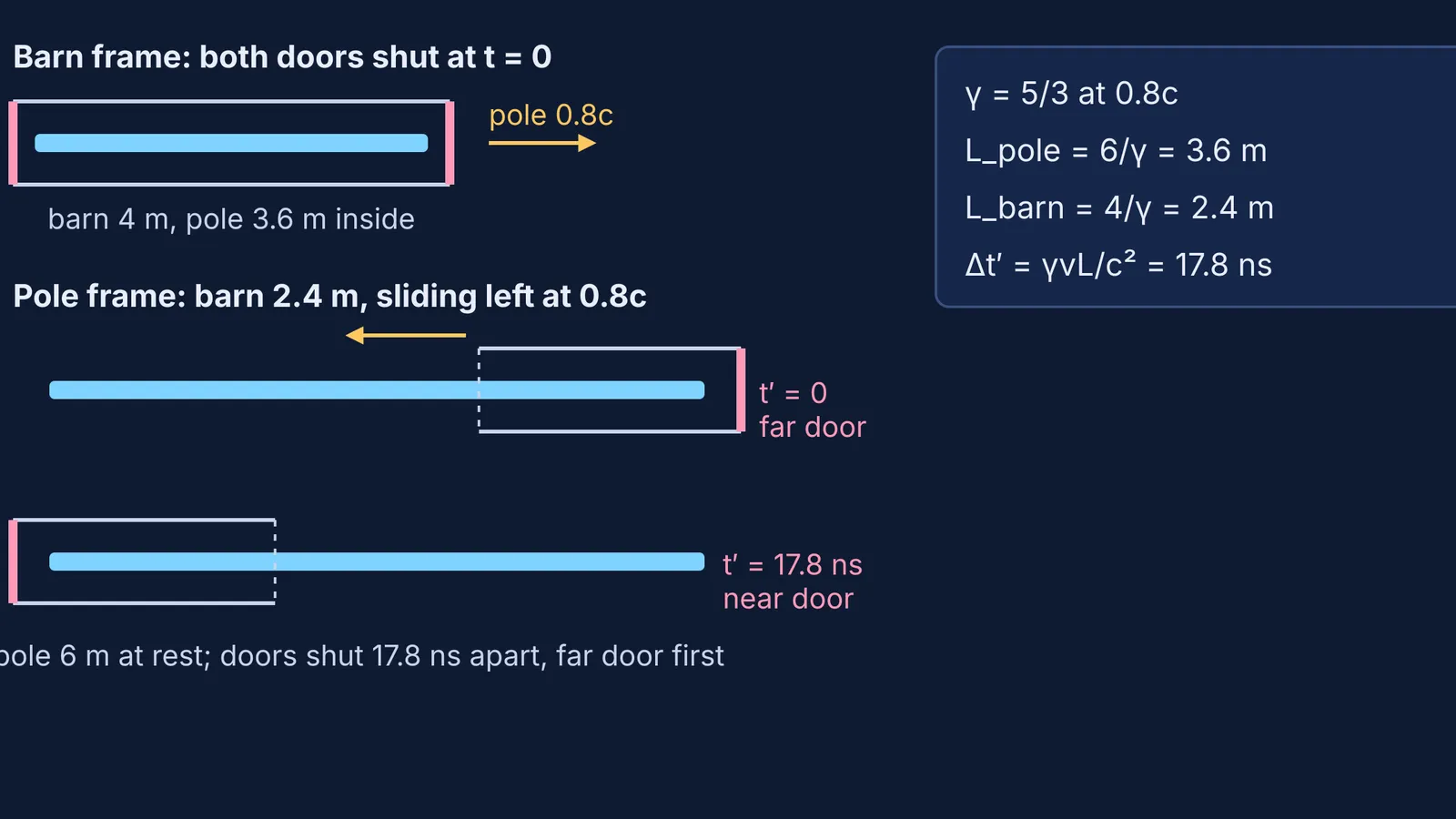
In the barn's frame: the pole is 6 ÷ (5/3) = 3.6 m long. The barn is 4 m. The pole fits, with 0.4 m to spare.
In the pole's frame: the barn is 4 ÷ (5/3) = 2.4 m long. The pole is 6 m. It does not fit, by a long way.
Both statements are correct in their own frame. Length contraction has been tested indirectly many times, for example through the decay of fast muons, but no one has photographed a contracted macroscopic object, so think of these lengths as measurements, not pictures.
Why are the two door closings not simultaneous for the pole?
To measure a length you must mark both ends at the same time. "At the same time" depends on the frame. That is the relativity of simultaneity (OpenStax, section 5.2).
The Lorentz transformation for time makes it exact (OpenStax, section 5.5):
t′ = γ(t − vx/c²)
Take two events that happen at the same barn time t but at different places, a distance L apart in the barn. In the pole's frame they are separated in time by
Δt′ = γvL/c²
The event further along the pole's direction of travel happens first in the pole's frame. If you want to see where this formula comes from, Minkowski's geometry of spacetime draws the same two events on tilted axes.
Worked example: when do the doors shut in the pole's frame?
Use v = 0.8c, γ = 5/3, c = 2.998 × 10⁸ m/s and the barn length L = 4 m.
Set up the barn's frame. Put the near door at x = 0 and the far door at x = 4 m. The pole moves in the +x direction. At t = 0, the pole's tail is at x = 0.2 m and its front at x = 3.8 m, so it sits inside with 0.2 m to spare at each end. Both doors shut at t = 0.
Use the right distance. The two door events are 4 m apart in the barn's frame. That is the L in the formula. Do not use the pole's length.
Find the time gap. Δt′ = γvL/c² = (5/3) × 0.8 × 4 ÷ (2.998 × 10⁸) = 1.78 × 10⁻⁸ s = 17.8 ns. Units: (m/s × m) ÷ (m/s)² = s.
Decide the order. The far door is further along the direction of motion, so in the pole's frame it shuts 17.8 ns before the near door.
Find where each door is. Transform x′ = γ(x − vt). The near door event is at x′ = 0. The far door event is at x′ = (5/3) × 4 = 6.67 m. In the pole's frame the pole runs from x′ = 0.33 m (tail) to x′ = 6.33 m (front).
Read the story. The far door shuts at x′ = 6.67 m, 0.33 m beyond the pole's front, and reopens. The pole's front has not reached it. Then the barn keeps sliding backwards past the pole at 0.8c. In 17.8 ns it moves 0.8 × 2.998 × 10⁸ × 1.78 × 10⁻⁸ = 4.27 m. Now the near door is at x′ = 0, 0.33 m behind the pole's tail, and it shuts and reopens.
Check. At no moment in the pole's frame are both doors shut with the pole between them. In the barn's frame, both doors are shut at once with the pole inside. The two accounts describe the same four events and never disagree about anything physical: no door ever touches the pole.
What if the far door stays shut?
Then the front of the pole hits it, and the problem changes. In the barn's frame, the tail cannot learn that the front has stopped any faster than a signal can travel along the pole, and no signal is faster than light. So the rear part keeps moving for a while and the pole is crushed or bends. No body is perfectly rigid in relativity. That version is about the material of the pole, not about simultaneity, so it is a different problem.
How does this fit with time dilation and the twin paradox?
The same three ideas, time dilation, length contraction and the relativity of simultaneity, all come out of the Lorentz transformation. The twin paradox worked at 0.8c uses the same γ = 5/3 and the same contraction of distances, 4 light-years to 2.4. Velocities combine through the same equations too, as in relativistic velocity addition, where 0.6c plus 0.6c is 0.88c.
If you want to see the underlying ideas laid out one at a time, the Fermi Concept Library covers every concept in physics, including length contraction and the Lorentz transformation.
Quick checklist
γ at 0.8c is 5/3. A 6 m pole becomes 3.6 m in the barn's frame; a 4 m barn becomes 2.4 m in the pole's frame.
Events simultaneous in one frame are not simultaneous in another moving along the line joining them.
Δt′ = γvL/c², with L measured in the frame where the events are simultaneous: 17.8 ns here.
The event further along the pole's direction of travel happens first for the pole.
The doors shut and reopen; nothing is trapped in either frame.
If a door stays shut, the problem becomes one about non-rigid bodies.