On this page
Every order here is from NCERT Class 11 Biology, Chapter 14 (Reprint 2026-27). It falls under Unit 5, Human Physiology, of the NMC's NEET (UG) 2026 syllabus. The 10 questions are ours, not past-paper items or predictions.
Which sequences in Breathing and Exchange of Gases should you know?
Steps of respiration (14.1.1): pulmonary ventilation; diffusion across the alveolar membrane; transport by blood; diffusion between blood and tissues; use of O₂ by cells, releasing CO₂.
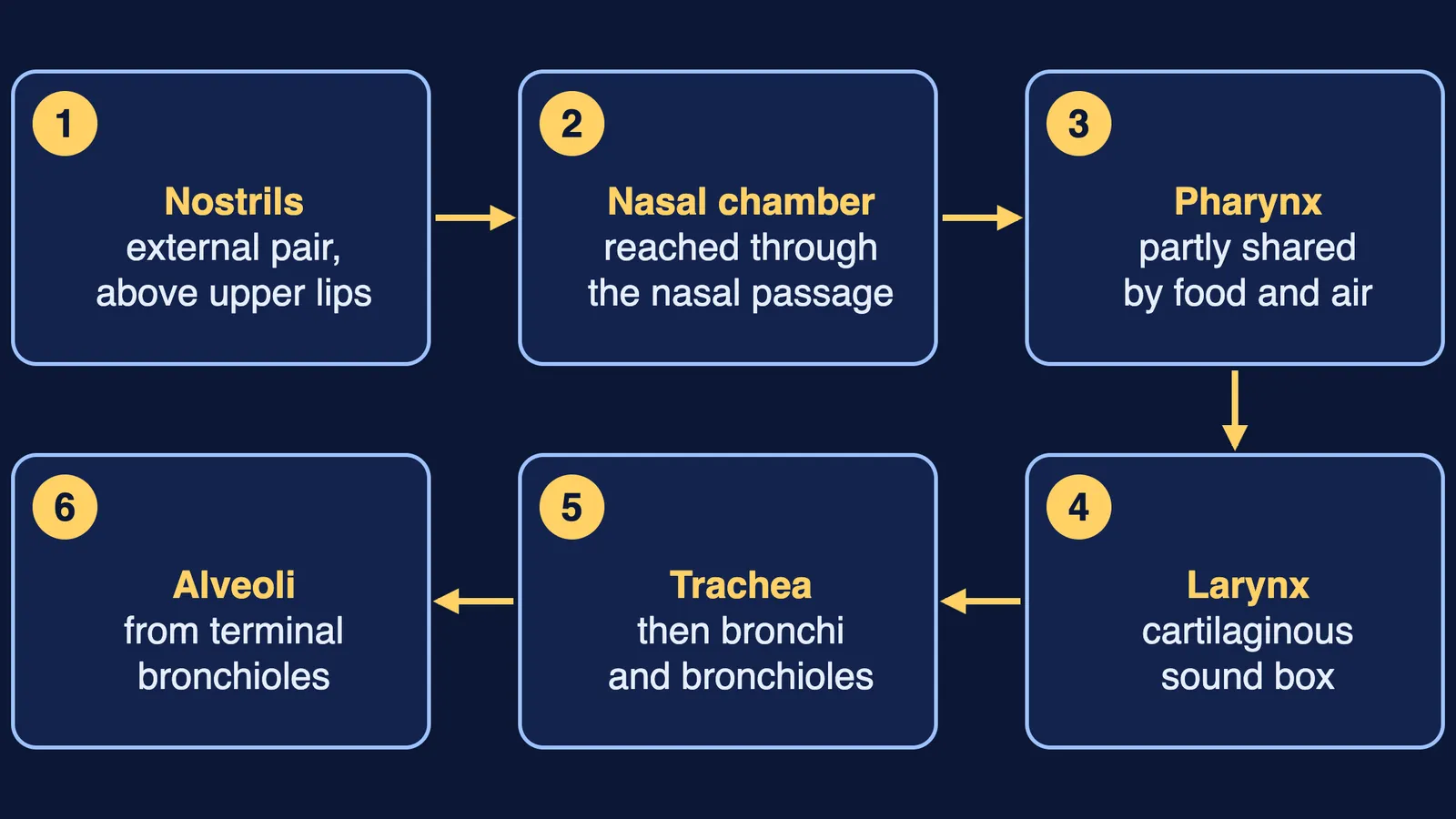
Route of inhaled air (14.1.1): external nostrils, nasal passage, nasal chamber, pharynx, larynx, trachea, primary, secondary and tertiary bronchi, bronchioles, terminal bronchioles, alveoli.
Inspiration (14.2): diaphragm and external intercostals contract together; thoracic and pulmonary volume rise and intra-pulmonary pressure falls below atmospheric; air moves in.
Expiration (14.2): diaphragm and intercostals relax; diaphragm and sternum return to normal positions; volume falls and pressure rises slightly above atmospheric; air is expelled.
Oxygen's journey (14.3, 14.4.1): O₂ diffuses from alveoli into blood; binds haemoglobin at the lung surface; is carried as oxyhaemoglobin; dissociates at the tissues, where pO₂ is low.
CO₂ transport (14.4.2): catabolism raises tissue pCO₂; CO₂ diffuses into RBCs and plasma; carbonic anhydrase turns CO₂ + H₂O into H₂CO₃, then HCO₃⁻ + H⁺; low alveolar pCO₂ reverses this, releasing CO₂. Carbamino-haemoglobin forms in tissues, dissociates at alveoli.
Regulation (14.5): CO₂ and H⁺ rise; the chemosensitive area is activated; it signals the medulla's rhythm centre; breathing is adjusted to eliminate them.
Occupational disorder (14.6): long exposure to grinding or stone-breaking dust; inflammation; fibrosis; serious lung damage.
Study summary, not medical advice: item 8 restates NCERT for revision; for health questions, ask a doctor.
How do you attack arrange-in-order questions?
Arrange in the correct order: 6 practice questions
Q1. Arrange the steps of respiration: A. Transport of gases by blood; B. Diffusion across the alveolar membrane; C. Pulmonary ventilation; D. Use of O₂ by cells; E. Diffusion between blood and tissues. (1) C, B, A, E, D (2) C, A, B, E, D (3) B, C, A, E, D (4) C, B, E, A, D
Answer: (1). Blood must carry gases before they diffuse into tissues.
Q2. Arrange one quiet breath, inspiration first: A. Intra-pulmonary pressure rises slightly above atmospheric; B. Diaphragm and external intercostals contract; C. Alveolar air is expelled; D. Air moves into the lungs; E. Diaphragm and intercostals relax. (1) B, D, A, E, C (2) B, D, E, A, C (3) D, B, E, A, C (4) B, D, E, C, A
Answer: (2). Contraction draws air in; relaxation raises pressure, pushing air out.
Q3. Arrange CO₂ carriage as bicarbonate: A. Low pCO₂ at the alveoli reverses the reaction; B. Catabolism raises pCO₂ in tissues; C. CO₂ is released out; D. CO₂ diffuses into RBCs and plasma; E. HCO₃⁻ and H⁺ form. (1) B, D, E, A, C (2) D, B, E, A, C (3) B, E, D, A, C (4) B, D, A, E, C
Answer: (1). CO₂ enters the blood before carbonic anhydrase traps it as bicarbonate.
Q4. Arrange CO₂ carriage by haemoglobin: A. Blood reaches the alveoli, where pCO₂ is low and pO₂ high; B. CO₂ binds haemoglobin as carbamino-haemoglobin; C. CO₂ dissociates from carbamino-haemoglobin; D. Blood in the tissues meets high pCO₂ and low pO₂. (1) D, B, A, C (2) B, D, A, C (3) D, A, B, C (4) D, B, C, A
Answer: (1). Binding needs the tissues' conditions; release needs the alveoli's.
Q5. Arrange the chemical control loop: A. Rhythm centre adjusts breathing; B. CO₂ and H⁺ build up; C. Chemosensitive area is activated; D. Excess CO₂ and H⁺ are eliminated; E. Chemosensitive area signals the rhythm centre. (1) B, E, C, A, D (2) B, C, E, A, D (3) C, B, E, A, D (4) B, C, A, E, D
Answer: (2). The area is activated, then signals; the rhythm centre acts on that signal.
Q6. Arrange CO₂'s route out of the body: A. CO₂ diffuses from blood into the alveoli; B. Cells release CO₂ in catabolic reactions; C. Blood carries CO₂ to the lungs; D. CO₂ diffuses from tissues into blood; E. CO₂-rich alveolar air is breathed out. (1) B, C, D, A, E (2) B, D, C, A, E (3) D, B, C, A, E (4) B, D, C, E, A
Answer: (2). The gradient runs tissues, blood, alveoli; breathing then releases alveolar air.
Before-after, out-of-place and two-statement items
Q7. In normal expiration, what happens immediately after the diaphragm and intercostals relax? (1) Air is expelled (2) The diaphragm and sternum return to their normal positions (3) Intra-pulmonary pressure rises above atmospheric (4) The ribs are lifted
Answer: (2). Their return to position is what shrinks the thorax.
Q8. A student orders oxygen's journey: O₂ diffuses from alveoli into blood; oxyhaemoglobin dissociates; O₂ binds haemoglobin at the lung surface; blood carries oxyhaemoglobin to the tissues. Which step is out of place? (1) Diffusion (2) Dissociation (3) Binding (4) Carriage
Answer: (2). Dissociation needs the tissues' low pO₂, so it goes last.
Options for Q9 and Q10: (1) both true (2) both false (3) only I true (4) only II true.
Q9. Statement I: In expiration, intra-pulmonary pressure rises above atmospheric before air leaves the lungs. Statement II: The chemosensitive area signals the rhythm centre before CO₂ and H⁺ activate it.
Answer: (3). Raised pressure expels air; activation comes before the signal.
Q10. Statement I: In inspiration, air enters before intra-pulmonary pressure falls below atmospheric. Statement II: At the tissues, H₂CO₃ forms before HCO₃⁻ and H⁺.
Answer: (4). The pressure drop draws air in; carbonic acid forms, then splits.
How should you practise with this set?
Cover the answers and mark all 10; redraw each missed sequence next day. Other formats: the statement and match-the-list set, the diagram-based breathing questions and the NCERT exceptions and odd-one-out set.
Which chain keeps slipping? Fermi's AI tutor works out what you already know and builds a plan for the session.