On this page
Drop a coin into the curved funnel at a science centre or charity box and it rolls round and round, slowly at the wide rim, then faster and faster as it spirals towards the hole. It looks like a planet falling towards a star, and for circular orbits the comparison is exact. In a funnel whose height goes as −1/r, the time for one lap obeys T² ∝ r³, which is Kepler's third law.
Fermi News has covered the pieces separately: a block circling inside a cone, Kepler's third law for planets and why a satellite speeds up as drag pulls it lower. This post joins them through the shape of the funnel.
What shape are coin funnels?
Science museums show them under names such as the Exploratorium's Gravity Well exhibit. A 2012 paper in the American Journal of Physics, English and Mareno, "Trajectories of rolling marbles on various funnels", states that actual coin funnels have a hyperbolic surface. Hyperbolic here means that the height of the surface falls off as 1/r: written with z as the height and r as the distance from the central axis,
z = −k/r
where k is a constant that sets how deep the funnel is. The surface is nearly flat far out and plunges steeply near the hole.
How fast must a coin go to circle at one radius?
Treat the coin as a small object sliding without friction, and look at one horizontal circle of radius r. The surface there slopes at angle α to the horizontal, with tan α = dz/dr. Two forces act: gravity mg down and the normal force N, perpendicular to the surface.
Vertical balance: N cos α = mg
Horizontal (centripetal): N sin α = mv²/r
Dividing gives tan α = v²/(gr), so
v² = gr tan α = gr (dz/dr)
This is the banked-road result, with the bank angle set by the local slope of the funnel.
Why does a 1/r funnel give Kepler's third law?
For z = −k/r the slope is dz/dr = k/r². Put that in:
v² = gr × k/r² = gk/r
Compare a planet in a circular orbit, where gravity provides the centripetal force: GMm/r² = mv²/r, so v² = GM/r. The two are the same with gk playing the part of GM. The period follows the same way. T = 2πr/v gives
T² = 4π²r³/(gk)
So T² ∝ r³, exactly as for planets round the Sun.
The match goes deeper. The height energy of the coin is mgz = −mgk/r, the same 1/r shape as gravitational potential energy −GMm/r. On a circular orbit the kinetic energy is ½mgk/r, so the total energy is −mgk/(2r): the kinetic energy is minus the total, and the potential energy is twice the total, just as for a satellite.
Worked example: three orbits in one funnel
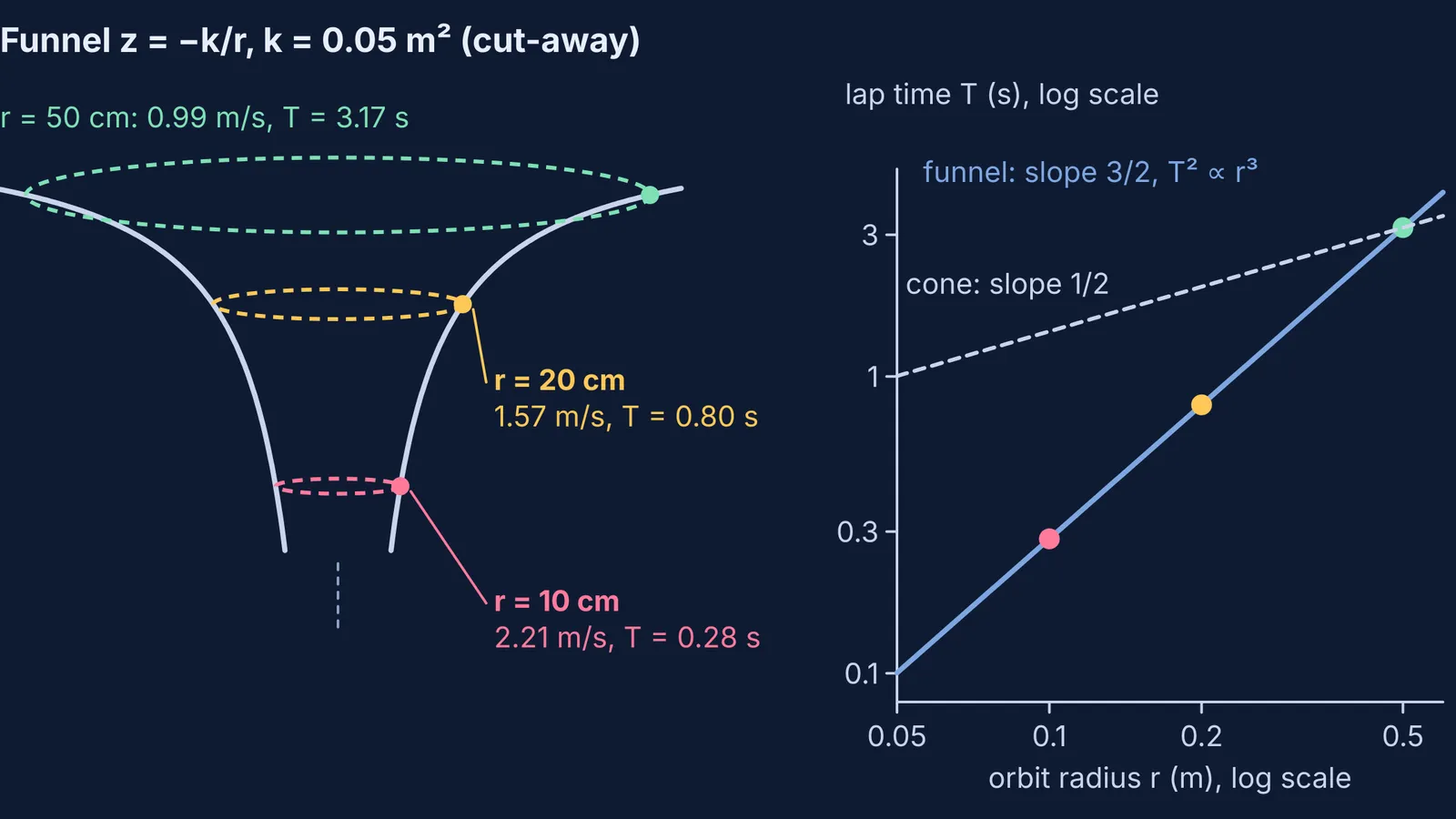
Take k = 0.05 m² (an illustrative funnel, 1 m across) and g = 9.81 m/s², so gk = 0.491 m³/s².
At r = 50 cm: slope dz/dr = 0.05/0.25 = 0.20, so α = 11.3°. Speed v = √(0.491/0.5) = 0.99 m/s. Period T = 2π(0.5)/0.99 = 3.17 s.
At r = 20 cm: slope 1.25, α = 51.3°. Speed 1.57 m/s. Period 0.80 s.
At r = 10 cm: slope 5.0, α = 78.7°, nearly a vertical wall. Speed 2.21 m/s. Period 0.28 s.
The coin at 10 cm sits 0.40 m lower than at 50 cm (z goes from −0.10 m to −0.50 m). Check the ratio with Kepler's law alone: T₅₀/T₁₀ = (0.5/0.1)^(3/2) = 5^1.5 = 11.2, and 3.17/0.284 = 11.2. Units: gk is in m³/s², the same as GM, so r³/(gk) is in s².
Why does the coin speed up as it spirals in?
Friction and rolling losses take energy from the coin, so its total energy −mgk/(2r) becomes more negative. That can only happen if r gets smaller. As r falls, v² = gk/r rises: the coin loses energy and yet goes faster. It drops twice as much height energy as it gains in kinetic energy, and the other half is lost to friction.
Taking our coin from 50 cm to 10 cm, the energy per kilogram falls from −0.49 J to −2.45 J while the speed rises from 0.99 m/s to 2.21 m/s. A satellite in thin upper air does exactly the same thing, as the drag post explains.
Where does the planet comparison break down?
Only circular orbits match. If the coin moves in and out, it also moves up and down, and that vertical motion carries kinetic energy that a planet's orbit does not have. The paths are not closed ellipses. English and Mareno go further and show that no funnel shape reproduces Kepler's orbits in general.
A real coin rolls on its edge. A rolling coin has spin energy and gyroscopic effects, so its circling speed differs from the sliding formula. Treat v² = gk/r as the ideal for a sliding particle.
The funnel is a picture of gravity, not gravity. Here gravity pulls straight down and the surface's slope does the work. Comparisons with curved spacetime are an analogy only.
This is a JEE Advanced style circular-motion problem: the banked-surface balance, then a shape you have to differentiate. For step-by-step working on circular-motion and gravitation problems, try the Fermi Problem Library, whose solver explains the reasoning. For a full plan, Fermi Test Prep offers personalised preparation for JEE Main & Advanced with an AI tutor, adaptive mocks and a study plan that updates based on mastery.
Quick checklist
Circling on any smooth surface of revolution: v² = gr (dz/dr).
Funnel z = −k/r: v² = gk/r, T² = 4π²r³/(gk).
gk takes the place of GM; T² ∝ r³ for circular orbits only.
Cone: T ∝ √r. Funnel: T ∝ r^(3/2).
Losing energy moves the coin inwards and makes it faster.
Treat the coin as a sliding particle; a rolling coin differs.