

On this page
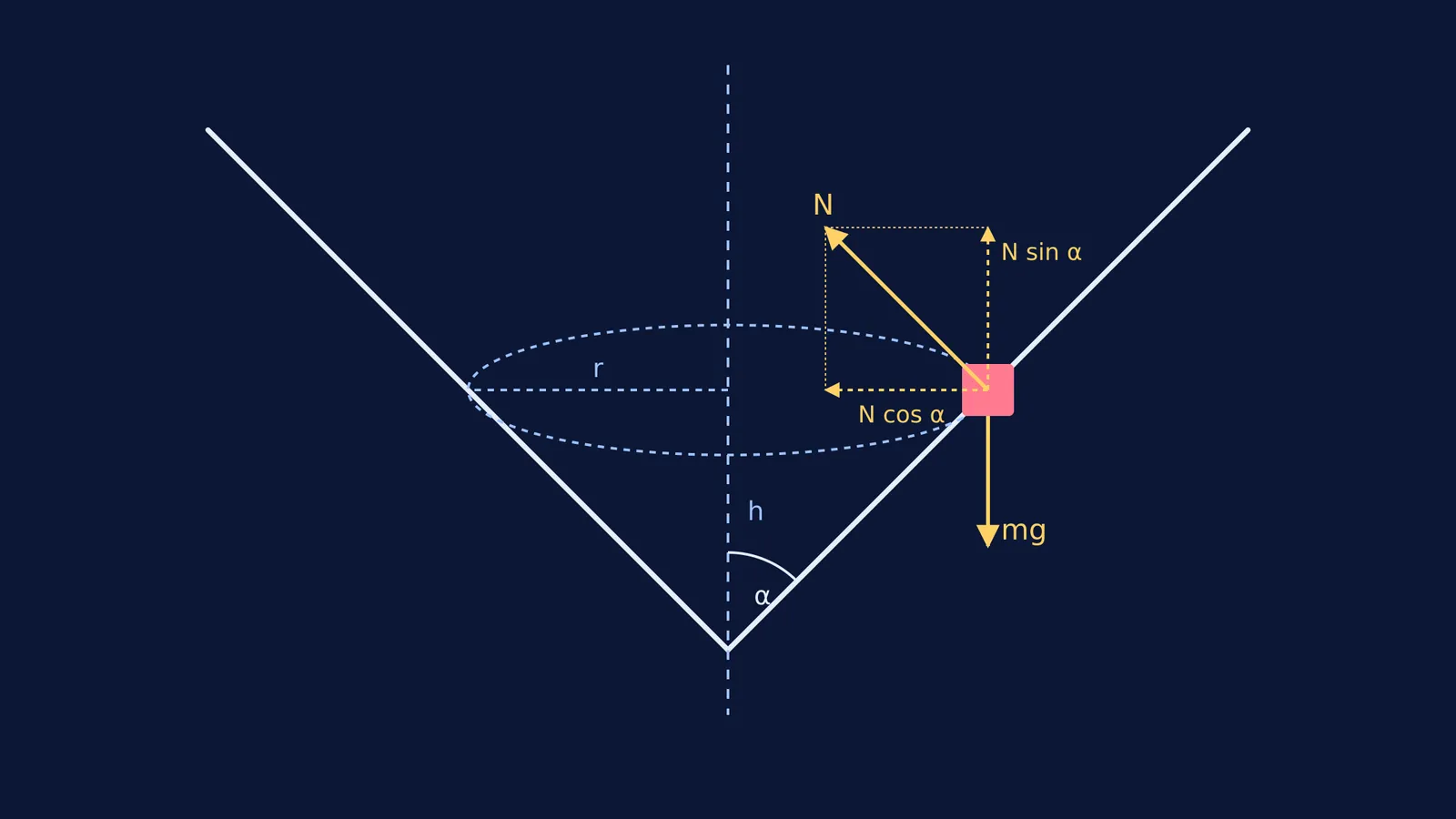
Imagine a small block sliding in a steady horizontal circle along the inside wall of a smooth, inverted cone. Because the cone is frictionless, no force holds the block up or slows it down along the surface. Only two forces act on it:
Gravity (mg): pulling straight down.
Normal force (N): pushing perpendicular to the surface of the cone.
This setup relies on the exact same physics as a frictionless banked turn on a road. The cone's angled wall acts as an indefinitely long banked curve, where the tilted normal force provides the necessary push toward the centre.
How do you resolve the forces to find the speed?
Let the cone's semi-vertical angle—the angle between its central vertical axis and its wall—be α. Because the wall tilts away from the vertical by α, the normal force pushes inward and upward, making an angle α with the horizontal.
We can split this normal force into two components:
Vertical component (N sin α): Since the block stays at a constant height without sliding down, this upward force must exactly balance the downward pull of gravity.
N sin α = mg
Horizontal component (N cos α): This inward force provides the centripetal force required to keep the mass m moving at speed v in a circle of radius r.
N cos α = mv²/r
By dividing the vertical equation by the horizontal equation, we eliminate the mass m and the normal force N:
(N sin α) / (N cos α) = mg / (mv²/r)
tan α = rg/v²
Rearranging this gives the speed required to maintain a horizontal circle of radius r:
v = √(rg/tan α) = √(rg cot α)
Why does the speed depend only on height?
Look at the geometry of the cone. The radius r of the horizontal circle and its height h above the vertex form a right-angled triangle with the cone's wall. From simple trigonometry, r = h tan α.
If we substitute this expression for r into our speed equation:
v = √((h tan α) g cot α)
Because tan α × cot α = 1, the angle drops out entirely:
v = √(hg)
This is a surprisingly simple result. Whether the cone is wide like a shallow bowl or narrow like a funnel, the speed required to orbit at a given height h is always exactly √(hg).
What is the time period of the block?
How long does it take the block to complete one full circle? The time period T is the circumference of the circle divided by the speed:
T = 2πr / v
We know that r = h tan α and v = √(hg). Substituting these in:
T = 2π(h tan α) / √(hg) = 2π tan α √(h/g)
Unlike the speed, the time period does depend on the cone's angle. For a given height, a wider cone (larger α) has a larger radius to cover, so the orbit takes longer. You might notice the mathematical similarity here to finding the simple pendulum string tension and period; a conical pendulum sweeping out the same angle behaves almost identically.
How is this similar to a conical pendulum?
It is worth noting that a block sliding in a smooth cone behaves very much like a conical pendulum. In a conical pendulum, a mass hangs from a string and swings in a steady horizontal circle, tracing out a cone shape in the air.
Instead of the normal force N pushing outward from a physical wall, the tension T in the string pulls inward toward the pivot. However, the angles are often defined differently. For a conical pendulum, we usually define the angle θ as the angle between the string and the vertical axis. Because the string itself provides the force, the tension makes an angle θ with the vertical. This means the vertical component that balances gravity is T cos θ = mg, and the horizontal component for centripetal force is T sin θ = mv²/r.
While the trigonometric functions swap compared to our cone (where N sin α = mg), the core physical principle is identical: a tilted force must simultaneously fight gravity and turn the mass. Recognizing these patterns across different setups can significantly reduce the number of concepts you need to memorize.
How can you tackle cone problems in exams?
When you see a particle moving in a cone in a physics exam, you can often save time if you know what to look out for:
Remember v = √(hg): If a question asks for the speed at a certain height (or the height for a given speed) inside a smooth cone, you can use this shortcut directly.
Draw the forces: If the cone has friction or is itself rotating, the shortcut will fail. Always draw the free-body diagram and balance the vertical and horizontal forces independently. Friction introduces physics similar to finding the angle of repose for a block on a slope.
Check the angle: Read carefully whether the problem gives the semi-vertical angle (from the axis) or the angle the wall makes with the horizontal. If the problem specifies the angle with the horizontal θ, the normal force formulas swap to N cos θ = mg and N sin θ = mv²/r, which is the standard notation for a banked turn.
If you have a gap in your understanding of resolving components, you can explore the Fermi Concept Library for step-by-step guides on centripetal forces. Understanding these core ideas is the first step to mastering problems involving banked tracks, a car over a hump, and orbital mechanics.


