On this page
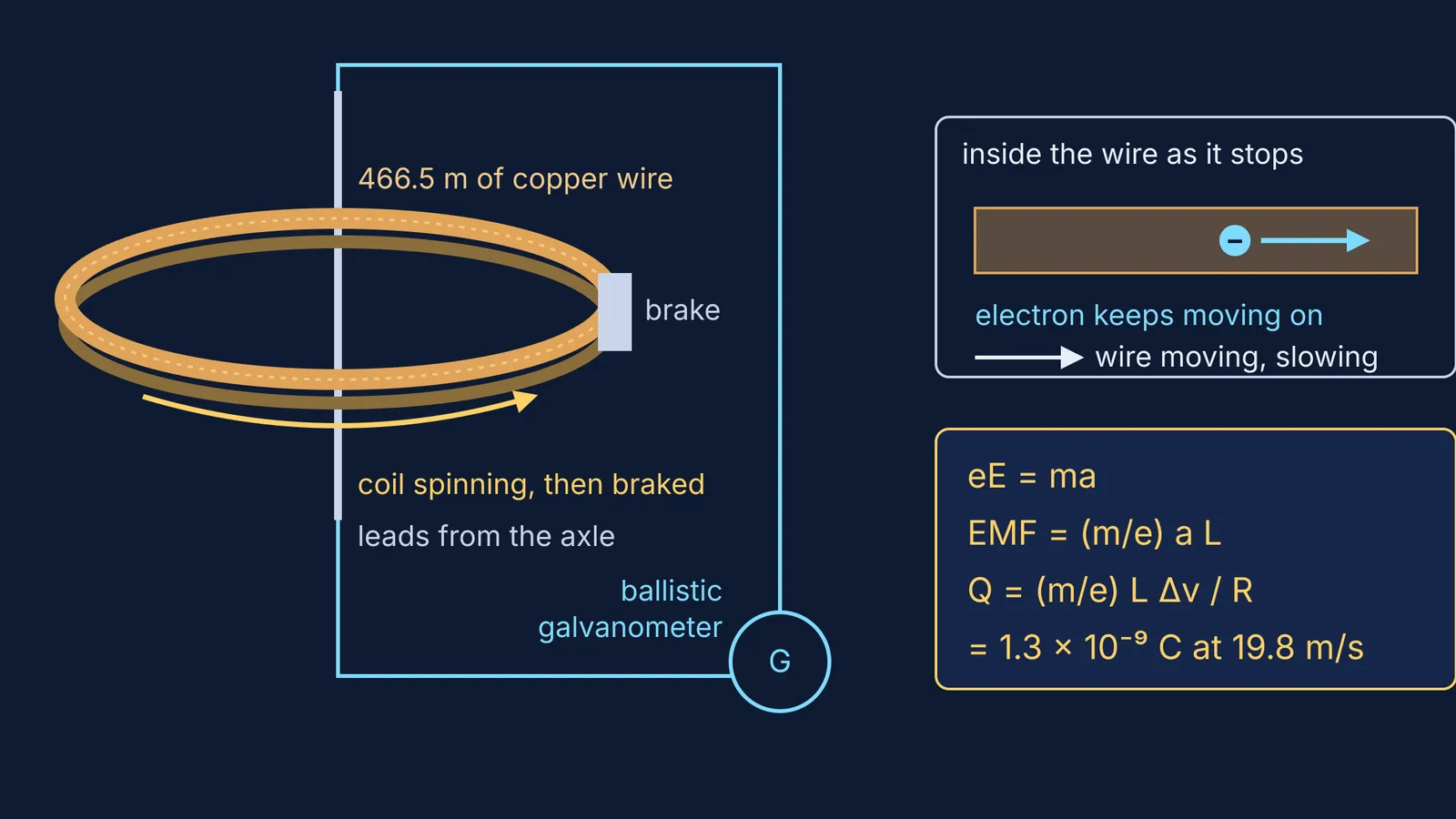
Spin a coil of copper wire fast, then jam on the brake. The copper stops, but the free electrons inside it do not stop at once. For a moment they keep sliding forward, like passengers in a bus that brakes hard, and a tiny pulse of charge runs round any circuit joined to the coil. In 1916 Richard Tolman and T. Dale Stewart measured that pulse and used it to find the mass-to-charge ratio of whatever carries current in a metal. The experiment is beyond the NCERT syllabus, so treat it as enrichment for current electricity and Newton's laws.
Why would stopping a wire push a current?
In the free-electron picture you meet in Drude's model of a metal, the copper ions form a fixed lattice and the conduction electrons move freely through it. When the whole wire moves at speed v, the electrons move along with it.
Now slow the wire with deceleration a. Each electron must also slow down at a, and by Newton's second law that needs a force ma on it. What supplies it:
The electrons lag a little and bunch up towards the front of each stretch of wire.
That bunching sets up an electric field E inside the metal.
The field grows until the force on each electron, eE, is exactly the ma it needs to slow down with the wire.
So eE = ma, or E = (m/e)a. Inside the metal the field points along the direction of motion, because a negative charge feels a force opposite to E, and the electron needs a backward push.
Add this field along a coil of total wire length L and you get an EMF:
EMF = (m/e) a L
How big is the pulse of charge?
If the whole circuit (coil, leads and galvanometer) has resistance R, the current while the coil slows is I = EMF/R = (m/e)aL/R. The total charge is the current added up over the stopping time:
Q = ∫ I dt = (m/e)(L/R) ∫ a dt.
∫ a dt is just the total change of speed, Δv.
So Q = (m/e) L Δv / R.
The braking time has cancelled out. Brake gently or brake hard, the same charge flows. Self-inductance does not change the total either, because the current starts and ends at zero.
For an electron, m/e = 9.109 × 10⁻³¹ kg ÷ 1.602 × 10⁻¹⁹ C = 5.69 × 10⁻¹² kg/C, so the EMF is tiny. But Q depends only on the speed lost, not on how sharp the brake is, and a ballistic galvanometer measures exactly that: total charge.
Worked example: does the formula match the 1916 numbers?
Tolman and Stewart reported their apparatus in Physical Review 8, 97 (1916) (a scanned copy is on Caltech's archive). The coil held 46,650 cm of No. 20 copper wire wound on a wooden wheel, with an average coil diameter of 24.65 cm. The total circuit resistance was 40 Ω. Their first line of results was at a rim speed of 1,980 cm/s.
Predict the charge, assuming the carriers are ordinary electrons:
Data. L = 466.5 m, Δv = 19.8 m/s, R = 40 Ω, m/e = 5.69 × 10⁻¹² kg/C.
Substitute. Q = 5.69 × 10⁻¹² × 466.5 × 19.8 / 40.
Result. Q = 1.31 × 10⁻⁹ C, or 1.3 nC.
Units check. (kg/C) × m × (m/s) ÷ Ω = kg m² s⁻¹ C⁻¹ Ω⁻¹. Since Ω = kg m² s⁻³ A⁻² and A = C/s, this reduces to C.
Compare. Their Table II gives 1.30 × 10⁻⁹ C for this speed.
Now the EMF. The paper says the wheel could be stopped "in a fraction of a second". Take 0.1 s as an illustrative stopping time:
a = 19.8 / 0.1 = 198 m/s².
E = (m/e)a = 1.1 × 10⁻⁹ V/m inside the copper.
EMF = (m/e)aL = 0.53 µV, and the current is 0.53 µV / 40 Ω = 13 nA for about 0.1 s.
Check: 13 nA × 0.1 s = 1.3 nC, the same charge as before.
Half a microvolt is easily swamped by stray thermoelectric voltages, which the authors took care to allow for. The charge, not the voltage, made the result measurable.
What did Tolman and Stewart actually find?
From the same paper:
The sign. "The throw was always in the direction predicted on the basis of mobile electrons with a negative charge." The carriers in copper are negative.
The speed test. Across rim speeds from 19.8 to about 56 m/s, Q rose in proportion to the speed, as the formula says.
The length test. With part of the wire removed (30,370 cm, 32 Ω), QR/(Lv) changed by about 20 per cent, which they judged acceptable for the few runs made.
The mass. Averaged over 131 runs, the mass carried per faraday of charge came out as 1/1910 g, against 1/1845 g then accepted for free electrons. That corresponds to m/e = 5.43 × 10⁻¹² kg/C, about 5 per cent below today's electron value.
Individual runs scattered from about 1/2170 to 1/1460 g per faraday. The authors noted that the mass of an electron inside a metal need not equal its free-space mass, and that runs with aluminium and silver were under way.
Why was this a big deal?
By 1916, J. J. Thomson had measured e/m for electrons in a vacuum tube, which you can read about in how the e/m ratio of cathode rays was measured. That the same light, negative particles carry current inside a solid metal was still mainly a model. This pulse is direct evidence about the carriers themselves, measured in an ordinary piece of copper wire.
The size of the pulse settles it. Suppose current in copper were carried by copper ions, as in an electrolyte, with roughly 32 g moving per faraday. The same formula would then give Q ≈ 76 µC, about 58,000 times the pulse actually seen. The tiny measured charge only fits carriers about two thousand times lighter than a hydrogen atom.
In electrolytes, with their heavy ions, the effect is far larger; the paper cites Colley's 1882 measurement with a dropped tube of cadmium iodide solution.
Where does this sit in your syllabus?
It uses three ideas you already know: Newton's second law for the carriers, I = EMF/R for the circuit, and charge as the area under the current-time graph, which is why the braking time drops out. The everyday current in a wire is a slow drift of these same electrons, covered in drift velocity in a wire of varying thickness.
To revise how EMF, field and drift fit together, the Concept Library has every concept in physics laid out, including current electricity and Newton's laws.
Quick checklist
Decelerate a wire at a, and an internal field E = (m/e)a appears so that eE = ma for each free electron.
Round a coil of wire length L: EMF = (m/e)aL, a fraction of a microvolt in practice.
Charge through the circuit: Q = (m/e)LΔv/R, independent of braking time.
Tolman and Stewart (1916): 466.5 m of copper, 40 Ω, 19.8 m/s gave 1.30 nC; the formula predicts 1.31 nC.
The pulse direction showed negative carriers; the size gave m/e within about 5 per cent of the electron's.