On this page
For years chemists had taken sulphur to be S₆, and by 1890 one chemist was arguing that sulphur vapour is really S₂ at every temperature. Ernst Beckmann, the chemist whose name is on the Beckmann thermometer, settled the question with a boiling solvent. He dissolved rhombic sulphur in carbon disulphide (CS₂), measured how far the boiling point rose, and got a molar mass close to 256: eight atoms per molecule. The same paper gave P₄ for phosphorus and I₂ for iodine, which made the sulphur result hard to dismiss. We read the paper, "Über die Molekulargrösse des Jods, Phosphors und Schwefels in Lösungen", in Zeitschrift für physikalische Chemie, vol. 5 (1890), pp. 76–82, and took every number below from the printed tables in the page images. Translations are ours.
Why was the formula of sulphur in doubt in 1890?
Beckmann sets out the problem at the start of his sulphur section. For a long time chemists had assumed that just above its boiling point sulphur vapour consists of S₆ molecules, which break into S₂ on stronger heating. H. Biltz now claimed the vapour is S₂ at all temperatures, and that the high densities near the boiling point only show that the gas laws do not yet hold there.
Beckmann saw a test. If Biltz were right, he wrote, "dilute solutions would have to give the molecule S₂ just as surely as they gave the molecules P₄ and I₂". He had just described his boiling-point method (Z. phys. Chem. 4, 539), and rhombic sulphur dissolves readily in CS₂.
How does a rise in boiling point give a molar mass?
For a dilute solution of a non-volatile solute, the rise depends only on the number of solute particles:
ΔTb = Kb × m, where m is the molality, moles of solute per kg of solvent.
Write m as (w₂ ÷ M) ÷ (w₁ ÷ 1000), with w₂ grams of solute in w₁ grams of solvent, and rearrange:
M = Kb × w₂ × 1000 ÷ (ΔTb × w₁)
Beckmann gave his constants as the rise for one mole in 100 g of solvent: 23.75° for CS₂ and 21.05° for ether. Divide by 10 to get the modern unit: Kb = 2.375 K kg mol⁻¹ for CS₂ and 2.105 for ether. A footnote says he calculated them from the latent heats of vaporisation. The textbook version of this method, with water and NaCl, is in elevation in boiling point numericals.
What did Beckmann find for iodine and phosphorus?
Iodine. M. Loeb had used vapour-pressure lowering and reported I₄ in brown ether solutions (found 466.1 to 577.2 against 508 for I₄) and an average of I₂.₄ in violet CS₂ solutions (264 to 326.5 against 254 for I₂). Beckmann's boiling method gave about the same answer in both solvents. In his most dilute ether run, 1.2077 g of iodine in 52.04 g of ether raised the boiling point by 0.207°, giving 236. In CS₂, 0.6143 g in 48.45 g gave 0.120° and 251. He concluded that dilute solutions lead to I₂. The colour difference, he suggested, is not a change in molecular size: the brown molecules may "associate with those of the solvent", while the violet ones exist freely, as in the gas.
Phosphorus. An earlier freezing-point result in benzene by Paternò had fallen between P₂ and P₄, but with a sample that was "not quite pure". In CS₂, Beckmann's first reading was 0.2931 g of phosphorus in 54.65 g, a rise of 0.098°, giving 130. P₄ is 124. "For dilute solutions the molecular size P₄ follows without doubt."
What did boiling CS₂ show for sulphur?
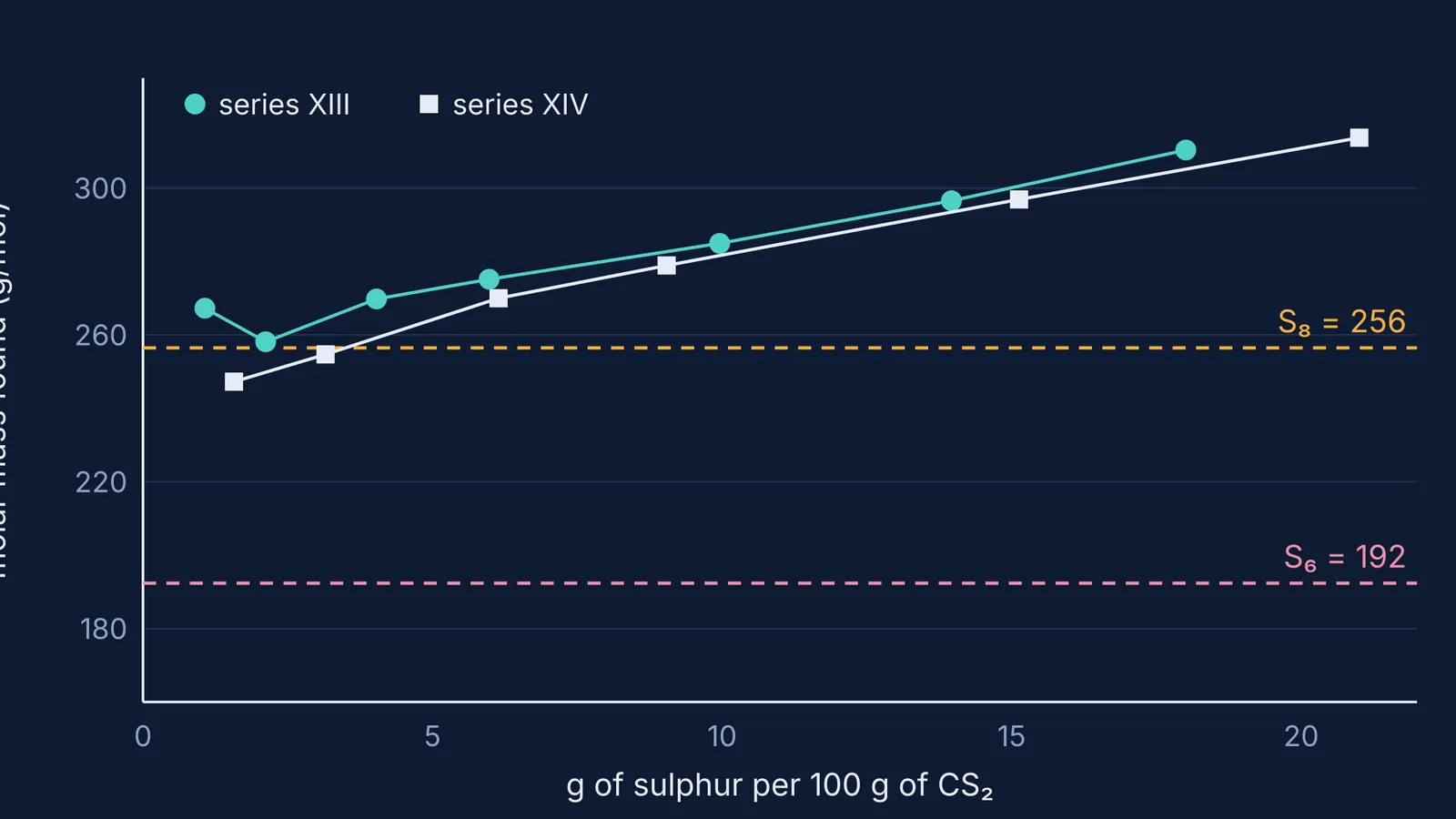
The sulphur readings did not lead to S₂ but, in his words, "to a value four times larger". Take series XIII from his table.
0.5417 g of sulphur in 50.67 g of CS₂: rise 0.095°, M 267.
1.0740 g in the same CS₂: rise 0.195°, M 258.
At the end of the series, 9.1246 g: rise 1.378°, M 310.
A second series, XIV, ran from 247 to 314 over a similar range. Raising the concentration "twentyfold" in his words did not give a "very striking rise" in the values. His verdict: all the numbers point above the "formerly generally accepted formula S₆ (192)" and "come very close to the formula S₈ (256)".
He did not overclaim. Because molecular elevations are not perfectly constant, and those measured for CS₂ sometimes come out a little smaller than the calculated ones, he called S₈ "only approximately established" and proposed S₂Cl₂ as a second solvent to check it.
He also reprinted Biltz's own vapour densities, which pointed the same way: 6.35 atoms per molecule at 518°, rising to 7.07 at 467.9°. Sulphur boils at 448°, and Beckmann thought it "not excluded" that the vapour reaches S₈ there.
Worked example: molar mass and atoms per molecule
Use Beckmann's series XIII reading: 1.0740 g of sulphur in 50.67 g of CS₂, ΔTb = 0.195 K, Kb = 2.375 K kg mol⁻¹, S = 32.06.
Find M. M = 2.375 × 1.0740 × 1000 ÷ (0.195 × 50.67) = 258.2 g/mol. Beckmann printed 258.
Atoms per molecule. 258.2 ÷ 32.06 = 8.05, so S₈.
Test the rival formulas. Predict the rise from ΔTb = Kb × w₂ × 1000 ÷ (M × w₁). For S₈ (256.5): 0.196 K, matching the 0.195 K he read. For S₆ (192.4): 0.262 K. For S₂ (64.1): 0.785 K. S₂ is off by a factor of four, S₆ by a third.
Phosphorus. M = 2.375 × 0.2931 × 1000 ÷ (0.098 × 54.65) = 130.0. Then 130.0 ÷ 30.974 = 4.20 atoms, so P₄.
Iodine in ether (Kb 2.105). Series III, 5.1166 g in 52.73 g, rise 0.805 K: M = 2.105 × 5.1166 × 1000 ÷ (0.805 × 52.73) = 253.7, and 253.7 ÷ 126.904 = 2.00 atoms, so I₂.
Exercise. All these rises are between 0.1 and 0.2 K. If your thermometer reads only to 0.1 K, what range of M could the 0.195 K sulphur reading give? With ΔTb anywhere from 0.1 to 0.3 K, M runs from about 168 to 503, which cannot separate S₆ from S₈. That is why this work needed a thermometer reading to hundredths of a degree or better; see the Beckmann thermometer in the Rast method with camphor.
For more ΔTb and molar-mass numericals of this kind, Fermi Test Prep covers JEE Main and Advanced preparation with an AI tutor.
Where does this sit in your syllabus?
Class 12 Solutions: elevation of boiling point, ΔTb = Kb × m, molar mass of a solute.
Class 12 p-Block Elements: rhombic sulphur as S₈ rings, white phosphorus as P₄ tetrahedra. Why sulphur prefers rings of single bonds is in why oxygen is O₂ but sulphur is S₈.
Beckmann measured mass only. The ring shape came later, from X-ray work. For that geometry, the Concept Library has a lesson for each concept in chemistry.
Quick checklist
M = Kb × w₂ × 1000 ÷ (ΔTb × w₁).
Beckmann's 1890 constants: CS₂ 2.375, ether 2.105 K kg mol⁻¹.
Sulphur in CS₂: M about 258, so S₈, not S₆ or S₂.
Phosphorus 130, so P₄; iodine 254 in ether, so I₂.
Brown and violet iodine solutions both contain I₂.
He called S₈ approximate and asked for a second solvent.