On this page
The NMC's NEET (UG) 2026 syllabus puts this chapter in Unit 4, Plant Physiology, and names "sequence of developmental process in a plant cell" as a topic. Every order below comes from NCERT Class 11 Biology, Chapter 13 (Reprint 2026-27). All 12 questions are original, not past-paper items or predictions.
Which sequences in Plant Growth and Development does NCERT give in order?
Chapter opening: seed germination (the first step of growth) → vegetative phase → flowering → eventual death. Without favourable conditions, a seed rests in suspended growth → conditions return → metabolism and growth resume.
Phases along a root (13.1.3, Figure 13.3), moving away from the apex: meristematic phase → phase of elongation → phase of maturation.
The sigmoid curve (13.1.4, Figure 13.6): slow lag phase → log (exponential) phase → growth slows as nutrient supply is limited → stationary phase.
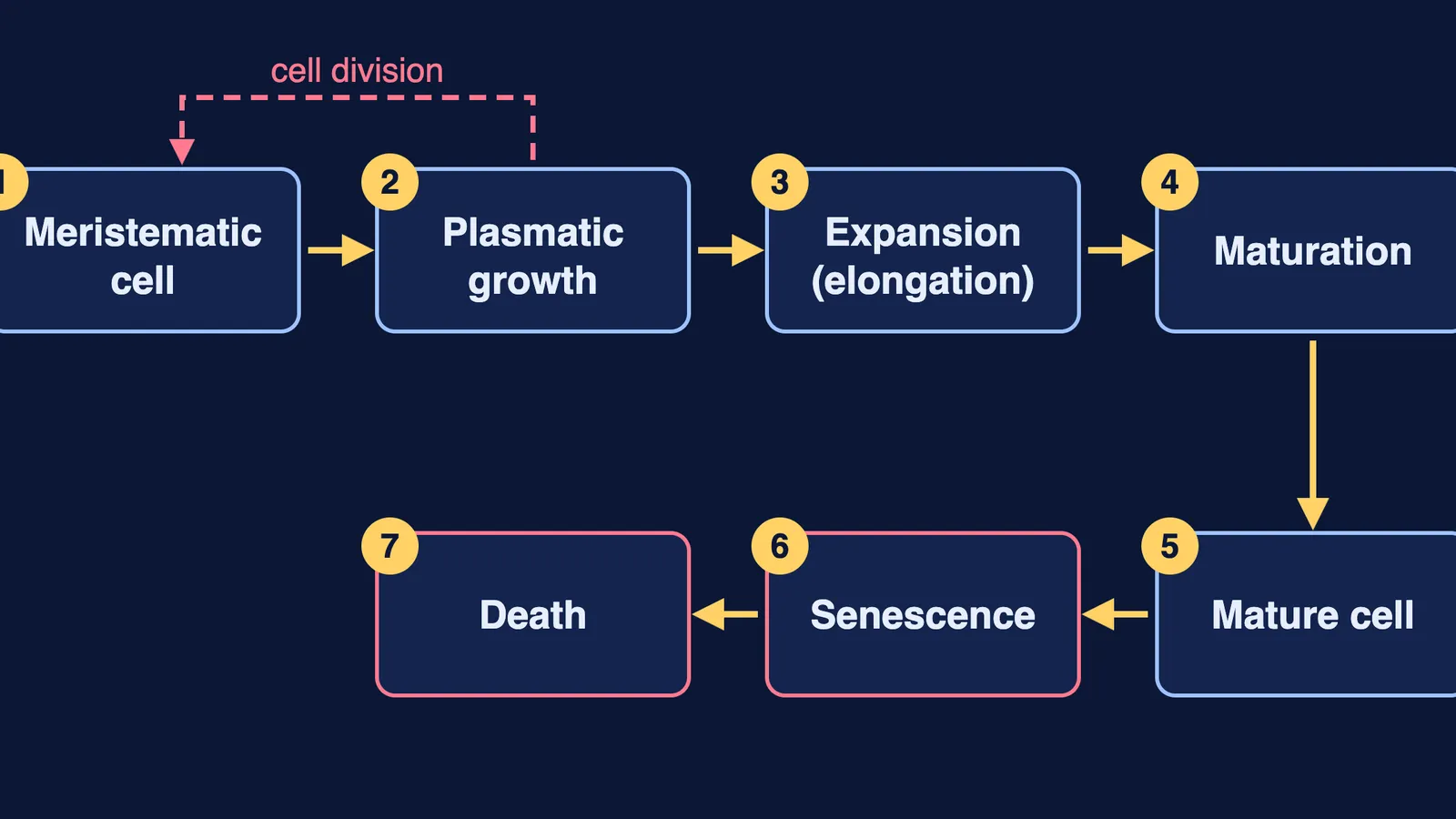
A plant cell's development (13.3, Figure 13.8): meristematic cell → plasmatic growth → expansion (elongation) → maturation → mature cell → senescence → death. Cell division loops back to the meristematic cell.
Gibberellins (13.4.2, 13.4.3.2): rice seedlings treated with sterile Gibberella fujikuroi filtrates → bakanae symptoms (Kurosawa, 1926) → active substances identified as gibberellic acid; GA3 was among the first of over 100 gibberellins.
Auxin (13.4.2): Charles and Francis Darwin see canary grass coleoptiles grow toward one-sided light → a series of experiments → the tip is the site of a transmittable influence. Went's isolation of auxin is not placed against these.
Dated discoveries (13.4.2): H.H. Cousins, 1910 (volatile from ripened oranges, later ethylene) → E. Kurosawa, 1926 (bakanae symptoms) → Miller et al., 1955 (kinetin) → mid-1960s (three inhibitors, later one compound, ABA).
Cytokinins (13.4.2, 13.4.3.3): Skoog's tobacco callus needs a supplement besides auxin → Miller et al. crystallise kinetin → search for natural cytokinins → zeatin from corn kernels and coconut milk → several natural and synthetic cytokinins.
How do you attack arrange-in-order questions?
Fix the first and last steps, then cross out every code that disagrees. Of the codes left, check only the first pair where they differ.
Can you put these plant growth steps in order?
Q1. A seed in the chapter opening: A. It resumes metabolic activities and growth takes place B. It goes into suspended growth or rest C. Favourable conditions return D. Favourable conditions for growth are absent (1) D-B-C-A (2) B-D-C-A (3) D-C-B-A (4) D-B-A-C
Answer: (1). Rest follows unfavourable conditions; metabolism restarts once they return (chapter opening).
Q2. Figure 13.8 order: A. Plasmatic growth B. Maturation C. Meristematic cell D. Expansion (elongation) E. Mature cell (1) C-A-D-B-E (2) C-D-A-B-E (3) A-C-D-B-E (4) C-A-B-D-E
Answer: (1). Plasmatic growth precedes expansion, and maturation leads to the mature cell (13.3).
Q3. A plant's life: A. Flowering B. Seed germination C. Vegetative phase D. Eventual death (1) B-C-A-D (2) C-B-A-D (3) B-A-C-D (4) B-C-D-A
Answer: (1). Germination comes first; the vegetative phase precedes flowering (chapter opening).
Q4. By the dates NCERT prints: A. Miller et al. crystallise kinetin B. Cousins confirms a volatile from ripened oranges C. Three inhibitors later named ABA are characterised D. Kurosawa reports bakanae symptoms from sterile fungal filtrates (1) D-B-A-C (2) B-D-A-C (3) B-A-D-C (4) B-D-C-A
Answer: (2). The years run 1910, 1926, 1955, then the mid-1960s (13.4.2).
Q5. The cytokinin story: A. Zeatin is isolated from corn kernels and coconut milk B. Skoog's group sees callus proliferate only with a supplement to auxin C. Miller et al. crystallise kinetin D. Several natural and synthetic cytokinins are identified E. A search begins for natural cytokinin-like substances (1) C-B-E-A-D (2) B-C-A-E-D (3) B-C-E-A-D (4) B-E-C-A-D
Answer: (3). The search for natural cytokinins followed kinetin and found zeatin (13.4.3.3).
Q6. The gibberellin story: A. The active substances are identified as gibberellic acid B. Rice seedlings get sterile Gibberella fujikuroi filtrates C. Kurosawa reports bakanae symptoms in them D. Over 100 gibberellins come to be reported (1) B-C-A-D (2) C-B-A-D (3) B-C-D-A (4) B-A-C-D
Answer: (1). Identification came later; GA3 was among the first gibberellins (13.4.2, 13.4.3.2).
Which steps come before or after, or sit out of place?
Q7. Of these four, which comes next after Kurosawa's 1926 report? (1) Cousins's report on the orange volatile (2) Miller et al. crystallising kinetin (3) The three inhibitors of the mid-1960s (4) The Darwins' coleoptile observation
Answer: (2). Kinetin is 1955; Cousins (1910) and the Darwins, where "all this started", came earlier (13.4.2).
Q8. In Figure 13.8, which step comes immediately before maturation? (1) Meristematic cell (2) Mature cell (3) Expansion (elongation) (4) Death
Answer: (3). Expansion leads into maturation (13.3).
Q9. A student's auxin account: A. A series of experiments follows B. The tip is concluded to be the site of a transmittable influence C. The Darwins see coleoptiles grow toward light from one side. Which step is out of place? (1) A (2) B (3) C (4) None
Answer: (3). The Darwins' observation started it, so C goes first (13.4.2).
Codes for Q10 to Q12: (1) I and II both true (2) I and II both false (3) Only I is true (4) Only II is true.
Q10. I: In Figure 13.8, the cell-division arrow leads back to the meristematic cell. II: NCERT says flowering precedes the vegetative phase.
Answer: (3). The vegetative phase comes before flowering (chapter opening).
Q11. I: The chapter summary names three principal phases of growth: lag, log and senescent. II: Figure 13.6 labels the last phase of the idealised curve stationary.
Answer: (1). NCERT uses both names for the last phase (13.1.4, Summary).
Q12. I: Went isolated auxin before the Darwins observed coleoptile bending. II: Zeatin was isolated after kinetin was discovered.
Answer: (4). The Darwins came first; zeatin followed kinetin (13.4.2, 13.4.3.3).
What should you redo after this set?
Missed Q2, Q8 or Q10: redraw Figure 13.8. Missed Q4 to Q7, Q9 or Q12: put the discoveries on one timeline. Missed Q1, Q3 or Q11: reread the opening and 13.1.4. Other formats: the plant growth diagram questions, the statement and match-the-list set, or our chapter notes on growth rates and PGRs.
Which sequence keeps slipping? Fermi's AI tutor works out what you already know and builds a plan for the session.