On this page
This chapter opens Unit 6, Reproduction, of the NMC's NEET (UG) 2026 syllabus. Every order below follows NCERT Class 12 Biology, Chapter 1 (Reprint 2026-27), with sections in brackets. All 11 questions are new and none is a forecast.
Which sequences does NCERT give in sexual reproduction in flowering plants?
Flower initiation (1.2): decision to flower → hormonal and structural changes → floral primordium → inflorescences with floral buds → flowers → androecium and gynoecium develop.
Pollen formation (1.2.1): sporogenous tissue → meiosis in pollen mother cells → microspore tetrad → microspores separate as the anther dries → pollen grains → release at dehiscence.
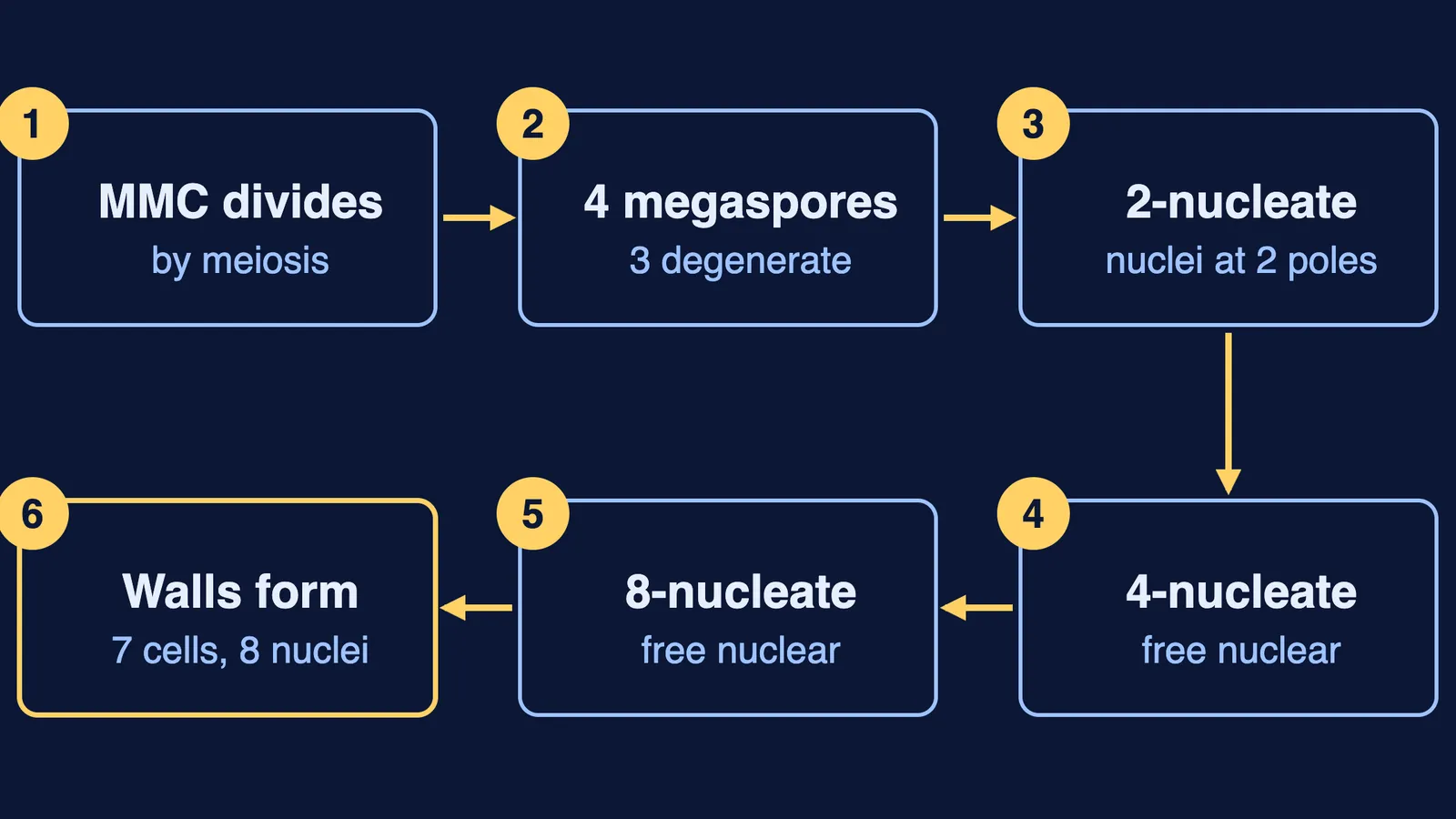
Embryo sac (1.2.2): one megaspore mother cell near the micropyle → meiosis → four megaspores, three degenerate → 2-nucleate (nuclei at opposite poles) → 4-nucleate → 8-nucleate, all free nuclear → walls laid down → 7-celled, 8-nucleate sac.
Pollen-pistil interaction (1.2.3): pollen lands → pistil recognises compatible pollen → tube emerges through a germ pore → grows through stigma and style → ovary → micropyle → a synergid, via the filiform apparatus.
Artificial hybridisation (1.2.3): bisexual female parent: emasculation before anthers dehisce → bagging → receptive stigma dusted → rebagging. Unisexual: buds bagged before opening → stigma receptive → pollination → rebagging.
Fertilisation to endosperm (1.3, 1.4.1): two male gametes released in a synergid → syngamy and triple fusion → primary endosperm cell → free nuclear divisions → cellular endosperm.
Nucellar embryos (1.5), as in many Citrus and mango varieties: nucellar cells near the embryo sac begin to divide → push into the sac → develop into embryos → one ovule holds many embryos.
How do you attack arrange-in-order questions?
Fix the first and last steps before reading the codes; usually two codes survive. Then test one middle pair against an NCERT line.
Can you arrange these steps in the correct order?
Q1. Before a flower forms: A. Inflorescences bearing floral buds form B. Androecium and gynoecium differentiate C. Hormonal and structural changes begin D. The floral primordium differentiates (1) D, C, A, B (2) C, A, D, B (3) C, D, A, B (4) C, D, B, A Answer: (3). The changes lead to the primordium; the whorls develop last, inside the flower (1.2).
Q2. Pollen formation: A. Microspores separate and become pollen grains B. Sporogenous cells divide by meiosis C. The anther dehisces D. Four microspores lie together as a tetrad (1) B, A, D, C (2) B, D, A, C (3) D, B, A, C (4) B, D, C, A Answer: (2). The tetrad comes straight from meiosis (1.2.1).
Q3. Early embryo sac: A. Four megaspores result, one of them functional B. The megaspore mother cell undergoes meiosis C. The functional megaspore's nucleus divides; the nuclei move to opposite poles D. A single megaspore mother cell differentiates (1) D, B, A, C (2) B, D, A, C (3) D, A, B, C (4) D, B, C, A Answer: (1). Only the functional megaspore divides further (1.2.2).
Q4. After pollination: A. The tube grows through stigma and style B. Pollen lands on the stigma C. The tube enters the micropyle D. The pistil recognises the pollen as compatible E. A tube emerges through a germ pore (1) B, E, D, A, C (2) D, B, E, A, C (3) B, D, A, E, C (4) B, D, E, A, C Answer: (4). Wrong pollen can be stopped before it germinates, so recognition comes first (1.2.3).
Q5. Nucellar embryos: A. Nucellar cells protrude into the embryo sac B. The ovule holds many embryos C. Nucellar cells near the embryo sac begin dividing D. The protruding cells develop into embryos (1) A, C, D, B (2) C, A, D, B (3) C, D, A, B (4) C, A, B, D Answer: (2). NCERT gives division, protrusion, then embryo formation (1.5).
Q6. From triple fusion: A. The primary endosperm nucleus divides into free nuclei B. The central cell becomes the primary endosperm cell C. The endosperm becomes cellular D. A male gamete fuses with the polar nuclei (1) D, A, B, C (2) B, D, A, C (3) D, B, C, A (4) D, B, A, C Answer: (4). In the common type, free nuclei come before walls (1.3, 1.4.1).
Which step comes before, after or out of place?
Q7. The embryo sac has just reached the 4-nucleate stage. What comes next? (1) Cell walls are laid down (2) One more free-nuclear mitosis gives 8 nuclei (3) Two nuclei move to opposite poles (4) The megaspore mother cell undergoes meiosis Answer: (2). Walls follow the 8-nucleate stage (1.2.2).
Q8. The pollen tube has released two male gametes into a synergid. What happens next? (1) One moves towards the egg, the other towards the polar nuclei (2) Both fuse with the egg (3) The tube enters via the filiform apparatus (4) The zygote divides Answer: (1). (3) is earlier, (4) later (1.3).
Q9. A student writes: decision to flower → hormonal and structural changes → inflorescences with floral buds → flowers → floral primordium differentiates → androecium and gynoecium develop. Which step is out of place? (1) Hormonal and structural changes (2) Inflorescences with floral buds (3) Flowers (4) Floral primordium differentiates Answer: (4). The primordium differentiates before any inflorescence forms (1.2).
Codes for Q10 and Q11: (1) Both true (2) Both false (3) Only I true (4) Only II true
Q10. I: In the common type of endosperm, free nuclei form before walls. II: Microspores separate from one another before the anther dehisces. Answer: (1). Both follow NCERT's order (1.2.1, 1.4.1).
Q11. I: Nucellar cells start dividing before they protrude into the embryo sac. II: The two male gametes move towards the egg and polar nuclei before the tube enters a synergid. Answer: (3). The gametes are released only after the tube enters a synergid (1.3, 1.5).
What should you do after this set?
Rewrite each missed sequence from memory and check its section. Then switch formats: the statement and match-the-list items for this chapter, the diagram-based questions, which also drill dicot embryo stages and the solved NEET practice questions.
Which sequence keeps slipping? Fermi's AI tutor works out what you already know and builds a plan for the session.