On this page
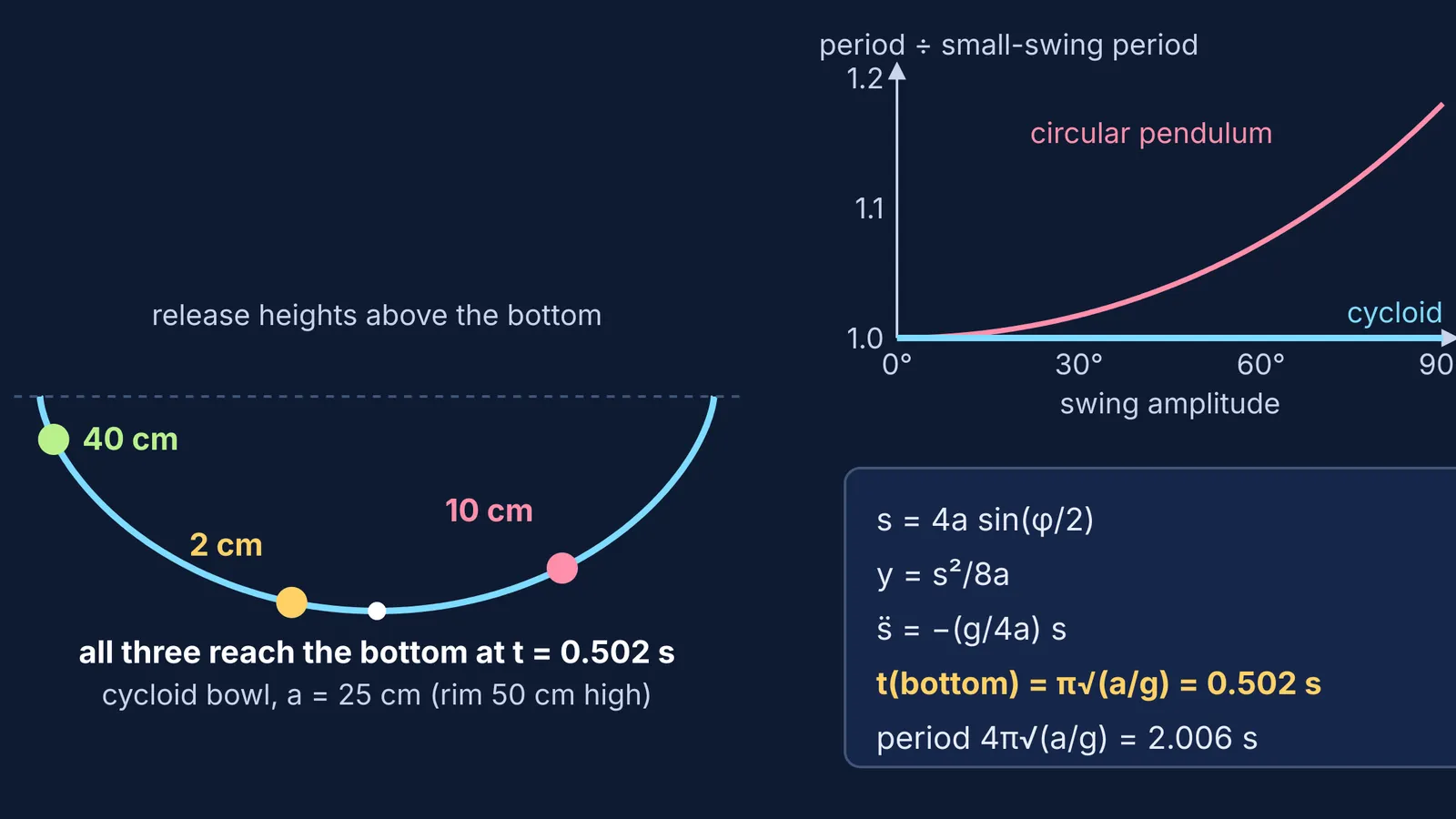
Put a bead on a smooth wire bent into the shape of an upside-down cycloid and let it go. Start it 2 cm above the bottom, or 40 cm above, and it reaches the bottom in exactly the same time. Christiaan Huygens proved this in 1673 and used it to try to build a perfect pendulum clock. The proof is a short piece of Class 11 SHM, and it works for any amplitude, not just small swings.
Galileo's pendulum post shows why an ordinary pendulum slows at large swings, and our Huygens post says he designed a cycloidal pendulum. Here is the proof, with numbers.
What is a tautochrone, and how is it different from a brachistochrone?
A tautochrone (Greek for "same time") is a curve on which a body sliding without friction reaches the lowest point in the same time from every starting point. The cycloid is that curve.
The cycloid is also the brachistochrone: the curve of fastest descent between two given points, which is covered in why the fastest slide is not a straight line. These are two different results for the same curve. One compares different starting heights on one curve. The other compares different curves between the same two points. Do not mix them up in an answer.
A cycloid is the path of a point on the rim of a wheel of radius a rolling along a line. Turned upside down, it is a bowl. Measure x sideways and y upwards from the bottom:
x = a(φ + sin φ)
y = a(1 − cos φ)
The angle φ runs from −π to +π, so for a = 25 cm the bowl is 1.57 m wide and 50 cm deep.
How do you prove every release takes the same time?
The trick is to use the distance along the curve, s, measured from the bottom, instead of x or the angle.
Find ds. dx = a(1 + cos φ) dφ and dy = a sin φ dφ. Then ds² = dx² + dy² = 2a²(1 + cos φ) dφ², so ds = 2a cos(φ/2) dφ.
Integrate. s = 4a sin(φ/2), measured from the bottom where φ = 0.
Write height in terms of s. y = a(1 − cos φ) = 2a sin²(φ/2). Since sin(φ/2) = s/4a, this gives y = s²/8a.
Find the acceleration along the curve. Only the part of gravity along the wire changes the speed. That part is g times the slope, dy/ds. So s̈ = −g dy/ds = −g(2s/8a) = −(g/4a)s.
Read off SHM. This is exactly s̈ = −ω²s with ω = √(g/4a). No approximation was made, so it holds for any amplitude.
The period of SHM does not depend on amplitude. One full oscillation takes T = 2π/ω = 4π√(a/g), and the trip from rest to the bottom is a quarter of that: t = π√(a/g), from any starting point. An ordinary pendulum needs sin θ ≈ θ to reach SHM; the cycloid needs no such step, because its height grows exactly as s².
Worked example: a bowl traced by a 25 cm wheel
Question. A bead slides without friction inside a cycloid bowl generated by a wheel of radius 25 cm. It is released from rest (a) 10 cm and (b) 40 cm above the bottom. Find the time to reach the bottom and the speed there. Take g = 9.81 m/s².
Angular frequency. ω = √(g/4a) = √(9.81/1.00) = 3.13 rad/s.
Time to the bottom. t = π√(a/g) = π√(0.25/9.81) = 0.502 s for both releases.
Starting arc length. From y = s²/8a, s₀ = √(8a h). For h = 0.10 m, s₀ = √(8 × 0.25 × 0.10) = 0.447 m. For h = 0.40 m, s₀ = 0.894 m.
Speed at the bottom. In SHM the top speed is ωs₀. For (a), 3.13 × 0.447 = 1.40 m/s. For (b), 3.13 × 0.894 = 2.80 m/s.
Check with energy. v = √(2gh) gives √(2 × 9.81 × 0.10) = 1.40 m/s and √(2 × 9.81 × 0.40) = 2.80 m/s. They agree.
The higher bead starts twice as far along the curve and is twice as fast, so it needs no extra time. We also integrated the motion numerically from 2 cm, 10 cm, 40 cm and 49 cm; every run gave 0.5015 s.
The full period is 4π√(a/g) = 2.006 s, the same as a 1 m simple pendulum at small swings. That is no accident: the radius of curvature of the cycloid at its lowest point is 4a = 1 m, so for tiny swings the bead cannot tell the bowl from a circle of radius 1 m.
How much slower is an ordinary pendulum at large swings?
For a 1 m simple pendulum, the small-swing period is 2.006 s. Using the exact elliptic-integral formula, our computed periods are:
30° amplitude: 1.7% longer, 2.041 s
60° amplitude: 7.3% longer, 2.153 s
90° amplitude: 18.0% longer, 2.368 s
A cycloidal path keeps 2.006 s at all of them, which is what a clock with a changing swing needs.
How did Huygens make a pendulum follow a cycloid?
To bend a bob's circular path into a cycloid, Huygens hung the string between two curved metal "cheeks" near the pivot. As the bob swings out, the string wraps onto one cheek, its free length shortens, and the bob rises more steeply than on a circle. The Linda Hall Library notes that he deduced the cheeks should have the curve of a cycloid, which made the pendulum truly isochronous.
Why cycloid cheeks? The path traced by the end of a taut string unwinding from a curve is called its involute, and the MacTutor biography of Huygens records that in *Horologium Oscillatorium* (1673) he defined evolutes and involutes and found the evolute of the cycloid. The answer is another cycloid of the same size. So a string of length 4a between cheeks shaped from a wheel of radius a makes the bob trace a cycloid generated by the same wheel. For our 1 m pendulum, the cheeks come from a 25 cm wheel.
MacTutor also records that the same book proves the cycloid is tautochronous, and calls this an important theoretical result with little practical application to the pendulum. A clock can instead keep its swing small, where an ordinary pendulum is already close to isochronous: at 10° it is only 0.2% slow.
The proof assumes a bead that slides without friction; a rolling ball also stores rotational energy, which changes the time.
The Fermi Problem Library has SHM problems like this with a step-by-step solver that explains the reasoning. If you are preparing for JEE Main & Advanced, Fermi Test Prep offers personalised preparation with an AI tutor, live classes, adaptive mocks, mentorship and a study plan that updates based on mastery.
Quick checklist
Cycloid bowl: x = a(φ + sin φ), y = a(1 − cos φ).
Arc length from the bottom: s = 4a sin(φ/2); height y = s²/8a.
s̈ = −(g/4a)s exactly, so the motion is SHM at any amplitude.
Time to the bottom: π√(a/g), 0.502 s for a = 25 cm.
Tautochrone (same time) and brachistochrone (fastest path) are different properties.