On this page
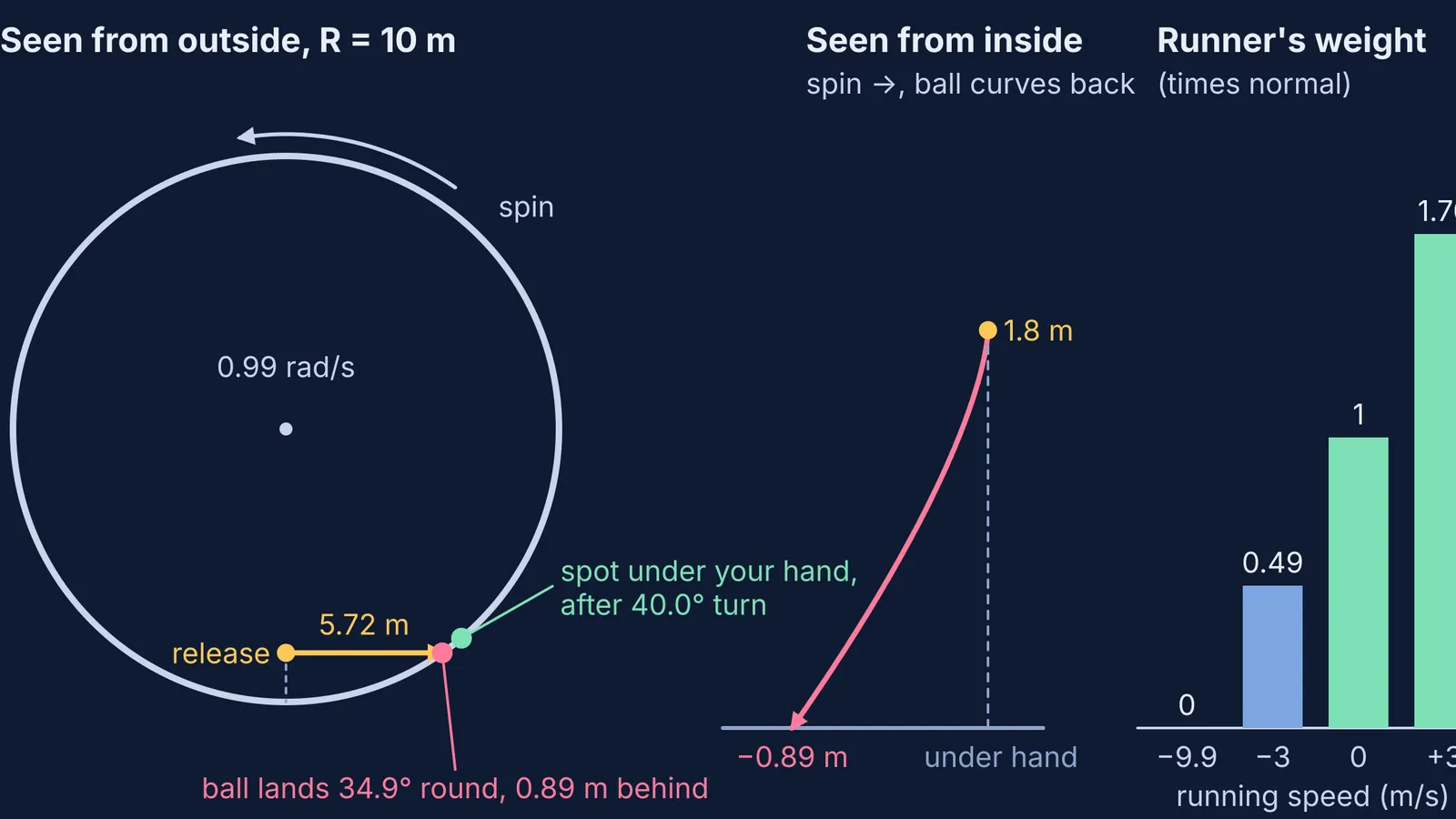
Stand in a small spinning space station, hold a ball at shoulder height and let go. It falls, but it does not land between your feet. In a station 10 m in radius, spun to give 1 g at the floor, a ball dropped from 1.8 m lands 0.89 m behind you, against the direction of spin. Start running round the station and your weight changes too: 1.70 times as heavy running one way, less than half as heavy the other.
Fermi News has already worked out how fast a station must spin for artificial gravity, ω = √(g/R), and why small stations make people dizzy. This post follows the dropped ball and the runner, using nothing but straight lines and circles in a non-rotating frame.
Does a spinning space station exist today?
Not for crews. Astronauts on today's stations float; none of them spins to make gravity. The nearest test was in 1966, when the Gemini XI crew tethered their capsule to an Agena rocket stage and slowly rotated the pair. NASA's account of the Gemini XI artificial gravity experiment puts the result at about 0.00015 g. So the station below is a textbook design, not a real one, and its numbers are illustrative.
How does a dropped ball move, seen from outside?
Take R = 10 m. For 1 g at the floor, ω = √(9.81/10) = 0.990 rad/s, about 9.46 revolutions per minute.
The key step is to watch from a frame that is not spinning. Before you let go, the ball goes round with you. At 1.8 m above the floor it is at radius r₀ = R − h = 8.2 m, so it moves at
u = ωr₀ = 0.990 × 8.2 = 8.12 m/s
along the tangent. When you open your hand, nothing pushes on it any more. There is no real gravity in the station, so the ball simply flies off in a straight line at 8.12 m/s, along that tangent, until it meets the curved floor.
Meanwhile you and the floor keep going round at ω. Your feet are at radius R, so they move at ωR = 9.90 m/s, faster than the ball. The ball falls behind. "Down" in the station is just the ball's straight path meeting a floor that curves up to meet it.
Worked example: where does the ball land?
Station radius R = 10 m, ω = 0.990 rad/s, release height h = 1.8 m.
Distance the ball travels: it starts at r₀ = 8.2 m from the centre and moves along a tangent, so by Pythagoras it hits the floor after d = √(R² − r₀²) = √(100 − 67.24) = 5.72 m.
Flight time: t = d/u = 5.72/8.12 = 0.705 s. On Earth, a drop from 1.8 m takes √(2h/g) = 0.606 s.
Angle the ball sweeps round the centre: tan φ = d/r₀ = 5.72/8.2, so φ = 34.9°.
Angle the floor turns: ωt = 0.990 × 0.705 = 0.698 rad = 40.0°.
The point of floor that was under your hand has moved 5.08° further than the ball. Along the floor that is R × 0.0886 rad = 0.89 m.
So the ball lands 0.89 m behind the point directly below where you let go, in the anti-spinward direction. Every unit checks: angles in radians times a radius in metres give metres.
Try the same drop in larger stations, keeping 1 g at the floor:
R = 100 m (2.99 rpm): the ball lands 0.23 m behind.
R = 224 m (2.0 rpm): 0.15 m behind.
Bigger, slower stations behave more like Earth, but the miss never quite vanishes.
What does the drop look like from inside the station?
To you, the ball appears to fall and curve backwards, sweeping 0.89 m anti-spinward on the way down. Inside the rotating frame you explain this with two pseudo forces: the centrifugal force mω²r pointing outwards, which you feel as gravity, and the Coriolis force −2m(ω × v_rel), which pushes any falling object sideways. Both views must give the same landing point, and they do; the outside view is simply easier to compute. For more on choosing between the two frames, see centripetal against centrifugal force.
How heavy do you feel when you run round the station?
Your weight is the push of the floor, and the floor must supply all your centripetal force. Standing still you go round at v = ωR = 9.90 m/s, so N = mv²/R = mg.
Now run at speed u along the floor. Seen from outside, your real speed is v + u if you run with the spin and v − u if you run against it. The floor must push with
N = m(v + u)²/R
Take u = 3 m/s, an easy jog:
With the spin: (12.90/9.90)² = 1.70, so you weigh 1.70 times your normal weight.
Against the spin: (6.90/9.90)² = 0.49, about half.
Run against the spin at 9.90 m/s: your speed in the outside frame is zero, the floor pushes with nothing, and you float.
Do not use a small-speed approximation here; u is not small compared with v. Expanding the bracket shows where the inside view's pseudo forces come from: m(v + u)²/R = mω²R + 2mωu + mu²/R. The first term is the centrifugal force, the middle one is the Coriolis force on a runner, and the last is the centripetal force for running in a circle.
For step-by-step working on frames and circular-motion problems, try the Fermi Problem Library, whose solver explains the reasoning. This drop and the runner's weight are JEE-style circular-motion questions; for a full plan, Fermi Test Prep offers personalised preparation for JEE Main & Advanced with an AI tutor, adaptive mocks and a study plan that updates based on mastery.
Quick checklist
Work in the non-rotating frame: a released ball moves in a straight line.
It starts with tangential speed ω(R − h), slower than the floor.
Flight distance √(R² − (R − h)²); compare its angle with ωt.
The ball lands anti-spinward of the point under your hand.
A runner's weight is m(v ± u)²/R, with v = ωR.
No crewed station spins for gravity yet; station figures are illustrative.