On this page
An ant sets off along a 1 m rubber band at 1 cm/s. One end of the band is pinned down and someone pulls the other end away at 2 cm/s, twice as fast as the ant walks. Most people say the ant never gets there. In fact it arrives after about 5 minutes 19 seconds, and it would arrive however fast the band were pulled, as long as the pull is steady. The trick is to track the fraction of the band covered, not the distance.
Why does the ant on a rubber rope reach the end at all?
The band stretches evenly, so every bit of rubber moves at a speed in proportion to its distance from the fixed end. A point halfway along moves at half the pulling speed. The ant stands on some bit of rubber, so the stretching carries it forwards too.
If the ant stood still at the halfway mark, it would stay at the halfway mark as the band grew. Stretching never changes the ant's fraction of the way along. Only the ant's own walking changes that fraction.
So each second the ant adds a little to its fraction: 1 cm divided by the current length of the band. That share shrinks as the band grows, but like the sum 1/1 + 1/2 + 1/3 + …, the shares add up without limit. Sooner or later the fraction reaches 1.
When crossing a river, every bit of water moves at the same speed, so you just add vectors. On a stretching band the medium's speed depends on where you are, which is why you need a new variable.
How do you set up the equation for the fraction covered?
Call the starting length L₀, the pulling speed u and the ant's walking speed w, measured relative to the rubber under its feet. The length at time t is
L(t) = L₀ + ut
Let x be the ant's distance from the fixed end and φ = x/L its fraction of the way along. The ant's speed over the ground is its walking speed plus the speed of the rubber where it stands:
dx/dt = w + u(x/L)
Now differentiate φ = x/L, remembering that dL/dt = u:
dφ/dt = (1/L)(dx/dt) − (x/L²)(u) = w/L + ux/L² − ux/L² = w/(L₀ + ut)
The stretching terms cancel exactly. Integrate from φ = 0 at t = 0:
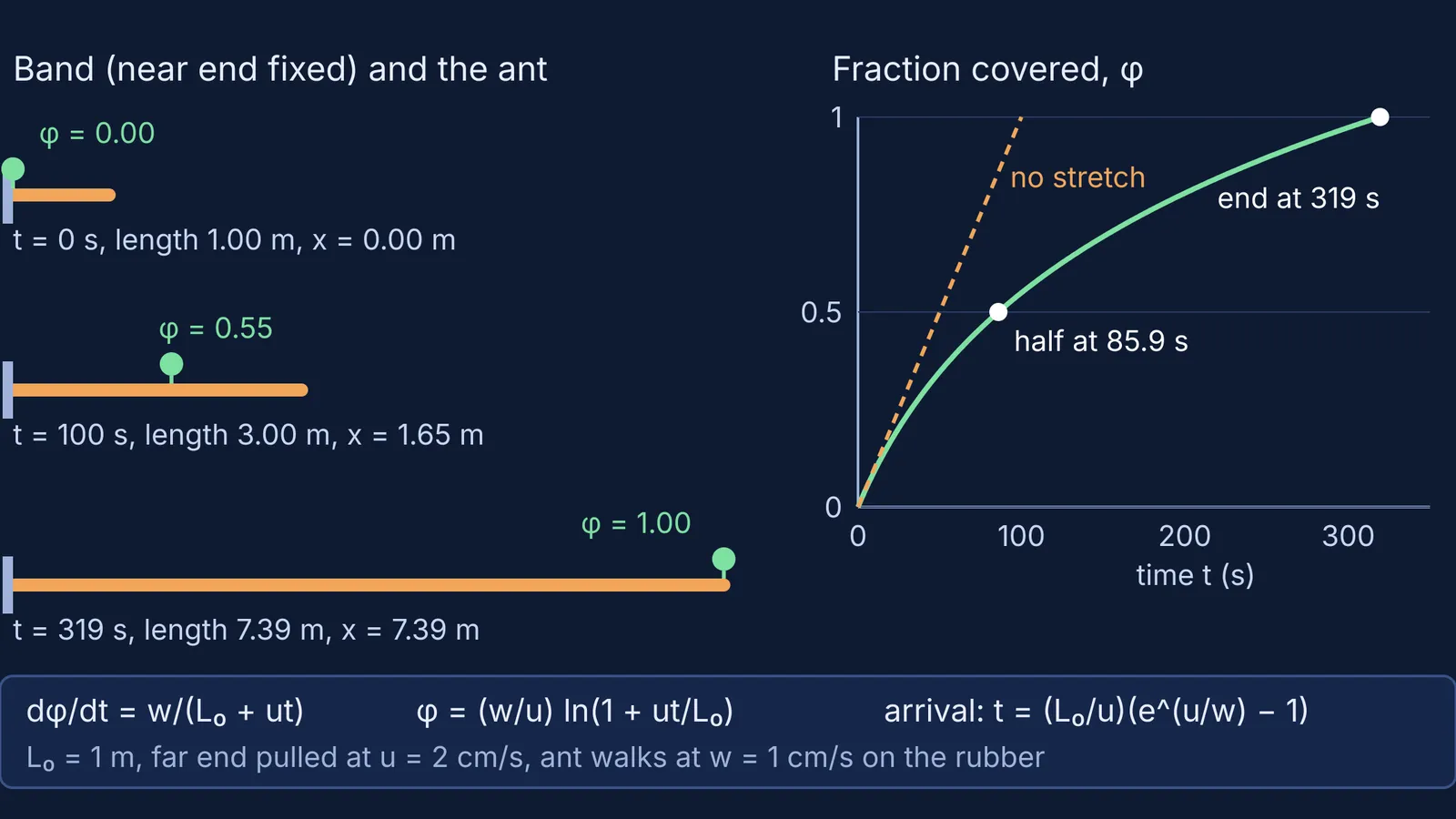
φ = (w/u) ln(1 + ut/L₀)
Set φ = 1 to find when the ant arrives:
t = (L₀/u)(e^(u/w) − 1)
Check the units: L₀/u is a time, and u/w has no units, so the exponential is a pure number. Check a limit too: if u is tiny, e^(u/w) − 1 ≈ u/w, and t ≈ L₀/w, the time on a band that does not stretch at all.
Worked example: how long does the ant take on a 1 m band?
Take L₀ = 1.00 m, u = 2.0 cm/s = 0.020 m/s and w = 1.0 cm/s = 0.010 m/s. These are illustrative values.
Ratio of speeds. u/w = 0.020/0.010 = 2.
Time to the end. t = (1.00/0.020)(e² − 1) = 50 × 6.389 = 319 s, about 5 minutes 19 seconds.
Length of the band at that moment. L = 1.00 + 0.020 × 319 = 7.39 m. That is L₀e², not a coincidence: 1 + ut/L₀ = e^(u/w) when φ = 1.
Halfway point. Set φ = 0.5: 0.5 × 2 = ln(1 + 0.020t), so t = 50(e − 1) = 85.9 s. The band is then 2.72 m long and the ant is 1.36 m from the fixed end.
After 100 s. φ = 0.5 ln 3 = 0.55. The band is 3.00 m long, so the ant is 1.65 m along, already further than the whole band was at the start.
The first half takes 85.9 s and the second half another 233 s, because each step is then a smaller share of a longer band. A numerical sum of dx/dt = w + ux/L in millisecond steps gives the same arrival, 319.46 s.
How does the time change with the pulling speed?
Keep the ant at 1 cm/s on a 1 m band and change u:
u = 1 cm/s: t = 100(e − 1) = 172 s, band 2.72 m long at the end
u = 2 cm/s: 319 s, band 7.39 m
u = 3 cm/s: 636 s, band 20.1 m
u = 5 cm/s: 2,948 s, about 49 minutes, band 148 m
The ratio u/w sits in an exponent. In the well-known extreme version, a 1 km rope is stretched at 1 km/s and the ant walks at 1 cm/s. Then u/w = 100,000 and t ≈ e^100,000 seconds, a number with about 43,400 digits. The ant still arrives.
Does the stretch have to be steady?
Yes. Suppose the band grew in proportion to its own length, L = L₀e^(kt), like compound interest. Then
dφ/dt = (w/L₀)e^(−kt), and the total fraction ever covered is w/(kL₀).
If w < kL₀, that total is less than 1 and the ant never arrives, even after infinite time.
The same question arises for light crossing an expanding universe, where galaxies recede faster the further away they are, as Edwin Hubble found. Whether distant light ever reaches us depends on how the expansion changes over time. The band models the idea, not the actual universe.
What are the common mistakes?
Using the ground speed of the far end. Saying "2 cm/s beats 1 cm/s, so never" ignores the rubber carrying the ant.
Treating w as a ground speed. Its ground speed is w + ux/L, which grows as it goes.
Assuming the band stretches only at the end. The formula needs even stretching along the whole band.
Quoting too many digits. Because u/w sits in an exponent, a 5% change in the ant's speed alone moves the 319 s answer by about 10 to 13%. Give two or three significant figures.
For problems like this, the Fermi Problem Library has a step-by-step solver that explains the reasoning. This is a JEE Advanced-style mix of relative velocity and integration, and if you are preparing for JEE Main & Advanced, Fermi Test Prep offers personalised preparation with an AI tutor, live classes, adaptive mocks, mentorship and a study plan that updates based on mastery. For more practice on integrating a velocity, see distance travelled when velocity changes sign.
Quick checklist
Track the fraction φ = x/L, not the distance x.
Even stretching leaves φ unchanged, so dφ/dt = w/L(t).
For L = L₀ + ut: φ = (w/u) ln(1 + ut/L₀) and t = (L₀/u)(e^(u/w) − 1).
For L₀ = 1 m, u = 2 cm/s, w = 1 cm/s: halfway at 85.9 s, the end at 319 s, band 7.39 m.
A band that grows exponentially can beat the ant; a steadily pulled one never can.