On this page
River-crossing questions in Class 11 physics and JEE Main usually ask one of two things: get across as fast as possible, or land at the point directly opposite. They need different headings, and mixing them up is an easy way to lose marks. Here is one boat worked both ways. It moves at 2 m/s in still water, the river flows at 1 m/s, and we take the river to be 100 m wide.
How do you cross a river in the shortest time?
The boat's velocity relative to the ground is the vector sum of its velocity relative to the water and the water's velocity relative to the ground (OpenStax University Physics, section 4.5). OpenStax's own boat-on-a-river example treats the velocity across the river and the current along it as separate perpendicular components, then combines them (OpenStax College Physics 2e, section 3.5), and that split is the whole trick.
Only the component across the river carries you to the far bank. The current runs parallel to the banks, so it adds nothing across. The crossing time is therefore the width divided by the across part of the boat's own velocity, and that part is largest when you point straight at the far bank.
Heading: perpendicular to the bank.
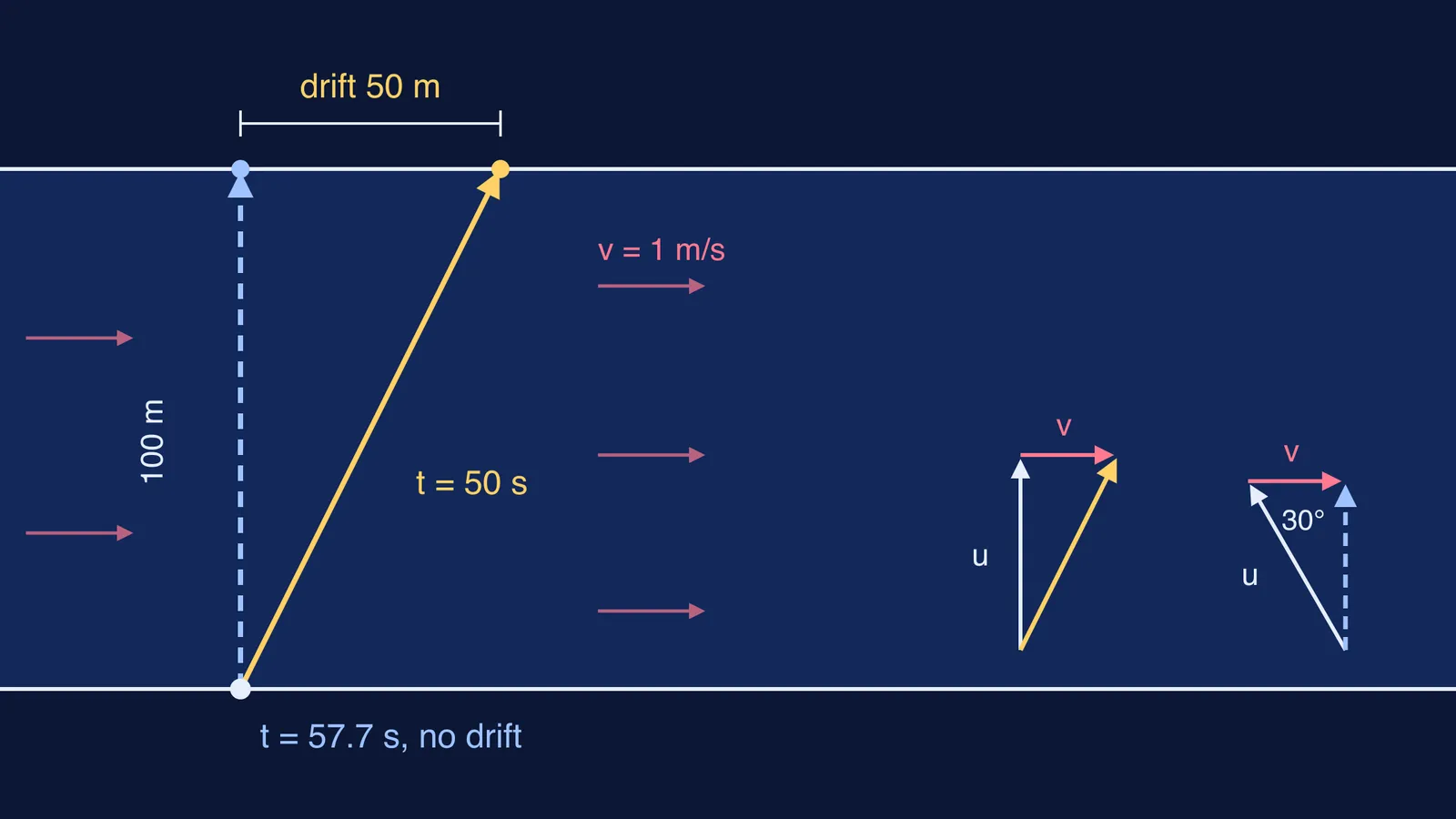
Shortest time: t = d / u = 100 m ÷ 2 m/s = 50 s.
How do you find the drift?
While you cross, the current carries you downstream the whole time. Drift is the river's speed multiplied by the crossing time.
Drift = v × t = 1 m/s × 50 s = 50 m downstream.
Speed relative to the bank = √(2² + 1²) = √5 ≈ 2.24 m/s.
Path length = √(100² + 50²) ≈ 111.8 m, at about 63.4° to the bank (tan θ = 2/1).
Check it: 111.8 m ÷ 2.24 m/s ≈ 50 s, the same time. If you divide the 100 m width by 2.24 m/s you get 44.7 s, which is wrong. The boat does not cover 100 m at 2.24 m/s; it covers 111.8 m.
How do you cross a river by the shortest path?
Shortest path means zero drift: you land directly opposite. Point the boat partly upstream so the upstream part of its velocity cancels the current.
The upstream component must equal the river's speed: u sin θ = v, with θ measured from the line straight across.
sin θ = 1/2, so θ = 30° upstream of straight across (120° to the direction of flow).
The across component is u cos θ = 2 × cos 30° ≈ 1.73 m/s.
Time = 100 m ÷ 1.73 m/s ≈ 57.7 s. Drift = 0.
The shortest path costs about 7.7 s more than the shortest time. In general the zero-drift crossing takes d / √(u² − v²), which is always longer than d / u when the river is moving. We go through the steering angle in more detail in how to find the angle to steer a boat to the point directly opposite.
If the river is faster than the boat, sin θ = v/u would be greater than 1, so no heading reaches the opposite point. The question then becomes least drift, or the minimum speed needed to reach a given point; see crossing a river to a point downstream at minimum speed.
Shortest time or shortest path: which does the question want?
Read the wording first, then choose the heading.
"Minimum time", "as quickly as possible": head straight across; t = d/u; drift = v × d/u.
"Directly opposite", "shortest path", "without drifting": head upstream with sin θ = v/u; t = d / √(u² − v²).
"Lands x metres downstream": write the across and along components, then solve for the heading.
River faster than the boat and "least drift": zero drift is impossible, so minimise the drift instead.
For more of the same family, including rain and moving observers, see relative velocity problems: river crossing, rain and moving observers.
What mistakes cost marks in river-crossing problems?
Run this checklist before you write the final answer.
Did you divide the width by the resultant speed? Divide it by the across component instead.
Did you measure the angle from the bank in one line and from the perpendicular in the next? Say which one you use.
Did you write sin θ = u/v? For the zero-drift heading it is v/u.
Is u the boat's speed in still water, that is, relative to the water?
Did you answer a shortest-path question with the straight-across heading?
If you keep picking the wrong heading, the Fermi Problem Library has worked problems with a step-by-step solver that explains the reasoning rather than printing an answer, so you can see where the velocity splits into components. If adding vectors still feels shaky, the Fermi Concept Library gives every concept in physics its own lesson, so you can go back over vector addition first.