

On this page
A river-crossing question is really one equation about adding velocities. Get it right and three JEE variants (shortest path, shortest time, least drift) come from the same picture.
What angle should you steer to reach the point directly opposite?
The boat's velocity relative to the ground is its velocity relative to the water plus the water's velocity relative to the ground, the relative-velocity rule set out in OpenStax University Physics, section 4.5.
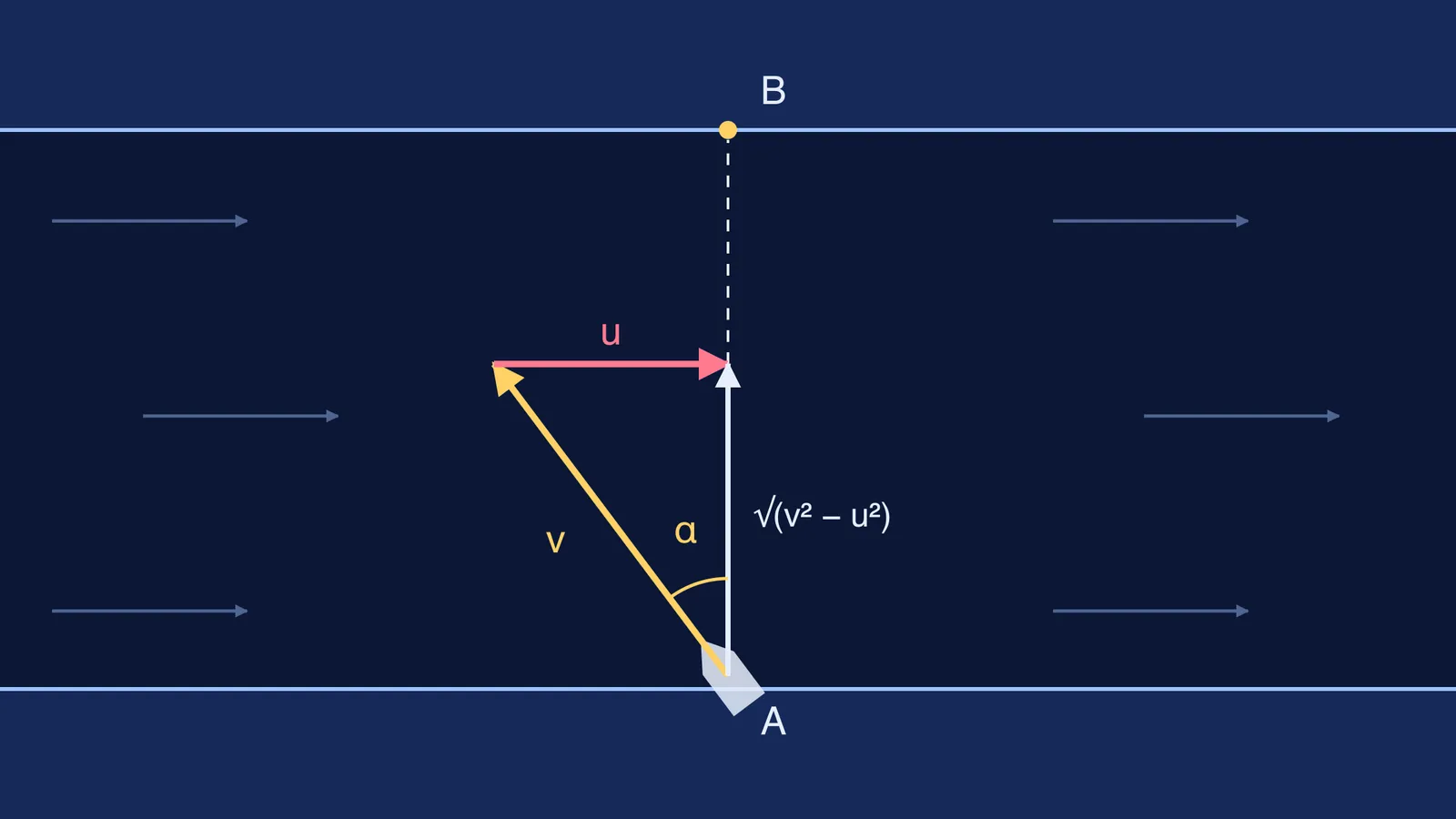
Call the river speed u and the boat's speed in still water v. Point the boat at an angle α upstream of the straight-across line. Split its velocity into two parts:
Along the river: u − v sin α (the current pushes downstream, the boat's upstream part pushes back)
Across the river: v cos α
To land directly opposite, the along-river part must be zero. So v sin α = u, which gives sin α = u/v.
The boat then moves straight across at √(v² − u²), and a river of width d takes d/√(v² − u²) to cross.
Worked example: a 3-4-5 river crossing
Use the same vector rule from OpenStax with easy numbers. A river is 100 m wide and flows at 3 m/s. The boat does 5 m/s in still water.
sin α = 3/5 = 0.6, so α ≈ 36.9° upstream of straight across.
Speed across = √(5² − 3²) = 4 m/s.
Time = 100/4 = 25 s, and the boat lands exactly opposite.
Compare pointing straight across instead. The crossing speed is the full 5 m/s, so it takes 20 s, but the current carries the boat 3 × 20 = 60 m downstream. That is the trade-off examiners like: the shortest path is not the shortest time. Our post on the river boat simulation for shortest time versus shortest path shows both routes side by side.
If you keep picking the wrong one of these two in mocks, the Fermi Problem Library has worked problems with a step-by-step solver that explains the reasoning rather than printing an answer, so you can see where your method split from the right one.
Why does it fail when the river is faster than the boat?
sin α = u/v only has an answer when u is less than v. If the river is faster, u/v is bigger than 1, and no angle has a sine bigger than 1. The current always wins some ground.
OpenStax College Physics 2e, Example 3.6 uses exactly this case: a boat at 0.75 m/s in a current of 1.20 m/s. Pointed straight across, its velocity relative to the shore is 1.42 m/s at 32.0° to the bank. Plug the same numbers into our formula and sin α = 1.20/0.75 = 1.6, which is impossible.
Where should you point when the river wins?
You can no longer avoid drift, but you can make it as small as possible. With heading α, the drift for a river of width d is d(u − v sin α)/(v cos α). Setting its derivative with respect to α to zero gives sin α = v/u, the formula flipped. The least drift is then d√(u² − v²)/v.
There is a neat picture behind it. Draw the river velocity, then a circle of radius v around its tip: every possible boat heading ends on that circle. The ground velocity that points most steeply across is the tangent to the circle, so at least drift the boat's heading is perpendicular to its actual path.
With the speeds from OpenStax Example 3.6 and a 100 m river: sin α = 0.75/1.20 = 0.625, so α ≈ 38.7° upstream. The drift is about 125 m, against 160 m if the boat points straight across.
A three-question check before you write sin α
Which is bigger, the river speed or the boat speed? If the river is faster, the directly opposite point is out of reach; switch to least drift.
Where is the angle measured from: the straight-across line, the bank, or the flow? From the bank, sin becomes cos.
What does the question ask for: shortest path, shortest time or least drift? Shortest time always means pointing straight across, whatever the speeds.
The same rule runs through the angle to hold an umbrella in rain and why a round trip in wind takes longer.
If the velocity triangle still feels abstract, the Fermi Simulation Lab has interactive simulations for ideas that are easier to see than to read.


