On this page
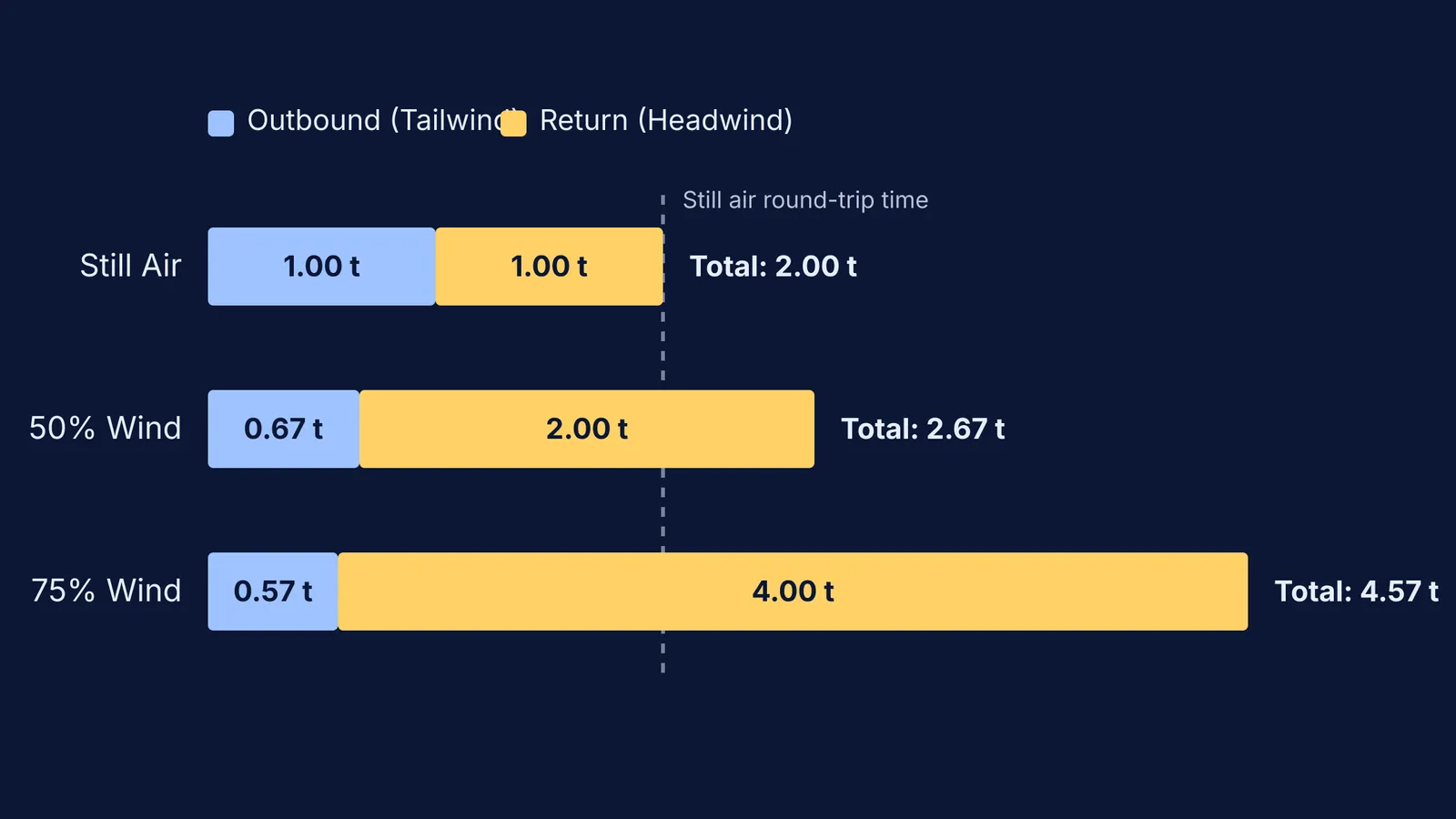
The intuition behind this classic physics problem is about time, not distance. Although the distance you travel with the wind is exactly the same as the distance against it, you travel the headwind leg much more slowly. That means you are stuck in the slow lane for a longer time than you get to enjoy the fast lane.
Do headwinds and tailwinds cancel each other out?
Imagine your plane flies at 500 mph and the wind blows at 100 mph. The distance is 1,000 miles each way.
In still air: The trip takes 2 hours each way, totalling 4 hours.
With the wind:
On the outbound leg (tailwind), your ground speed is 600 mph. Covering 1,000 miles takes 1 hour and 40 minutes (1.67 hours).
On the return leg (headwind), your ground speed is 400 mph. Covering 1,000 miles takes 2 hours and 30 minutes (2.5 hours).
Your total time is 4.17 hours, which is roughly 10 minutes longer than the trip in still air.
This is why the average speed for a round trip is not the simple average of the two speeds. Because you spend a larger fraction of your total travel time fighting the wind, the penalty of the headwind is always greater than the time bonus of the tailwind.
How do you prove it with algebra?
Let v be the plane's airspeed, w be the wind speed, and d be the distance of one leg.
With no wind, the time for the round trip is simply: t₀ = d/v + d/v = 2d/v
With wind, the tailwind leg takes d/(v+w) and the headwind leg takes d/(v−w). The total time is: t_w = d/(v+w) + d/(v−w)
To add these fractions, we find the common denominator, (v+w)(v−w) = v² − w²: t_w = [d(v−w) + d(v+w)] / (v² − w²) t_w = 2dv / (v² − w²)
We can rewrite this by dividing the numerator and denominator by v²: t_w = (2d/v) × [1 / (1 − w²/v²)] t_w = t₀ × [1 / (1 − w²/v²)]
Since the wind speed is less than the plane's speed, the fraction w/v is between 0 and 1. When you square it, you get a positive number. Subtracting that from 1 gives a denominator that is strictly less than 1. Dividing by a number less than 1 makes the whole fraction greater than 1, proving mathematically that t_w is always greater than t₀.
How do you solve relative velocity problems?
When you face a "wind and aircraft" or "boat and river" problem in an exam, use this three-step framework to avoid common mistakes:
Draw the vectors first: Never add speeds blindly. Draw an arrow for the object's speed in still air (v) and another for the wind or current (w). If they point the same way, your ground speed is v + w. If they point opposite ways, your ground speed is v − w.
Calculate times, not average speeds: Do not average the outbound and return speeds. Calculate the time for the outbound leg (t₁ = d / v₁) and the time for the return leg (t₂ = d / v₂).
Combine for the final answer: Add t₁ and t₂ to get the total time. If the question asks for the average speed of the whole trip, divide the total distance (2d) by the total time (t₁ + t₂).
Using this method ensures you always weight the slower leg more heavily, because the slower speed produces a larger time value in your calculation.
How do jet streams increase transatlantic flight times?
This is not just a textbook puzzle. In the real world, the jet stream—a high-altitude ribbon of fast-moving air—acts as a massive tailwind for eastbound transatlantic flights and a headwind for westbound ones.
Because of climate change, the jet stream is intensifying. A 2016 study published in *Environmental Research Letters* found that this strengthening wind increases the round-trip time for transatlantic flights. The research estimates that if atmospheric carbon dioxide doubles, the time penalty for westbound flights will exceed the time bonus for eastbound flights so much that it will add an extra 2,000 hours of flight time annually across all transatlantic traffic. This extra time in the air translates to 7.2 million extra gallons of jet fuel burned and $22 million in additional costs for airlines every year.
If you want to practice more kinematics problems like this, try setting them up in the Fermi Problem Library. It helps to avoid the average speed trap by writing out the time for each leg separately.