

On this page
You drive to a friend's house at 30 km/h in heavy traffic, and return along the same route at 60 km/h. What was your average speed for the round trip?
If you answered 45 km/h, you have fallen into one of the most common traps in introductory physics. The true average speed is 40 km/h. Here is why taking a simple average gives you the wrong answer, and how you can calculate average speed correctly every time.
Why is the simple average wrong?
The arithmetic mean — adding two numbers and dividing by two — only works if you spend *equal time* at each speed.
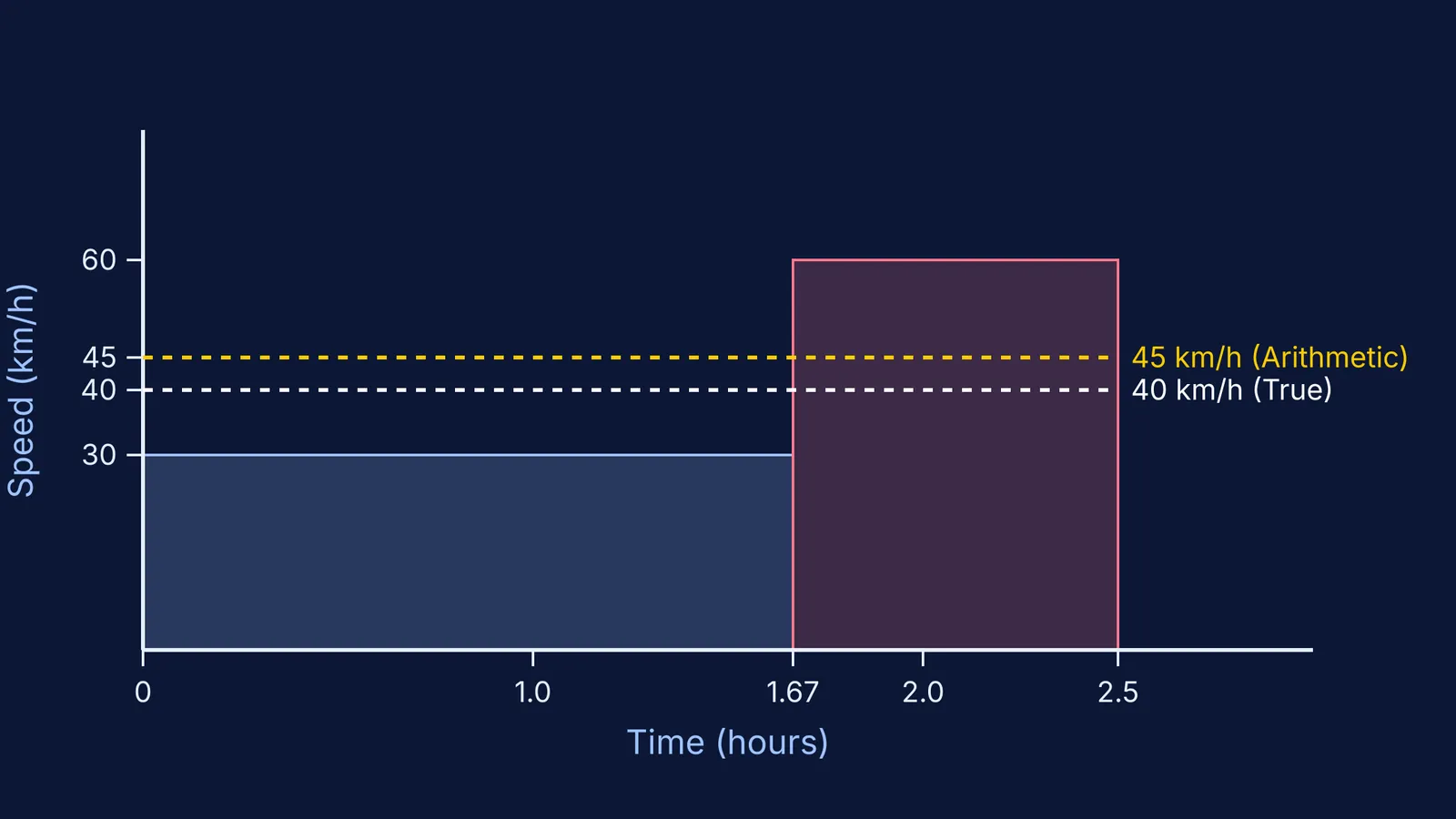
But when you cover *equal distances* at different speeds, you spend much more time driving slowly. Let's break down a 100 km round trip using a classic textbook example: 50 km driven at 30 km/h, and the return 50 km driven at 60 km/h.
The first 50 km takes 50 / 30 = 1.67 hours.
The second 50 km takes 50 / 60 = 0.83 hours.
You spent twice as much time going slow. That slower speed of 30 km/h exerts more "pull" on your overall time than the 60 km/h speed does. This disproportionate time spent dragging along at the lower speed pulls the true average below the arithmetic mean.
How do you calculate average speed?
The formal definition of average speed is always the total distance divided by the total elapsed time.
Average speed = Total distance / Total time
Using our example, the total distance of the round trip is 100 km, and the total time is 1.67 + 0.83 = 2.5 hours. Dividing the 100 km by the 2.5 hours gives exactly 40 km/h.
If you simply average 30 and 60 to get 45 km/h, you are imagining a completely different trip: one where you drove for 1.25 hours at 30 km/h and 1.25 hours at 60 km/h. That imaginary trip would cover 112.5 km, not the 100 km you actually drove. Understanding this distinction is key to mastering kinematics. (For more on interpreting motion and sequences of time, see how to find the distance in the nth second).
Where does the harmonic mean formula come from?
When a journey is split into two *equal distances* at speeds u and v, the average speed is their harmonic mean. This allows you to skip calculating the individual times.
Average speed = 2uv / (u + v)
We can prove this formula algebraically. Let the distance for each half of the journey be d. The total distance is therefore 2d. The time taken for the first half is d / u. The time taken for the second half is d / v. The total time is the sum of these two: (d / u) + (d / v). To add these fractions, we find a common denominator, which gives us [d(u + v)] / uv.
Now, we apply the definition of average speed: Average speed = 2d / [d(u + v) / uv]
The distance d cancels out entirely, which tells us that the average speed depends only on the two speeds and not on how far you travel. The uv term moves to the numerator, leaving us with 2uv / (u + v).
Let's test this with our earlier speeds of 30 and 60: Average speed = (2 × 30 × 60) / (30 + 60) = 3600 / 90 = 40 km/h.
What if there are more than two equal parts?
The logic extends to journeys split into three or more equal distances. For example, if an object covers three equal distances at speeds u, v, and w, the formula becomes:
Average speed = 3uvw / (uv + vw + uw)
This formula is a staple of competitive exams like JEE Main and NEET. When you see a question about travelling from A to B and back, or covering a distance in thirds at different constant speeds, use the harmonic mean.
A framework for average speed problems
When faced with an average speed problem, do not immediately reach for a formula. Read the problem carefully and use this checklist:
Identify the constant: Is the journey divided into equal distances, or equal times?
Equal distances: Use the harmonic mean. For two parts, it is 2uv / (u + v). (Example: A train travels between two stations and returns).
Equal times: Use the arithmetic mean, which is (u + v) / 2. (Example: A runner jogs for a set time, then sprints for the exact same amount of time).
Unequal parts: Revert to first principles. Calculate the total distance, calculate the total elapsed time separately, and divide them.
If you are unsure where to start, the Fermi Concept Library holds every concept in physics, chemistry, biology, mathematics and computing, each with its own lesson and its place in the map. When you are ready to practice applying these formulas, the Fermi Problem Library has worked problems with a step-by-step solver that explains the reasoning rather than printing an answer. (For extending these core principles to two-dimensional motion, you might explore the equation of trajectory of a projectile).


