

On this page
A classic challenge in kinematics is crossing a river to land at an exact spot on the opposite bank. If you want to reach a point directly across, you must steer upstream. But what if your target is downstream, and you want to use the least possible effort?
Finding the minimum speed of a boat relative to the water to reach a point downstream is a standard problem in two-dimensional relative motion. The solution relies on a beautiful vector geometry trick based on the principles of relative velocity rather than heavy calculus.
What is the minimum speed of a boat to reach a point downstream?
Imagine a river flowing at speed v_r. You want to reach a target point on the opposite bank. Let the straight line from your starting point to the target make an angle θ with the downstream riverbank.
The minimum speed required to reach a point at an angle θ downstream is v_b = v_r sin θ.
Your required speed depends only on the river's current and the destination angle. If using distances (river width d, downstream distance x), the target path is √(d² + x²), making the speed v_b = v_r d / √(d² + x²).
If you get stuck setting up vector equations for problems like this, the Fermi Problem Library has worked problems with a step-by-step solver that explains the reasoning rather than printing an answer.
How to find the optimal steering angle?
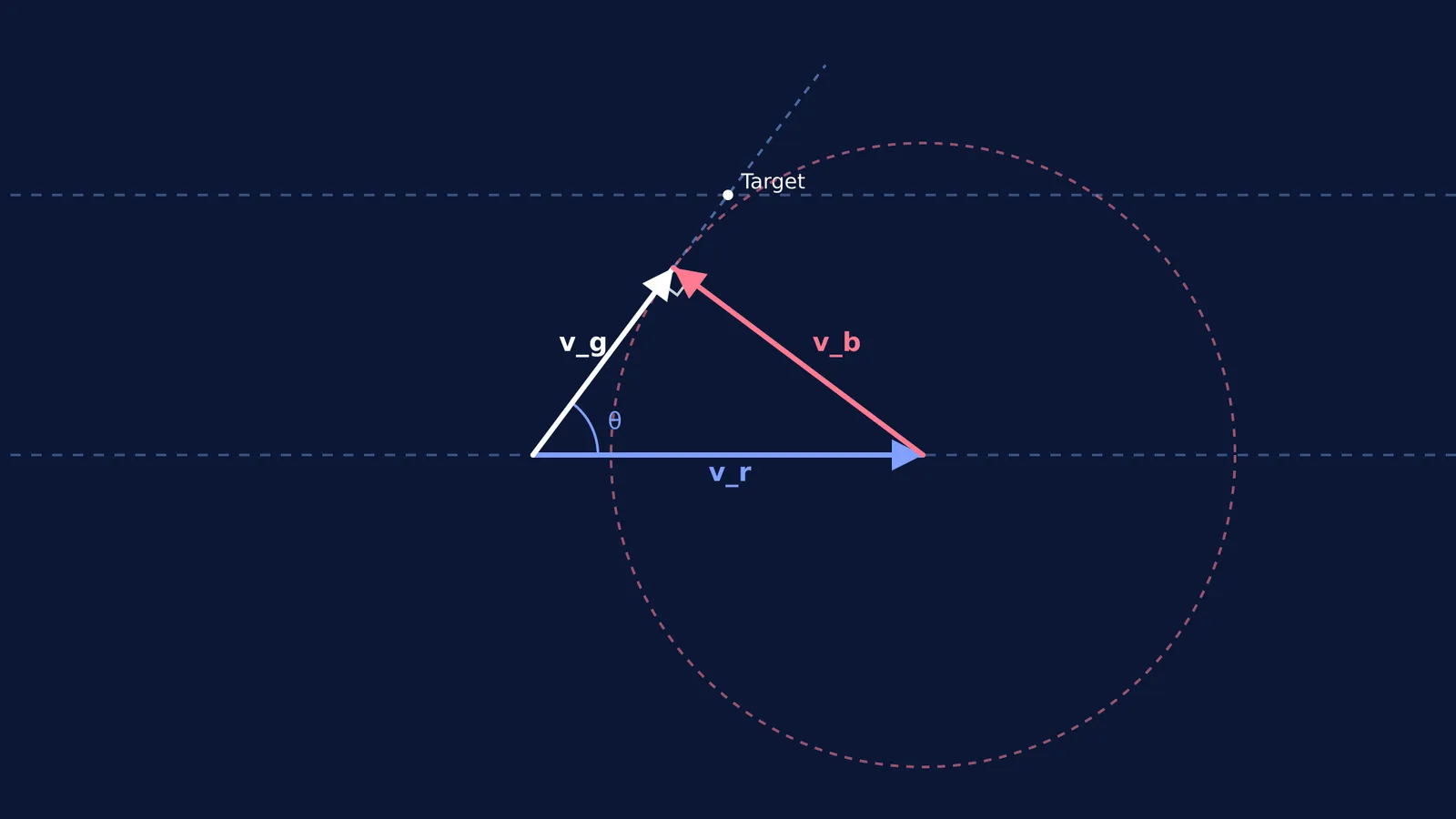
To achieve this minimum speed, you cannot just point the boat at the target. Your ground velocity (v_g) is the vector sum of the river's velocity (v_r) and your boat's relative velocity (v_b).
To see why the Tangent Method works, draw the river velocity vector v_r starting from your current position. From the tip of that vector, you can draw the boat velocity vector v_b in any direction. To minimise v_b, imagine drawing a circle of radius v_b around the tip of v_r.
For the boat to reach the target, this circle must touch your intended path across the ground. The smallest possible circle that touches a line is the one that is exactly tangent to it. At the point of tangency, the radius (which represents v_b) is perfectly perpendicular to the line (which represents v_g).
This leads to a counter-intuitive rule for the optimal steering angle: to use the minimum speed, you must steer the boat so that its heading is at 90° to your intended path across the ground. Since your target is downstream, this means you will actually be aiming the boat slightly upstream relative to the target line, allowing the river current to push you into the correct diagonal path.
If your velocity vectors or relative angles feel hard to picture, the Fermi Simulation Lab offers interactive simulations for the ideas that are easier to see than to read.
Worked example: crossing to a point downstream
Let's test this with a real problem. Suppose a river is 40 m wide, flowing at v_r = 3 m/s. You need to reach a dock that is 30 m downstream on the opposite bank. What is your minimum required speed, and where should you aim?
Find the geometry: The width d = 40 m and the downstream distance x = 30 m form a 3-4-5 right triangle. The length of the target path is √(40² + 30²) = 50 m.
Find the angle: The sine of the target angle θ (with the bank) is the opposite side over the hypotenuse: sin θ = 40 / 50 = 0.8.
Calculate minimum speed: The minimum speed is v_b = v_r sin θ = 3 × 0.8 = 2.4 m/s.
Determine the steering angle: Your path is at an angle where sin θ = 0.8 (which is about 53° from the downstream bank). You must steer exactly 90° away from this path, pointing upstream relative to the ground track.
When the target is directly across
We can test the formula on a familiar extreme case. What if you want to land directly opposite your starting point?
The target angle θ is 90°.
Since sin 90° = 1, the minimum speed becomes v_b = v_r.
If your boat's speed is exactly equal to the river current (v_b = v_r), you must steer straight upstream. Your cross-river speed becomes zero, meaning it would take infinite time to cross, but you would technically hold the line. At any speed less than the river current, you will always be swept downstream, no matter how you steer. This is why problems asking if two projectiles will collide midair or tracking motion in a plane from a position vector often require setting up relative velocities first to see what paths are physically possible.
By mastering the vector triangle method, you can avoid pages of algebra and solve river-crossing problems visually in seconds.


