

On this page
If an object moves in a straight line without ever turning around, its total distance travelled is simply the magnitude of its displacement. But if it stops and reverses direction, finding the distance is no longer as simple as subtracting the initial position from the final position.
According to OpenStax Calculus Volume 1, total distance travelled is the integral of the absolute value of velocity, which ensures that backward motion is added rather than subtracted (OpenStax). If a car travels 80 miles north and then 30 miles south, its net displacement is 50 miles, but the total distance travelled is 110 miles.
To calculate this in physics problems, you cannot just plug the start and end times into your position-time equation. You must break the journey into segments.
Why is distance different from displacement when velocity changes sign?
Velocity is the rate of change of position, or the derivative as the slope of a tangent. A positive velocity means the object is moving forward, and a negative velocity means it is moving backward.
Displacement only looks at where you started and where you finished. If you walk three steps forward and three steps back, your displacement is zero. Distance, however, is a scalar quantity that measures the total path length. It has no negative values. When the velocity changes sign, the object has reached a turning point. If you do not split the time interval at this point, the forward and backward displacements will cancel each other out.
How to find distance travelled from a position-time equation with a turning point?
To find the distance travelled, you must isolate the different "legs" of the journey. Here is the step-by-step method:
Find the velocity function: Differentiate the position-time equation s(t) to get the velocity v(t).
Find the turning points: Set v(t) = 0 and solve for t. These are the moments the object stops to reverse direction.
Split the interval: Divide your total time interval at these turning points. For example, if you are looking at t = 0 to t = 4, and the object turns around at t = 2, your two legs are t = 0 to t = 2, and t = 2 to t = 4.
Calculate displacement for each leg: Find the change in position for each sub-interval.
Add the magnitudes: Take the absolute value of each displacement and add them together.
What is a worked example of distance with a turning point?
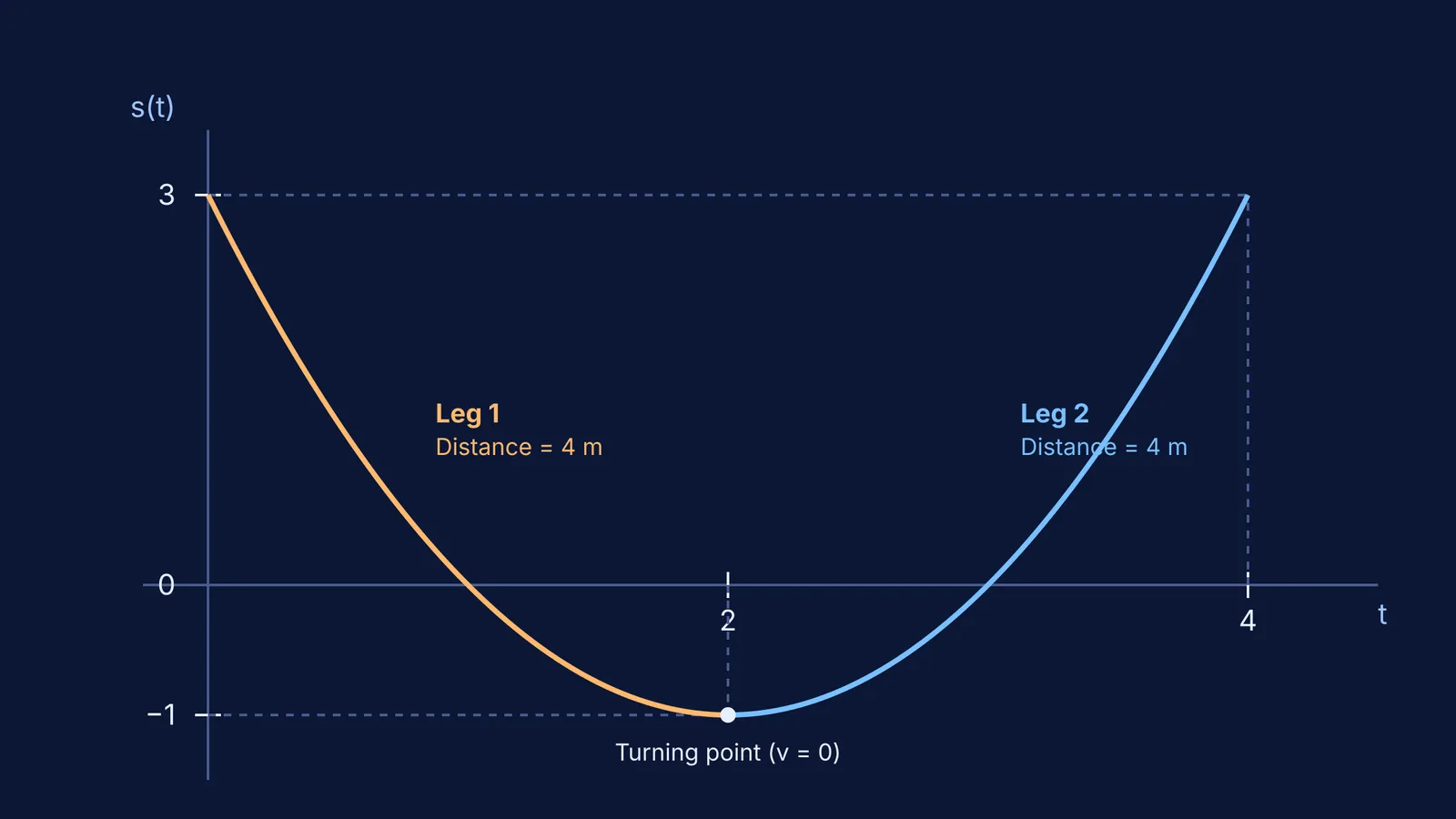
Suppose a particle's position is given by the equation s(t) = t² − 4t + 3 metres, and we want to find the distance travelled between t = 0 and t = 4 seconds.
First, finding the final and initial positions gives us:
s(0) = 3 m
s(4) = 4² − 4(4) + 3 = 3 m
The net displacement is 3 − 3 = 0 m. However, the particle did not stand still. We need to find the turning point.
Differentiating s(t) gives the velocity: v(t) = 2t − 4
Setting v(t) = 0 gives t = 2 seconds. This means the particle turned around at 2 seconds. We must split the journey into two legs: from 0 to 2 seconds, and from 2 to 4 seconds.
Leg 1 (t = 0 to t = 2): Position at t = 2 is s(2) = 2² − 4(2) + 3 = −1 m. Displacement = s(2) − s(0) = −1 − 3 = −4 m. Distance for Leg 1 = |−4| = 4 m.
Leg 2 (t = 2 to t = 4): Displacement = s(4) − s(2) = 3 − (−1) = 4 m. Distance for Leg 2 = |+4| = 4 m.
The total distance travelled is 4 + 4 = 8 metres.
When you plug a position-time equation into the Fermi Problem Library, its step-by-step solver explains this reasoning to find turning points rather than just printing the final distance. Breaking the problem down into intervals ensures that you always account for every part of the path, which is a core skill in how to solve physics problems step by step.


