On this page
In 1885 chemists knew that glucose and fructose were both C₆H₁₂O₆, but not where each kept its C=O. Heinrich Kiliani, writing in the Berichte of the German Chemical Society, made the carbonyl group mark its own position. HCN hangs a new carbon on the C=O carbon; hydriodic acid (HI) then strips out the oxygen but keeps the skeleton. The shape of the final acid tells you where the C=O was. He first put fructose's C=O at C3, then proved C2, the structure in your textbook. We read the English abstracts of his papers in the Journal of the Chemical Society, Abstracts for 1886 (vol. 50, pp. 219–220, 438, 441, 526–527 and 687), and checked the numbers below against the page images.
What was still unknown about glucose and fructose in 1885?
The abstract of Kiliani's 1886 glucose paper (Ber. 19, 767) lays out three candidates for glucose. Baeyer and Fittig wrote it as an open-chain aldehyde, CH₂(OH)·[CH(OH)]₄·CHO, which fitted its oxidation to gluconic and saccharic acids. V. Meyer had found that glucose does not give the aldehyde test with magenta decolourised by sulphurous acid (Schiff's reagent), and concluded that it was "a ketonic alcohol". Tollens had proposed ring "anhydride" formulae that explained both facts.
Fructose, then called levulose, was a ketone, but which carbon carried the C=O was unproven.
How do HCN and HI reveal where the C=O sits?
HCN adds to the C=O carbon. The cyanide carbon becomes a new, seventh carbon. Hydrolysis later turns it into COOH. The mechanism is in how HCN adds to aldehydes and ketones.
Hot HI removes oxygen without moving carbons. Every C–OH becomes C–H. The mole counting is in HI and red phosphorus: reducing alcohols, acids and sugars.
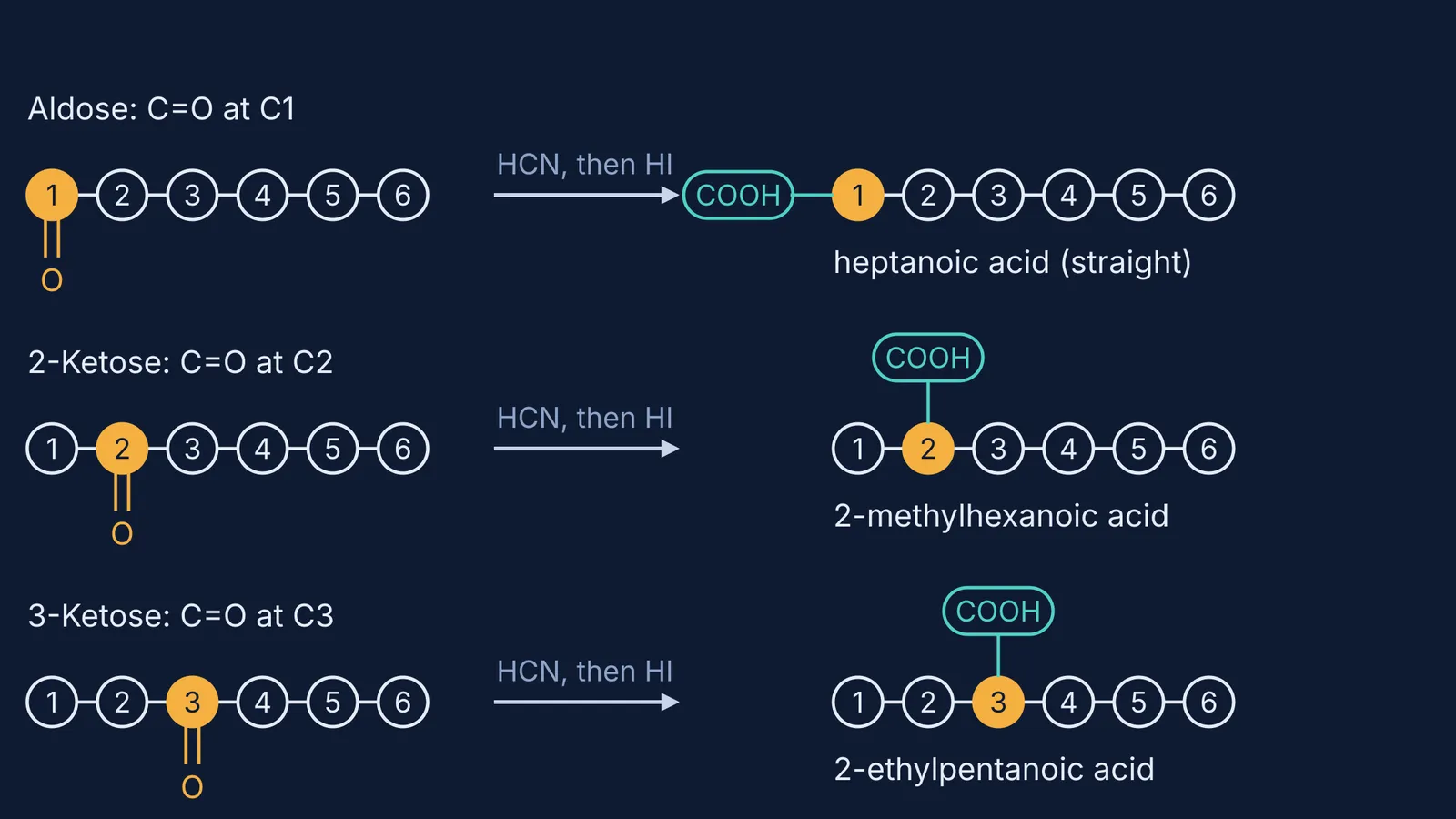
Now follow the new carbon. If the C=O is at C1, it extends the chain and you get a straight C₇ acid, heptanoic acid (the abstracts' "normal heptylic acid"). If the C=O is anywhere else, the new carbon sticks out from the chain, and the branch point is the old carbonyl carbon.
The glucose abstract states the test in exactly these terms: a ketonic alcohol "should yield a compound containing an abnormal", an anhydride "a compound containing a normal carbon-chain".
Why did Kiliani first put fructose's C=O at C3?
In 1885 (Ber. 18, 3066, abstract p. 219) he converted levulose, made from inulin, to its cyanohydrin. Hydrolysis with hydrochloric acid gave a syrupy acid. Heating that with hydriodic acid and amorphous phosphorus gave a heptolactone, C₇H₁₂O₂, boiling at 220°, and heating again gave an acid boiling at 209.6°. The abstract says this acid "could not be got to solidify, and therefore is not normal heptylic acid". So the chain was branched, and fructose was a ketone.
Which branched acid was it? A 2-ketone gives methylbutylacetic acid (2-methylhexanoic acid). A 3-ketone gives ethylpropylacetic acid (2-ethylpentanoic acid). Kiliani compared his acid's calcium salt with Hecht's published description of calcium methylbutylacetate. They did not agree, so he concluded that "the acid is probably ethylpropylacetic acid". That pointed to OH·CH₂·CH(OH)·CH(OH)·CO·CH(OH)·CH₂OH, a 3-ketone.
How did he prove the C=O is at C2?
He made both candidate acids himself, by the acetoacetic ester route covered in acetoacetic ester synthesis.
Methylbutylacetic acid (Ber. 19, 221, abstract p. 438): "identical with the acid previously described". Boiling point 210° (corrected); calcium salt with 6H₂O.
Ethylpropylacetic acid (Ber. 19, 227, abstract p. 441): boiling point 209.2° (corrected); calcium salt with 2H₂O. "This acid is not the same as that obtained from the cyanhydrin of levulose."
So the 1885 product was right; only its identification was wrong, because the published description it was checked against did not match the real compound. The new carbon sat on C2, so fructose carries its C=O at C2.
Notice what decided it. The boiling points differ by under 1°; the calcium salts, with six waters against two, do not.
E. Börnstein and A. Herzfeld reached C2 by another road (Ber. 18, 3353, abstract p. 328). Oxidising levulose gave glycollic acid (C₂) and trihydroxybutyric acid (C₄): a C₆ chain split into C₂ and C₄ pieces, as a C=O at C2 predicts.
What did the same test show for glucose?
The glucose route gave a crystalline lactone, C₇H₁₂O₇, with [α]D = −55.3°. The first HI reduction gave a heptolactone and "only a trace of a heptylic acid together with much hydrocarbon". In a follow-up (Ber. 19, 1128, abstract p. 687) he found "about an equal quantity of normal heptylic acid" alongside the lactone, and concluded that "dextrose cannot have the constitution of a ketone-alcohol". A straight C₇ acid puts the C=O at C1.
Worked example: count the carbons and place the branch
Molar masses use C 12.011, H 1.008, O 15.999, N 14.007.
Add HCN. C₆H₁₂O₆ + HCN → C₇H₁₃NO₆. Check: C 6 + 1 = 7, H 12 + 1 = 13, N 1, O 6. Molar mass 180.16 → 207.18 g/mol.
Hydrolyse the nitrile. C₇H₁₃NO₆ + 2H₂O → C₇H₁₄O₈ + NH₃. Check H: 13 + 4 = 17 = 14 + 3. The heptonic acid is 226.18 g/mol.
Close the lactone. C₇H₁₄O₈ → C₇H₁₂O₇ + H₂O. This is the 208.17 g/mol lactone Kiliani reported for glucose.
Reduce with HI. C₇H₁₂O₇ + 12HI → C₇H₁₄O₂ + 5H₂O + 6I₂. Check: H 12 + 12 = 24 = 14 + 10, O 7 = 2 + 5, I 12 = 12. Five C–OH groups need 2HI each, and opening the lactone's C–O bond needs 2 more.
Place the branch. The product is C₇H₁₄O₂, 130.19 g/mol, whichever sugar you start from. Its shape depends on the C=O position.
C=O at C1: the new carbon continues the chain. Heptanoic acid, CH₃(CH₂)₅COOH.
C=O at C2: the old C2 carries COOH, CH₃ (old C1) and a butyl group (C3 to C6). That is 2-methylhexanoic acid, Kiliani's methylbutylacetic acid.
C=O at C3: the old C3 carries COOH, an ethyl (C1 and C2) and a propyl (C4 to C6). That is 2-ethylpentanoic acid.
All three have the same formula and molar mass, so elemental analysis cannot separate them; only comparison with known samples can.
Exercise. Which acid would a 4-ketohexose give? The old C4 would carry a propyl group (C1 to C3) and an ethyl group (C5 and C6): 2-ethylpentanoic acid again. A 3-ketone and a 4-ketone give the same acid, so this method alone cannot tell them apart. More problems on reading structure from products are in the Fermi Problem Library, which has a step-by-step solver that explains the reasoning.
Where does this sit in your syllabus?
Class 12 Biomolecules: glucose with HCN gives a cyanohydrin; HI shows a straight six-carbon chain; fructose is a ketohexose with its C=O at C2.
JEE: HI and red phosphorus as a reducing system; acetoacetic ester synthesis.
If structure-proof questions keep slipping in mocks, Fermi's AI tutor for JEE prep works out where your reasoning stops and builds a plan from there.
Quick checklist
HCN puts a new carbon on the carbonyl carbon; it ends up as COOH.
HI removes oxygen and keeps the skeleton.
Straight C₇ acid: C=O at C1. Branched acid: the branch point is the old C=O carbon.
Fructose gave 2-methylhexanoic acid, so its C=O is at C2.
Kiliani first said C3 from a borrowed reference; making both acids himself fixed it.
Boiling points 210° and 209.2° could not decide; the calcium salt hydrates could.