

On this page
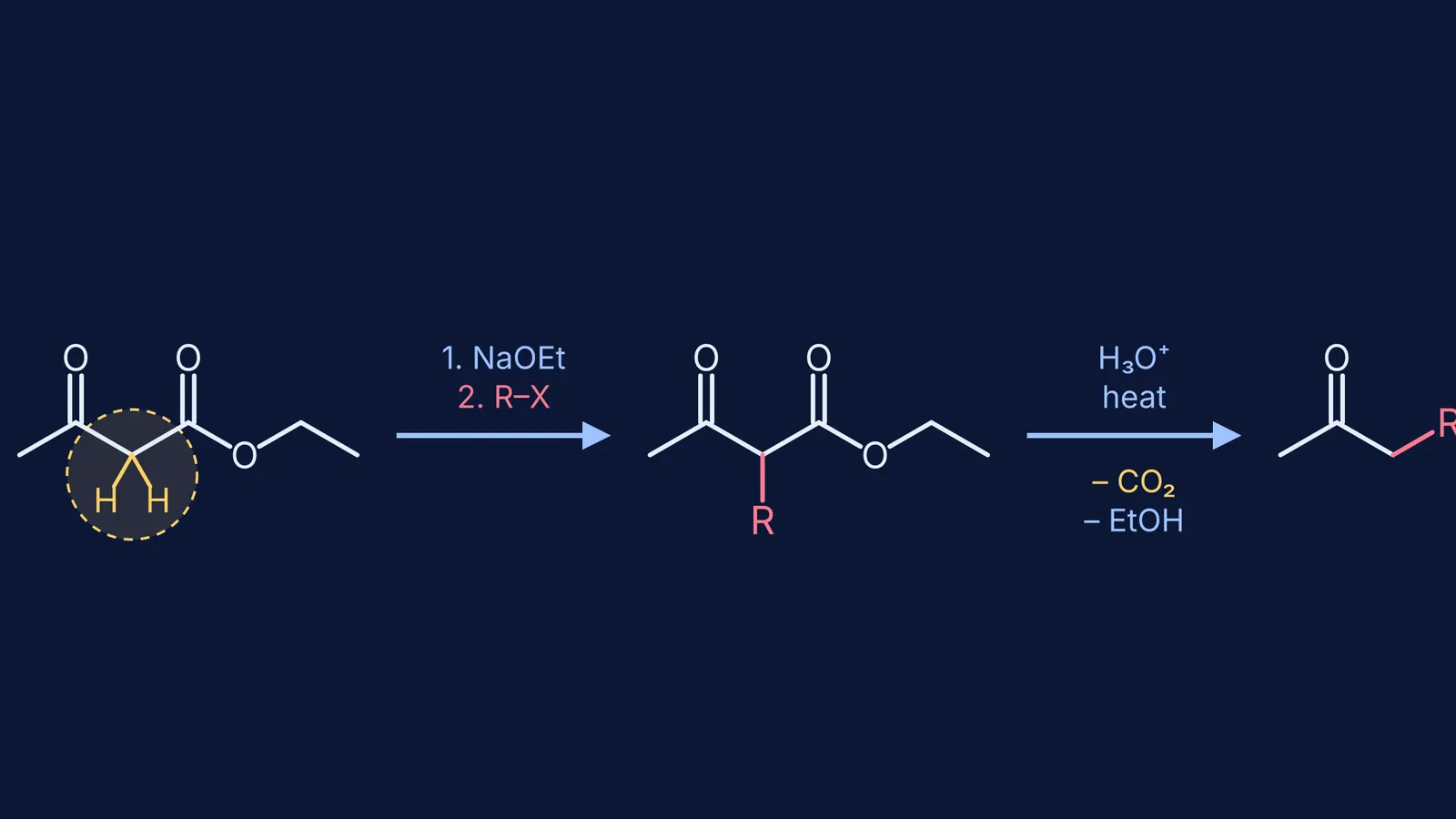
If an organic chemistry question gives you ethyl acetoacetate and an alkyl halide, the answer is almost always a methyl ketone. The route has three steps: make an enolate at the acidic CH2, alkylate it, then hydrolyse the ester and lose CO2. Once you see why each step works, you can run the synthesis forwards from the reagents or backwards from the product.
What is the acetoacetic ester synthesis?
Ethyl acetoacetate, CH3COCH2COOC2H5, is a β-keto ester: a ketone and an ester joined through a single CH2 group. In the lab it is made by the Claisen condensation, in which two molecules of ethyl acetate give one molecule of ethyl acetoacetate and one of ethanol (Wikipedia: Ethyl acetoacetate). If that reaction is new to you, start with our walk-through of the Claisen condensation of ethyl acetate.
The acetoacetic ester synthesis converts an alkyl halide into a methyl ketone with three additional carbons (LibreTexts: Alkylation of Enolate Ions/22%3A_Carbonyl_Alpha-Substitution_Reactions/22.07%3A_Alkylation_of_Enolate_Ions)). The ester group is only a temporary helper. It makes the CH2 acidic, then leaves as CO2.
Why is the CH2 of ethyl acetoacetate so acidic?
The two hydrogens on the CH2 sit between two carbonyl groups. When one leaves as H+, the negative charge spreads over both C=O groups, so the enolate is stabilised by resonance (Wikipedia: Acetoacetic ester synthesis).
Ethyl acetoacetate has a pKa of 10.68 in water (Wikipedia: Ethyl acetoacetate). Acetone, which has only one carbonyl group, has a pKa of 19.16 (Wikipedia: Acetone). That gap of about 8.5 pKa units means the CH2 of the β-keto ester is more than 100 million times more acidic. This is why sodium ethoxide, a fairly modest base, converts it almost completely to its enolate (LibreTexts/22%3A_Carbonyl_Alpha-Substitution_Reactions/22.07%3A_Alkylation_of_Enolate_Ions)).
What are the three steps, and what does each one do?
The sequence below follows the LibreTexts account/22%3A_Carbonyl_Alpha-Substitution_Reactions/22.07%3A_Alkylation_of_Enolate_Ions) and the Wikipedia summary.
Enolate formation. Sodium ethoxide removes one proton from the CH2.
Alkylation. The enolate carbon attacks the alkyl halide R–X in an SN2 substitution, giving CH3COCH(R)COOC2H5. The alkylated ester still has one acidic hydrogen, so you can repeat steps 1 and 2 with a second halide before going on.
Hydrolysis and decarboxylation. Heating with aqueous acid (or NaOH followed by acid) hydrolyses the ester to a β-keto acid, which loses CO2 to leave the methyl ketone CH3COCH2R.
Step 3 works because β-keto acids lose CO2 easily. Our post on why beta-keto acids decarboxylate on heating shows the mechanism.
How do you plan the synthesis backwards from a methyl ketone?
Many questions give you the product and ask which halide to use. Work through this check:
Confirm the target is a methyl ketone, CH3CO–.
Find the α carbon on the other side of the C=O.
Every group on that carbon, apart from hydrogen and the carbonyl, came from an alkyl halide. One group means one R–X.
Check each R–X can be used. The alkylation is an SN2 reaction, so it prefers a primary or secondary halide; tertiary halides cannot be used and typically give E2 elimination instead (LibreTexts/22%3A_Carbonyl_Alpha-Substitution_Reactions/22.07%3A_Alkylation_of_Enolate_Ions)).
Worked example 1: heptan-2-one. The target is CH3CO–CH2CH2CH2CH2CH3. The α carbon carries one butyl group, so the halide is 1-bromobutane. Route: ethyl acetoacetate, NaOEt, then CH3CH2CH2CH2Br; then H3O+ and heat. Carbon count: 3 from CH3–CO–CH2 plus 4 from butyl gives 7.
Worked example 2: 3-methylpentan-2-one. The target is CH3CO–CH(CH3)CH2CH3. The α carbon carries a methyl and an ethyl, so you alkylate twice: NaOEt then CH3I, NaOEt again then CH3CH2Br, then H3O+ and heat. Carbon count: 3 + 1 + 2 gives 6.
Worked example 3: the trap. The target is 4,4-dimethylpentan-2-one, CH3CO–CH2–C(CH3)3. Working backwards needs tert-butyl bromide, a tertiary halide, so this route fails. Say so in your answer rather than forcing it.
Which mistakes cost marks most often?
Leaving the ester on the product. The COOC2H5 group leaves as CO2 and ethanol.
Alkylating the CH3 instead of the CH2. The CH2 between the two carbonyls is the acidic one.
Adding two R groups with one round of base. Each alkylation needs its own deprotonation.
Choosing a tertiary halide.
Losing a carbon in the name. Number the chain from the end nearer the C=O and check the count.
If you keep slipping at the planning step, the Fermi Problem Library has worked problems with a step-by-step solver that explains the reasoning rather than printing an answer. To revise enolates, nucleophilic substitution and decarboxylation one at a time, the Fermi Concept Library gives each concept its own lesson and its place in the map.
Try this next: redo worked example 2 with the two halides in the opposite order, and check that you reach the same ketone.


