

On this page
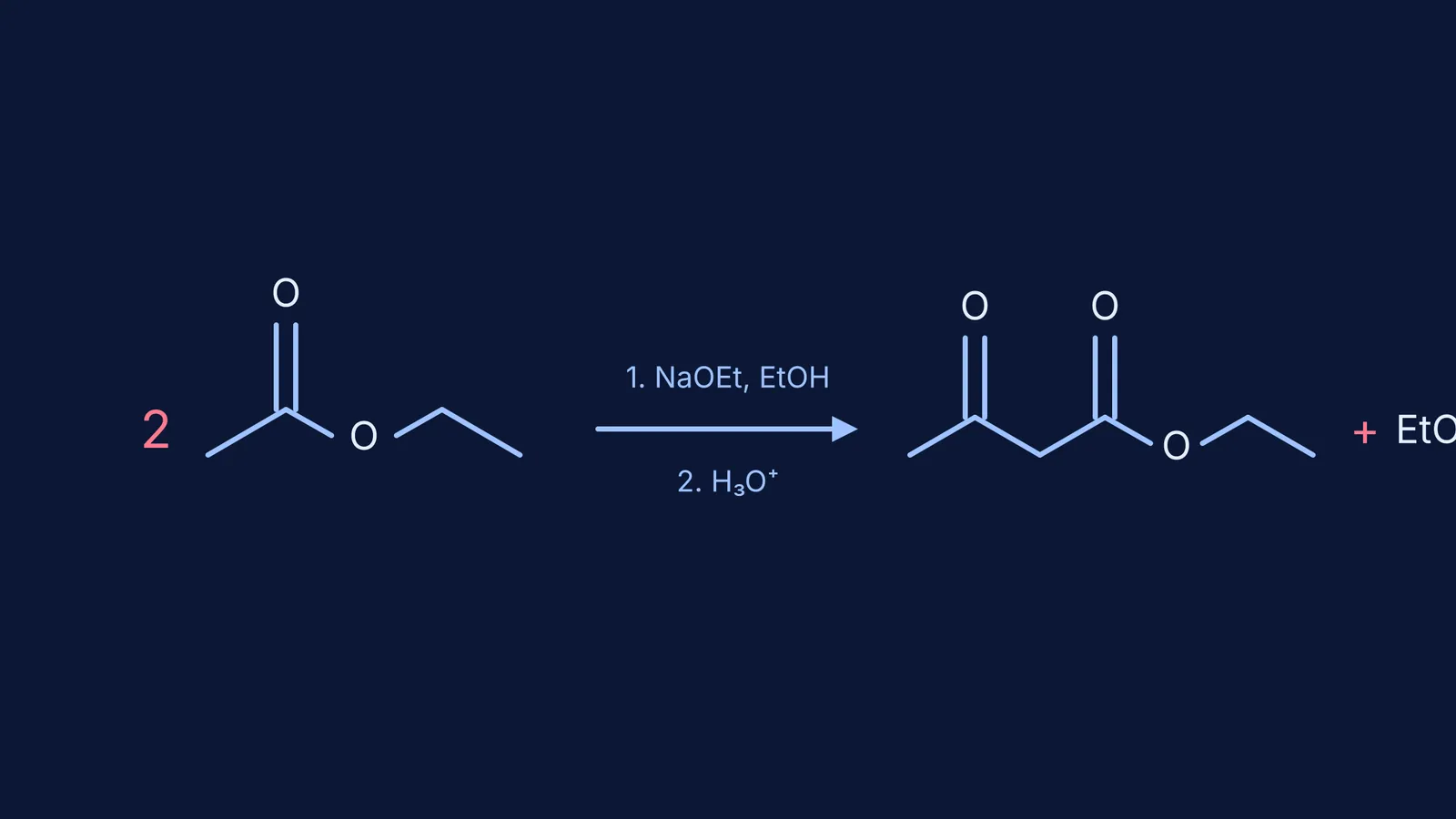
The Claisen condensation of ethyl acetate is a classic organic reaction where two molecules of ethyl acetate react in the presence of a strong base to form ethyl acetoacetate and ethanol. It is a cornerstone of organic synthesis for creating β-keto esters, which are versatile building blocks for making complex molecules. If you are preparing for exams, understanding exactly how this reaction works—and how to tell it apart from similar reactions—is essential for answering mechanism-based questions.
How does the Claisen condensation mechanism work?
According to Wikipedia's summary of the Claisen condensation, the reaction follows a nucleophilic acyl substitution pathway. Here is exactly what happens step by step:
Enolate Formation: The strong base, sodium ethoxide (NaOEt), removes an acidic α-hydrogen from one molecule of ethyl acetate. This creates a resonance-stabilised ester enolate. (The Fermi Concept Library can help you visualise resonance stabilisation).
Nucleophilic Attack: The newly formed enolate acts as a nucleophile and attacks the carbonyl carbon of a *second* ethyl acetate molecule. This forms a tetrahedral intermediate.
Elimination: The tetrahedral intermediate is unstable. It collapses, reforming the carbonyl double bond and expelling an ethoxide ion (OEt⁻) as a leaving group. This step distinguishes the Claisen condensation as a substitution reaction.
Deprotonation (The Driving Force): The product at this stage is ethyl acetoacetate, which has highly acidic hydrogens between its two carbonyl groups. The expelled ethoxide base immediately removes one of these protons, forming a stable enolate salt. This step is irreversible and is the crucial driving force that pushes the entire reaction to completion.
Acidic Workup: Finally, dilute acid (H₃O⁺) is added to protonate the salt, yielding the final neutral β-keto ester: ethyl acetoacetate.
Why do we use sodium ethoxide?
A common exam trap is asking what happens if you use a different base, like sodium methoxide (NaOMe) or sodium hydroxide (NaOH).
In the Claisen condensation, the base must match the alkoxy group of the ester. Since ethyl acetate is an ethyl ester (it has an –OEt group), you must use sodium ethoxide. If you used sodium methoxide, the base would act as a nucleophile and swap places with the ethoxy group, leading to a transesterification reaction and a messy mixture of products. Sodium hydroxide is also avoided because it would cause the ester to hydrolyse into a carboxylic acid and an alcohol.
What is the difference between the Claisen and aldol condensations?
It is easy to confuse the Claisen and aldol condensations because both involve enolates attacking carbonyl groups to form new carbon-carbon bonds. However, they follow fundamentally different mechanistic pathways and produce different results.
Reactants: The aldol condensation happens between aldehydes or ketones, whereas the Claisen condensation happens between esters.
Reaction Type: The aldol reaction is a nucleophilic addition. The Claisen condensation is a nucleophilic acyl substitution.
The Intermediate: In the aldol reaction, the tetrahedral intermediate gets protonated to form an alcohol. In the Claisen reaction, the tetrahedral intermediate eliminates an alkoxy leaving group to reform a carbonyl double bond.
Final Product: An aldol condensation produces a β-hydroxy aldehyde or ketone (which often dehydrates to an α,β-unsaturated compound). A Claisen condensation produces a β-keto ester.
If you are unsure how to decide leaving group ability in organic chemistry, remember that aldehydes and ketones lack a good leaving group, which is why they undergo addition, not substitution.
How should you study organic named reactions?
When studying named reactions for competitive exams, rote memorisation often fails. Instead, use a structured framework to learn the logic behind the reaction. The Fermi Problem Library uses a step-by-step solver that explains the reasoning rather than just printing an answer, which is exactly how you should approach your studies.
Identify the Reactants: What functional groups are present? Do they have α-hydrogens?
Find the Reagent: Is it an acid, a base, an oxidising agent, or a reducing agent? What is its primary role?
Trace the Electrons: Draw the mechanism arrows yourself. Start from the most electron-rich area (the nucleophile or base) to the most electron-poor area (the electrophile).
Predict the Byproducts: What leaves the molecule? Understanding the leaving group helps you confirm whether it is an addition or substitution reaction.
By breaking down the Claisen ester condensation into these logical steps, you build an intuition that works for any organic reaction, no matter how it is presented in the exam hall. If you ever get stuck, try asking AI the 'why' behind named organic reactions to clarify the underlying mechanism.


