On this page
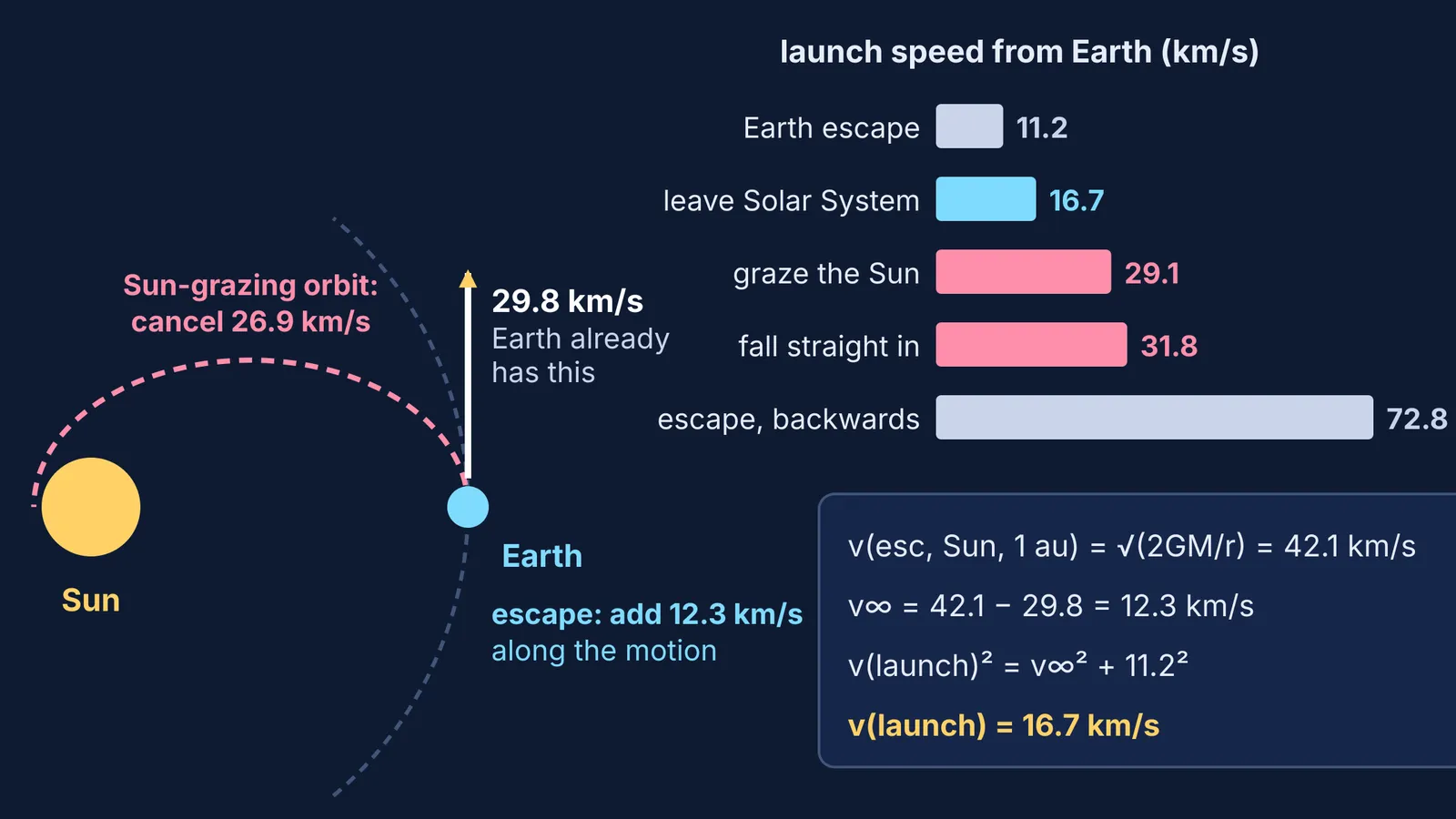
A spacecraft launched from Earth at about 16.7 km/s, in the right direction, never comes back: it leaves the Solar System. To reach the Sun you need at least 29.1 km/s, and 31.8 km/s to fall straight in. That surprises most people, because the Sun pulls everything towards it. The reason is that you start out moving sideways at Earth's orbital speed, and to fall into the Sun you must get rid of almost all of it.
This post uses two Class 11 ideas: escape speed from energy conservation, and relative velocity. Our post on deriving the escape velocity formula covers escape from a single planet. Here we chain two escapes together.
What speed do you need to escape the Sun from Earth's orbit?
Escape speed from a distance r is √(2GM/r). The NASA Sun fact sheet gives GM = 1.32712 × 10²⁰ m³/s² for the Sun, and the NASA Earth fact sheet gives Earth's mean distance as 1.496 × 10¹¹ m.
√(2 × 1.32712 × 10²⁰ / 1.496 × 10¹¹) = 42.1 km/s
The same Earth fact sheet gives Earth's mean orbital speed as 29.78 km/s and its escape speed as 11.19 km/s. So anything that leaves Earth already has 29.8 km/s of the 42.1 km/s it needs. The comet in our Maria Mitchell post meets the same 42 km/s limit.
Why is 16.7 km/s enough to leave the Solar System?
Launch along Earth's direction of motion. After the craft has climbed out of Earth's gravity, it needs only 42.1 − 29.8 = 12.3 km/s relative to Earth. Call this leftover speed v∞.
You do not simply add 12.3 to 11.2. Climbing out of Earth's gravity costs energy, so apply energy conservation per kilogram between the ground and a point far from Earth:
½v² − GM_E/R_E = ½v∞²
Since GM_E/R_E = ½v_e², where v_e = 11.2 km/s, this becomes v² = v∞² + v_e². It looks like Pythagoras, but it is an energy balance, not a vector sum.
v = √(12.3² + 11.2²) = 16.7 km/s
Textbooks often round the inputs and quote 16.6 km/s, the "third cosmic velocity". The difference is only rounding.
What does it cost to reach the Sun instead?
To fall towards the Sun, the craft must lose sideways speed. If it lost all of Earth's 29.8 km/s, it would drop straight in. To merely graze the Sun's surface, it can keep a little, on a long thin ellipse with its far end at Earth's orbit and its near end at the Sun's surface.
Worked example: the Sun-grazing launch
Take r = 1.496 × 10¹¹ m (Earth's orbit) and R = 6.957 × 10⁸ m (the Sun's radius, from the Sun fact sheet).
Speed kept at the far end. For an ellipse touching r and R, conservation of energy and angular momentum give v_far = √(2GM R / (r(r + R))). This is 2.87 km/s.
Speed to cancel. 29.78 − 2.87 = 26.9 km/s, launched backwards against Earth's motion. This is v∞.
Launch speed from the ground. v = √(26.9² + 11.2²) = 29.1 km/s.
Falling straight in. v∞ = 29.8 km/s, so v = √(29.78² + 11.19²) = 31.8 km/s.
Energy per kilogram. Leaving: ½ × (16.66 km/s)² = 1.39 × 10⁸ J. Falling straight in: ½ × (31.81 km/s)² = 5.06 × 10⁸ J, 3.6 times as much.
Check the units: m³/s² × m divided by m² gives m²/s², so v_far comes out in m/s, as it should.
How long a straight fall from Earth's orbit takes is worked out in how long Earth would take to fall into the Sun.
Why does direction matter so much?
Launch the wrong way, against Earth's motion, and you must cancel Earth's 29.8 km/s and then build up 42.1 km/s the other way. That needs v∞ = 71.9 km/s and a launch speed of √(71.9² + 11.2²) = 72.8 km/s, more than four times the forward launch.
Earth's spin helps a little too. At the equator the ground moves at about 0.47 km/s eastward, and Earth spins in the same sense as it orbits, so an eastward launch at the right time of day gains up to that much. This is one reason launch sites near the equator are useful.
These are minimum figures. They ignore air drag, the pull of other planets and the Sun's pull during the climb out of Earth's gravity. Real missions use gravity assists to avoid paying them.
How do real probes get close to the Sun?
No probe has been launched at 29 km/s relative to Earth. NASA's Parker Solar Probe instead uses repeated flybys of Venus to shed orbital energy. NASA's mission blog describes its August 2023 pass as the sixth of seven planned Venus gravity assists, each spiralling the orbit closer to the Sun. The NASA mission page gives its closest approach as about 6.2 million km from the Sun.
ISRO's Aditya-L1 does not try to approach the Sun at all. ISRO's mission page says it sits in a halo orbit around the Sun–Earth L1 point, about 1.5 million km from Earth, where it can view the Sun continuously without eclipses. Getting there costs far less than falling inwards.
The Fermi Problem Library has gravitation and energy problems with a step-by-step solver that explains the reasoning. If you are preparing for JEE Main & Advanced, Fermi Test Prep offers personalised preparation with an AI tutor, live classes, adaptive mocks, mentorship and a study plan that updates based on mastery.
Quick checklist
Escape from the Sun at 1 au: √(2GM/r) = 42.1 km/s.
Earth already moves at 29.8 km/s, so only 12.3 km/s more is needed far from Earth.
Launch speed: v² = v∞² + v_e², an energy balance, giving 16.7 km/s.
Grazing the Sun needs v∞ = 26.9 km/s, a launch of 29.1 km/s; falling straight in needs 31.8 km/s.
Leaving costs 1.39 × 10⁸ J/kg; falling straight in costs 3.6 times as much.
Real Sun probes use Venus flybys instead of brute force.