

On this page
Why does Earth stay in orbit instead of falling?
Earth avoids falling into the Sun because of its enormous tangential velocity. According to the NASA Earth Fact Sheet, Earth travels along its orbit at an average speed of 29.78 km/s (roughly 107,000 km/h). At this speed, the planet is in continuous free fall, but its forward momentum curves its path at the same rate that solar gravity bends it inward.
As explored in our guide on orbital speed and energy in satellite motion, a circular orbit represents an exact dynamical equilibrium where gravitational force matches centripetal demand.
If a cosmic brake suddenly cancelled Earth's 29.78 km/s orbital motion, that balance would vanish. Stripped of angular momentum, Earth would plunge along a direct radial line toward the solar center.
How does Kepler's third law turn a fall into an ellipse?
Setting up this problem with Newton's second law produces a variable-acceleration equation: d²r/dt² = −GM/r². Because gravitational pull strengthens as distance shrinks, finding the elapsed time through calculus requires an energy integral and trigonometric substitution.
However, as physicist Paul J. Nahin demonstrates in *Mrs. Perkins's Electric Quilt* (Princeton University Press, 2009), Keplerian geometry offers a simpler route. In 1619, Johannes Kepler established that the square of any orbital period T is proportional to the cube of its semi-major axis a: T² ∝ a³. This relationship depends exclusively on the semi-major axis, holding true regardless of orbital eccentricity.
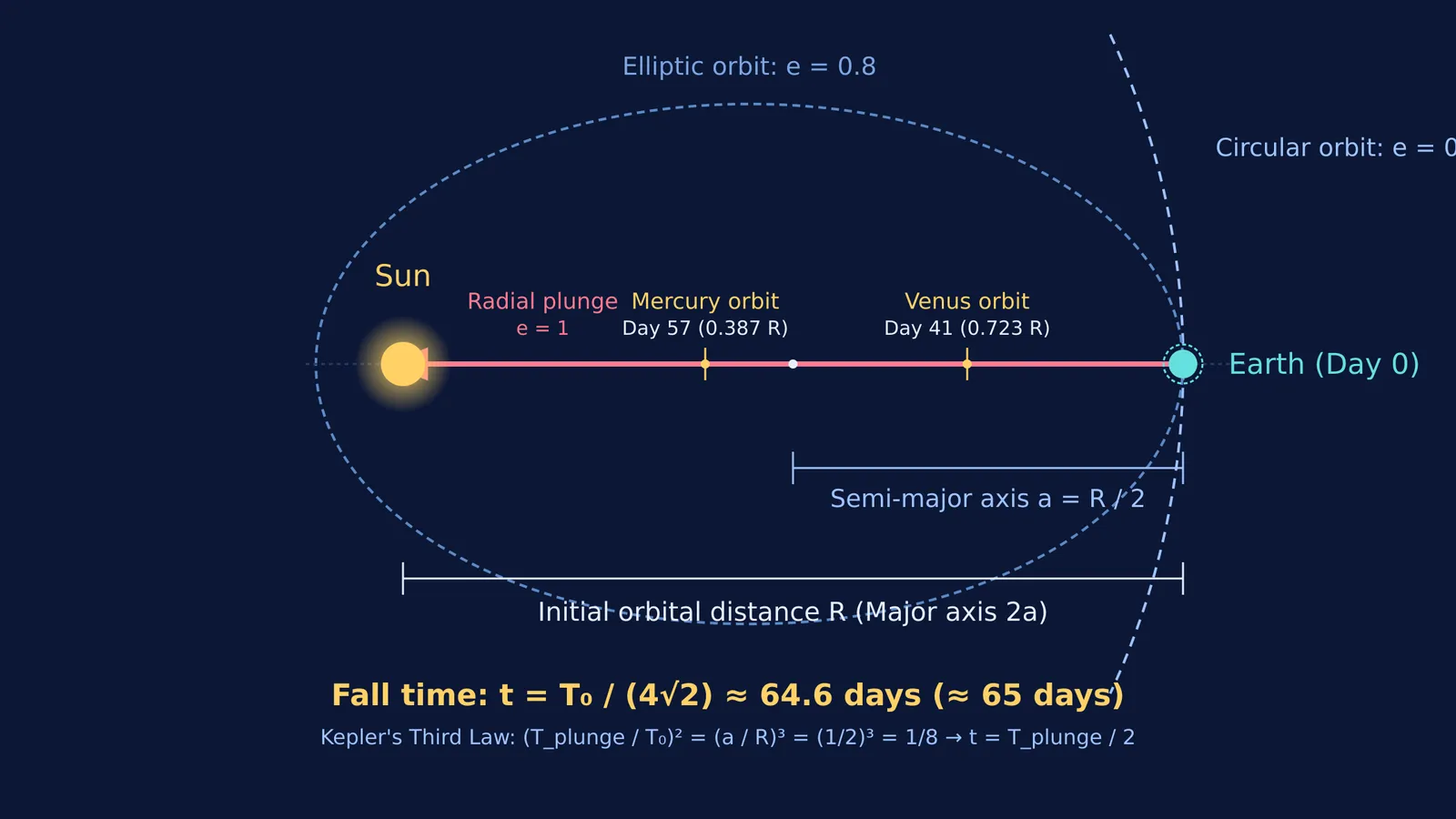
A straight-line drop from distance R is the limiting case of an ellipse whose eccentricity reaches e = 1, known as a degenerate elliptic trajectory. The farthest point (aphelion) is Earth's release position at R, while the closest point (perihelion) is r = 0 at the Sun's core.
Because the major axis spans from r = 0 to r = R, its total length is 2a = R. The semi-major axis of this squashed ellipse is simply a = R/2.
What is the step-by-step derivation of the 65-day fall?
With a = R/2, Kepler's third law solves the fall time using basic ratios. Let T₀ denote Earth's standard orbital period of 365.256 days (about 365.25 days) for its circular orbit of radius R, as given on the NASA Earth Fact Sheet.
Comparing the degenerate fall orbit to Earth's circular orbit using the free-fall time formula:
(T_orbit / T₀)² = (a / R)³ = ((R / 2) / R)³ = 1 / 8
Taking the square root gives the full orbital period:
T_orbit = T₀ / √8 = T₀ / (2√2)
A full orbit represents falling to the center, passing through, and returning. The actual one-way plunge to the Sun is exactly half of that period:
t_fall = T_orbit / 2 = T₀ / (4√2)
Substituting T₀ = 365.256 days:
t_fall = 365.256 / (4 × 1.414214) ≈ 64.57 days
Rounded to the nearest integer, the journey takes about 65 days.
When tackling classical mechanics problems for competitive examinations like JEE Advanced, transforming an unfamiliar differential equation into a known geometric limit is an essential skill. The Fermi Problem Library provides worked problems with a step-by-step solver that explains the reasoning rather than printing an answer, helping you master symmetry tricks and degenerate-case methods.
What would the timeline look like as Earth falls?
Because gravitational acceleration scales inversely with the square of distance, Earth accelerates continuously throughout its plunge:
Day 0 to Day 30: The descent begins slowly. Earth starts at 149.60 million km from the Sun according to the NASA Earth Fact Sheet. After 30 days, it has covered less than 15% of the distance.
Day 41: Earth crosses Venus's orbit at 108.21 million km (0.723 AU from the Sun), as recorded on the NASA Venus Fact Sheet. Solar radiation intensity more than doubles.
Day 57: Earth intersects Mercury's orbit at 57.91 million km (0.387 AU from the Sun), documented on the NASA Mercury Fact Sheet. Surface temperatures exceed 100 °C, boiling oceans away.
Day 64.5: Earth reaches the Sun's surface. The NASA Sun Fact Sheet lists the solar radius as 695,700 km and escape velocity as 617.6 km/s. The plunge through the solar radius takes under 3 hours, impacting at 617.6 km/s.
How can limiting cases simplify tough physics problems?
The squashed-ellipse method illustrates a central principle in physics: testing limiting cases. As discussed in our guides on Kepler's second law and areal velocity and gravitational potential energy calculations, spotting conserved quantities and geometric limits turns difficult calculus into direct arithmetic.
Visualising how an orbit flattens into a line segment as angular momentum vanishes builds genuine spatial intuition. On the Fermi Concept Library, which organizes every concept in physics, chemistry, biology, mathematics and computing, each with its own lesson and its place in the map, students can explore orbital mechanics from first principles.


