

On this page
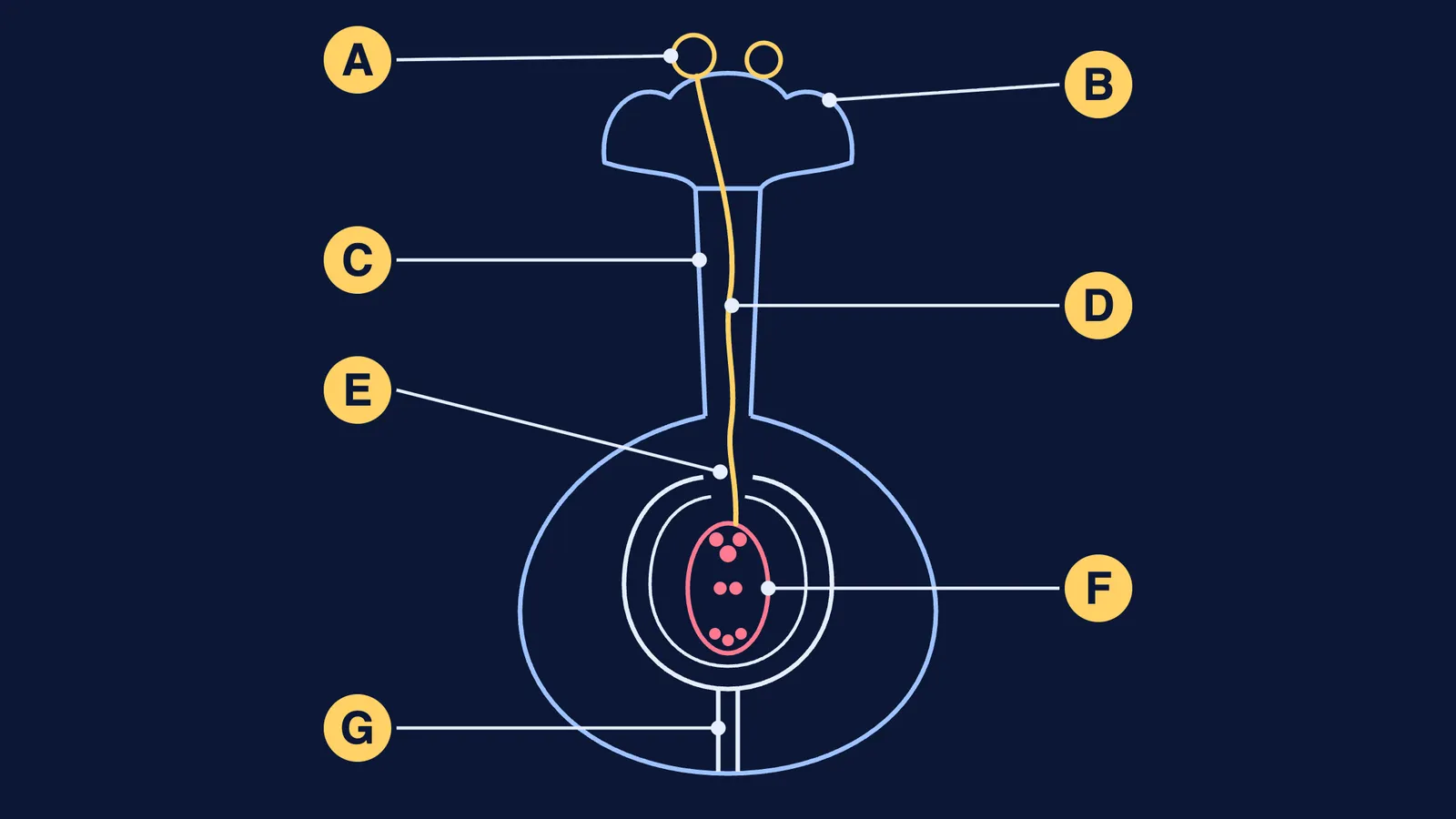
The schematic above shows a pistil after pollination, cut lengthwise, with seven parts marked A to G. Q1 to Q6 use those letters; Q7 to Q14 describe other figures of the chapter in words.
Where does this chapter sit in the NEET syllabus?
The syllabus notice for NEET (UG)-2026 places sexual reproduction in flowering plants at the head of Unit 6 (Reproduction) in Biology. The NEET (UG)-2026 information bulletin gives Biology 90 of the 180 questions, with +4 for a correct answer and −1 for a wrong one.
All 14 items are our own, not predictions. Every answer traces to NCERT's Class 12 Biology textbook, Chapter 1, Reprint 2026-27. New to it? Start with our NEET preparation plan for this chapter.
How do you read a NEET diagram question?
Fix one anchor letter you are sure of, such as where pollen lands.
Follow the path: in a pistil, the pollen tube runs top to bottom, so letters on it come in order.
Trace each leader line to its dot, not to the nearest shape.
Then strike out every option that mislabels your anchor.
Questions on the lettered pistil (Q1 to Q6)
Q1. Which letter marks the female gametophyte? (1) A (2) E (3) F (4) G
Q2. Match the letter with its description. List-I: A, B, C, G. List-II: (i) Slender part below the stigma (ii) Connects the ovule body to the placenta (iii) Male gametophyte (iv) Platform on which pollen lands (1) A-iii, B-iv, C-i, G-ii (2) A-iv, B-iii, C-i, G-ii (3) A-iii, B-i, C-iv, G-ii (4) A-ii, B-iv, C-i, G-iii
Q3. Statement I: D comes out of A through one of its germ pores. Statement II: After passing E, D enters F through one of the antipodal cells. (1) Both true (2) Both false (3) Only I true (4) Only II true
Q4. The species in the figure sheds pollen at the 3-celled stage. What does D contain as it grows through C? (1) Only a vegetative cell (2) Two male gametes from the start (3) A generative cell that divides inside F (4) The two polar nuclei
Q5. After fertilisation, which lettered part survives as a tiny opening in the seed coat? (1) B (2) G (3) F (4) E
Q6. Everything from pollen landing on B until D enters the ovule is called: (1) Double fertilisation (2) Microsporogenesis (3) Pollen-pistil interaction (4) Emasculation
Questions on figures described in words (Q7 to Q14)
How to attack two-statement items: mark each statement T or F on its own, then convert the pair to an option.
Q7. Young anther, T.S. Statement I: It is four-sided, with a microsporangium at each corner, two per lobe. Statement II: In each young microsporangium, the centre is filled by compact, uniform cells called sporogenous tissue. (1) Both true (2) Both false (3) Only I true (4) Only II true
Q8. In an enlarged microsporangium, which order of wall layers runs from outside to inside? (1) Endothecium, epidermis, tapetum, middle layers (2) Epidermis, endothecium, middle layers, tapetum (3) Epidermis, tapetum, middle layers, endothecium (4) Tapetum, middle layers, endothecium, epidermis
Q9. In an anatropous ovule, which food-rich tissue inside the integuments holds the embryo sac? (1) Funicle (2) Nucellus (3) Chalaza (4) Placenta
Q10. Mature embryo sac. Statement I: Of its eight nuclei, six are walled off into cells. Statement II: The three antipodal cells are grouped at the micropylar end. (1) Both true (2) Both false (3) Only I true (4) Only II true
How to attack match-the-list: mark the row you are surest of, keep only codes that agree, then test one more row.
Q11. Fertilised embryo sac: match each structure with its feature. List-I: P. Zygote Q. Primary endosperm nucleus R. Primary endosperm cell S. Synergid. List-II: (i) Triploid nucleus formed by triple fusion (ii) Receives the two male gametes (iii) Diploid, from syngamy (iv) What the central cell becomes after triple fusion (1) P-iii, Q-i, R-iv, S-ii (2) P-i, Q-iii, R-iv, S-ii (3) P-iii, Q-iv, R-i, S-ii (4) P-iii, Q-i, R-ii, S-iv
Q12. In a typical dicot embryo, the cylindrical axis below the cotyledons and the tip it ends in are: (1) Epicotyl, plumule (2) Hypocotyl, plumule (3) Hypocotyl, radicle (4) Epicotyl, radicle
Q13. L.S. of a grass embryo: match each part with its description. List-I: P. Scutellum Q. Coleorrhiza R. Coleoptile S. Epicotyl. List-II: (i) Hollow foliar structure around the shoot apex (ii) The single cotyledon, placed to one side (iii) Axis above the level where the cotyledon attaches (iv) Sheath around the radicle and root cap (1) P-ii, Q-i, R-iv, S-iii (2) P-ii, Q-iv, R-i, S-iii (3) P-iii, Q-iv, R-i, S-ii (4) P-ii, Q-iv, R-iii, S-i
Q14. Which sequence of dicot embryo stages is right? (1) Globular, proembryo, heart-shaped, mature (2) Proembryo, heart-shaped, globular, mature (3) Proembryo, globular, heart-shaped, mature (4) Heart-shaped, globular, proembryo, mature
Answer key for the lettered diagram
A pollen grain, B stigma, C style, D pollen tube, E micropyle, F embryo sac, G funicle.
Answers with NCERT reasons
(3). The embryo sac is the female gametophyte.
(1). Pollen grains are male gametophytes; the funicle joins ovule to placenta.
(3). The tube enters a synergid through the filiform apparatus, not an antipodal.
(2). With 3-celled pollen, the tube carries both male gametes from the beginning.
(4). The micropyle remains as a pore that lets oxygen and water in at germination.
(3). NCERT groups these events as pollen-pistil interaction.
(1). Both match NCERT's account of the young anther.
(2). The tapetum is the innermost layer.
(2). Nucellus cells have abundant reserve food and contain the embryo sac.
(3). Six nuclei become cells; the antipodals sit at the chalazal end.
(1). Syngamy gives the diploid zygote; triple fusion gives the triploid PEN, and the central cell becomes the PEC.
(3). The hypocotyl ends in the radicle; the epicotyl ends in the plumule.
(2). The scutellum is the grass cotyledon; the coleoptile encloses the shoot apex.
(3). Proembryo comes first, then globular and heart-shaped stages.
What should you do with your mistakes?
Redraw the figure behind each miss from memory and letter it yourself. For other formats, try our statement and match-the-list set on this chapter and the solved NEET practice questions.
Pistil clear, grass embryo still hazy? Fermi's AI tutor works out what you already know and builds a plan for the session.


