

On this page
Oxygen and sulphur sit right next to each other in Group 16 of the periodic table, yet they look completely different in the real world. You breathe oxygen as a colourless, diatomic gas (O₂), but you are likely to see sulphur as a crumbly, bright yellow solid (S₈).
While they share the same number of valence electrons, their behaviour diverges sharply. The reason for this difference comes down to atomic size, orbital overlap, and the type of bonds these atoms prefer to form.
Why does oxygen form O₂?
Oxygen is a period 2 element, making it a very small atom. When two oxygen atoms come together, their small size allows their 2p orbitals to overlap effectively side-by-side.
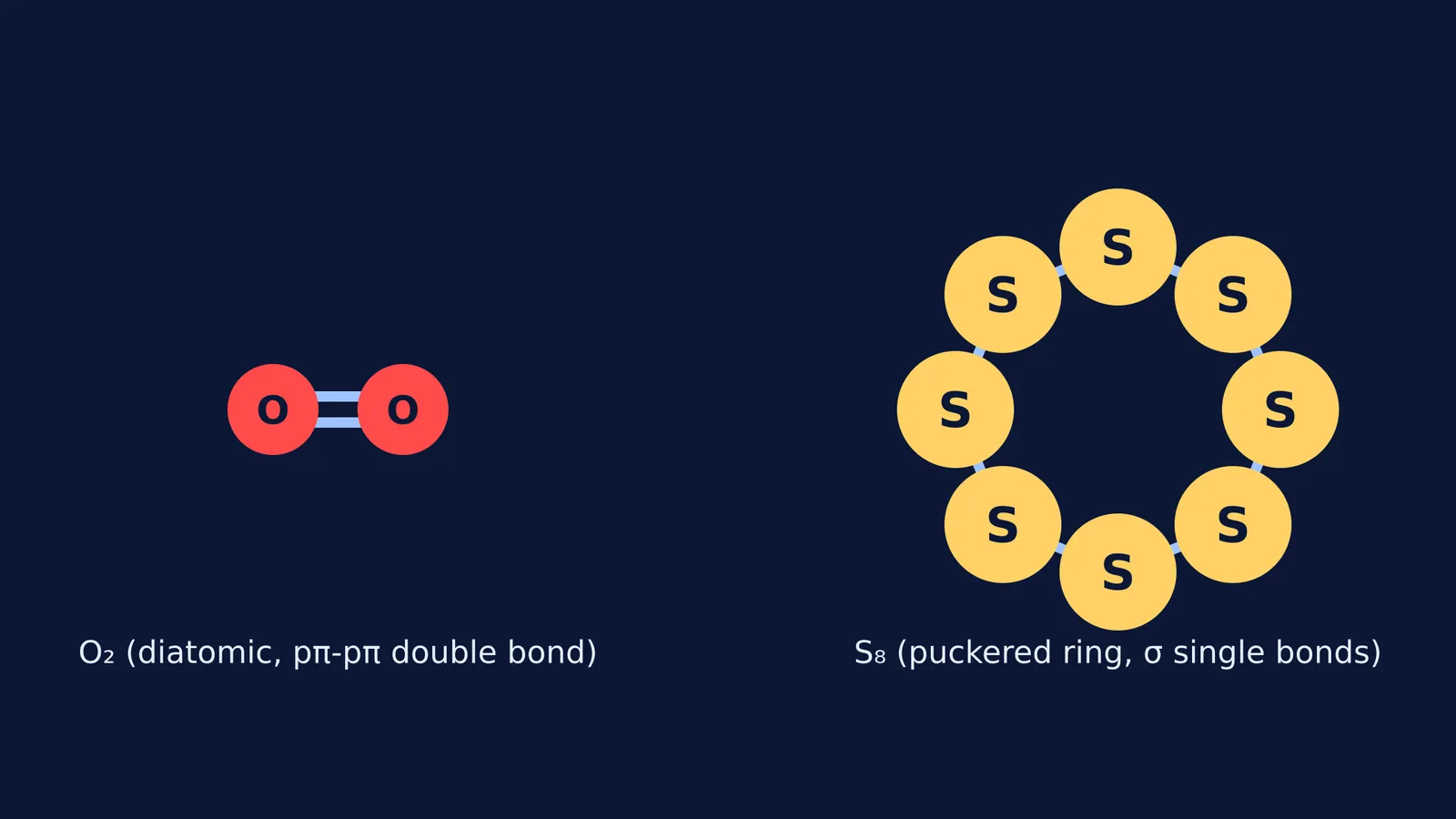
This efficient overlap creates a strong pπ-pπ double bond (O=O) with a high bond energy of 498 kJ/mol. Because this double bond makes the molecule very stable on its own, oxygen does not need to link up with any other atoms to complete its octet. It exists as a simple, stable diatomic molecule.
Small molecules like O₂ have a tiny surface area, meaning they exert very weak van der Waals forces on one another. This lack of intermolecular attraction is why oxygen remains a gas at room temperature.
If orbital overlaps and pi bonds are hard to picture from a flat textbook diagram, the Fermi Simulation Lab has interactive simulations for the ideas that are easier to see than to read.
Why does sulphur form S₈ instead of S₂?
Sulphur is a period 3 element, meaning its atom is significantly larger than an oxygen atom. Its outermost electrons sit in 3p orbitals, which are larger, more diffuse, and spread further from the nucleus.
When two sulphur atoms try to form a double bond, they simply cannot get close enough for a good side-by-side overlap. As a result, a pπ-pπ double bond is weak and not thermodynamically stable for sulphur at standard temperatures.
A diatomic S₂ gas does exist, but only when immense heat forces the atoms apart at temperatures above 720 °C. At room temperature, rather than forcing a weak double bond, sulphur atoms choose a much more stable route: they prefer to form single bonds (σ-bonds).
Why does sulphur form a puckered ring?
Sulphur solves its bonding problem through catenation, which is the tendency of atoms of the same element to link up with themselves into long chains or rings.
While its double bonds are weak, sulphur forms remarkably strong S–S single bonds with a bond energy of approximately 265 kJ/mol.
You might wonder why oxygen does not also form long chains of single bonds. The answer again comes back to size. If oxygen atoms try to link via single bonds, their incredibly small radii force their non-bonding electron pairs (lone pairs) too close together. These lone pairs repel each other strongly, making an O–O single bond inherently weak and unstable. Sulphur is large enough to space those lone pairs out safely, virtually eliminating the repulsion.
To satisfy each atom's need for two bonds, the sulphur chain eventually closes into a ring. The most stable arrangement is an eight-atom, puckered "crown" shape known as cyclo-octasulphur (S₈).
Because an S₈ molecule is eight times heavier and has a vastly larger surface area compared to O₂, the van der Waals forces between these rings are much stronger. These stronger intermolecular forces pull the heavy rings together, packing them tightly into a solid crystalline structure at room temperature.
How does this explain other Group 16 trends?
This pattern of small atoms forming double bonds and larger atoms preferring single bonds runs through the rest of the p-block. You can find this entire family mapped out in the Fermi Concept Library, which contains every concept in physics, chemistry, biology, mathematics and computing, each with its own lesson and its place in the map.
Understanding these size differences is also the key to unlocking other Group 16 mysteries. For example, similar size-based rules explain comparing bond angles in NH₃ vs PH₃ and H₂O vs H₂S. Furthermore, mastering sulphur's unique reactivity is a foundation for understanding major industrial topics like the Contact process for sulphuric acid.
Quick comparison checklist
If you need to contrast these elements for a quick exam answer or a practical viva, check these four points:
Bond type: Oxygen relies on pπ-pπ double bonds; sulphur relies on σ single bonds.
Molecule size: Oxygen is a simple diatomic molecule (O₂); sulphur is a large polyatomic molecule (S₈).
Catenation: Oxygen rarely catenates due to intense lone-pair repulsion; sulphur catenates readily to form rings.
Physical state: O₂ is a gas due to weak van der Waals forces; S₈ is a solid because its larger molecules create stronger intermolecular attractions.


