

On this page
In 1922, the chemist Karl Rast published a micro-analytical technique that changed how laboratories measured molecular weight (10.1002/cber.19220550429). By dissolving an unknown solid in camphor rather than water, he found he could measure the freezing point depression using an ordinary thermometer instead of highly fragile, specialized equipment.
What is the Rast method?
The method relies on cryoscopy, or freezing-point depression. When you add a non-volatile solute to a pure solvent, the solvent's freezing point drops. This is a colligative property, meaning the drop in temperature depends only on the number of solute particles dissolved, not on what those particles are.
The equation for freezing-point depression (ΔTf) is: ΔTf = Kf × m
Here, Kf is the cryoscopic constant of the solvent, and m is the molality of the solution.
Why does the freezing point drop?
At a fundamental level, freezing-point depression is driven by vapor pressure and entropy (Wikipedia). For any liquid to freeze into a solid, the vapor pressure of the liquid phase must exactly equal the vapor pressure of the solid phase. When you add a non-volatile solute to a solvent, it lowers the liquid's vapor pressure according to Raoult's Law.
Because the solute only remains in the liquid phase and does not pack into the growing crystal lattice, the vapor pressure of the solid solvent is unchanged. To reach a new state of equilibrium where the vapor pressures match again, the entire system must be cooled to a lower temperature. From an energy perspective, a liquid solution has higher entropy (randomness) than a pure liquid. This extra randomness makes the solution more stable, so it requires a deeper drop in thermal energy to force the molecules into a rigid, ordered solid structure.
The trouble with water and the Beckmann thermometer
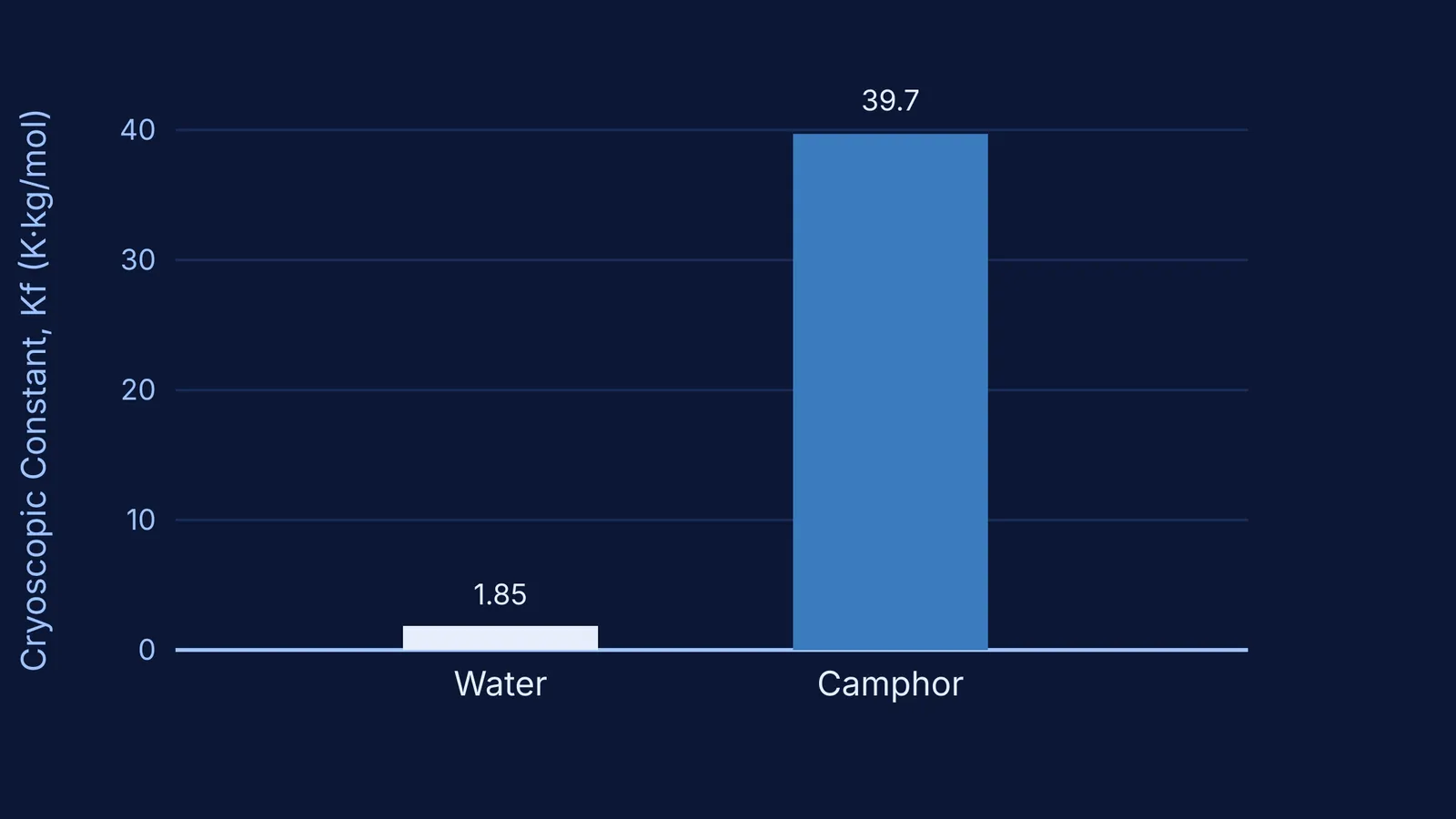
At the turn of the 20th century, cryoscopy was a primary analytical tool taught in university laboratories (Wikipedia). However, common solvents presented a major practical challenge. If you dissolve a substance in water, the freezing point drops by just 1.853 K for every mole of solute per kilogram of water (Wikipedia).
Measuring such a microscopic change required a highly fragile and complex instrument known as the Beckmann thermometer (Wikipedia). Invented by Ernst Otto Beckmann, this specialized mercury-in-glass thermometer was built with a large bulb and a top reservoir. It did not measure absolute temperature but was tuned to track temperature differences as small as 0.001 °C. A typical experiment required a complex setup with a test tube, an air jacket, a cooling bath, and constant stirring to prevent supercooling.
Why use camphor for molar mass?
Karl Rast bypassed the need for delicate equipment entirely. Camphor has a massive cryoscopic constant of 39.7 K·kg/mol (Wikipedia). A change that would drop water's freezing point by just 0.2 K drops camphor's freezing point by nearly 4.3 K. Because the depression is so dramatically amplified, an ordinary laboratory melting-point apparatus with a standard thermometer suffices to record the change accurately.
In a Rast determination, the chemist simply weighs the pure camphor and the unknown solute, melts them together to form a uniform mixture, allows it to cool and solidify, and then records the new melting point using a standard capillary tube method.
How to calculate molar mass using the Rast method?
The formula for molar mass (M) using freezing-point depression is:
M = (Kf × w × 1000) / (ΔTf × W)
Where:
Kf is the cryoscopic constant of camphor (39.7 K·kg/mol, Wikipedia).
w is the mass of the unknown solute in grams.
W is the mass of the camphor solvent in grams.
ΔTf is the depression in freezing point.
Worked example
Suppose you add 0.52 g of an unknown organic compound to 20.0 g of molten camphor. The pure camphor melts at 179.8 °C (Wikipedia), and the mixture melts at 173.3 °C.
First, find the freezing point depression: ΔTf = 179.8 − 173.3 = 6.5 K
Next, plug the values into the formula: M = (39.7 × 0.52 × 1000) / (6.5 × 20.0) M = 20644 / 130 M = 158.8 g/mol
The unknown compound has a molar mass of 158.8 g/mol.
If you are stuck on colligative property calculations, the Fermi Problem Library has worked problems with a step-by-step solver that explains the reasoning rather than printing an answer. For a deeper dive into the theory, the Fermi Concept Library contains every concept in physics, chemistry, biology, mathematics and computing, each with its own lesson and its place in the map.


