On this page
For most of history, people assumed light arrives instantly. In 1676 a 32-year-old Danish astronomer in Paris, Ole Rømer, showed that it does not, using nothing more than a telescope, a good clock and patience with Jupiter's innermost moon. This post explains what he saw, why the timings drifted, how to turn his 22 minutes into a speed, and what his reasoning can teach you about evidence.
Who was Ole Rømer?
The Danish encyclopedia Lex, in an entry by Claus Thykier, gives his dates as 25 September 1644 in Aarhus to 19 September 1710 in Copenhagen. He studied astronomy at the University of Copenhagen under Rasmus Bartholin. In 1671 the French astronomer Jean Picard came to Denmark, was impressed by Rømer's precise work, and took him to Paris in 1672, where he joined the Académie des sciences and lived at the new Observatory.
Rømer returned home in 1681 as professor of astronomy and director of the observatory in the Round Tower (Rundetaarn). He also built instruments, reformed Denmark's weights and measures, and served as Copenhagen's police chief and mayor. Lex notes that his idea of using the freezing and boiling points of water as fixed points inspired Daniel Fahrenheit; that story is in our post on Fahrenheit and the mercury thermometer. Most of his observations were lost in the Copenhagen fire of 1728.
How did Jupiter's moon show that light takes time?
The Royal Society printed an English version of the Paris report in 1677 as A demonstration concerning the motion of light. You can read the scanned pages in the Internet Archive copy.
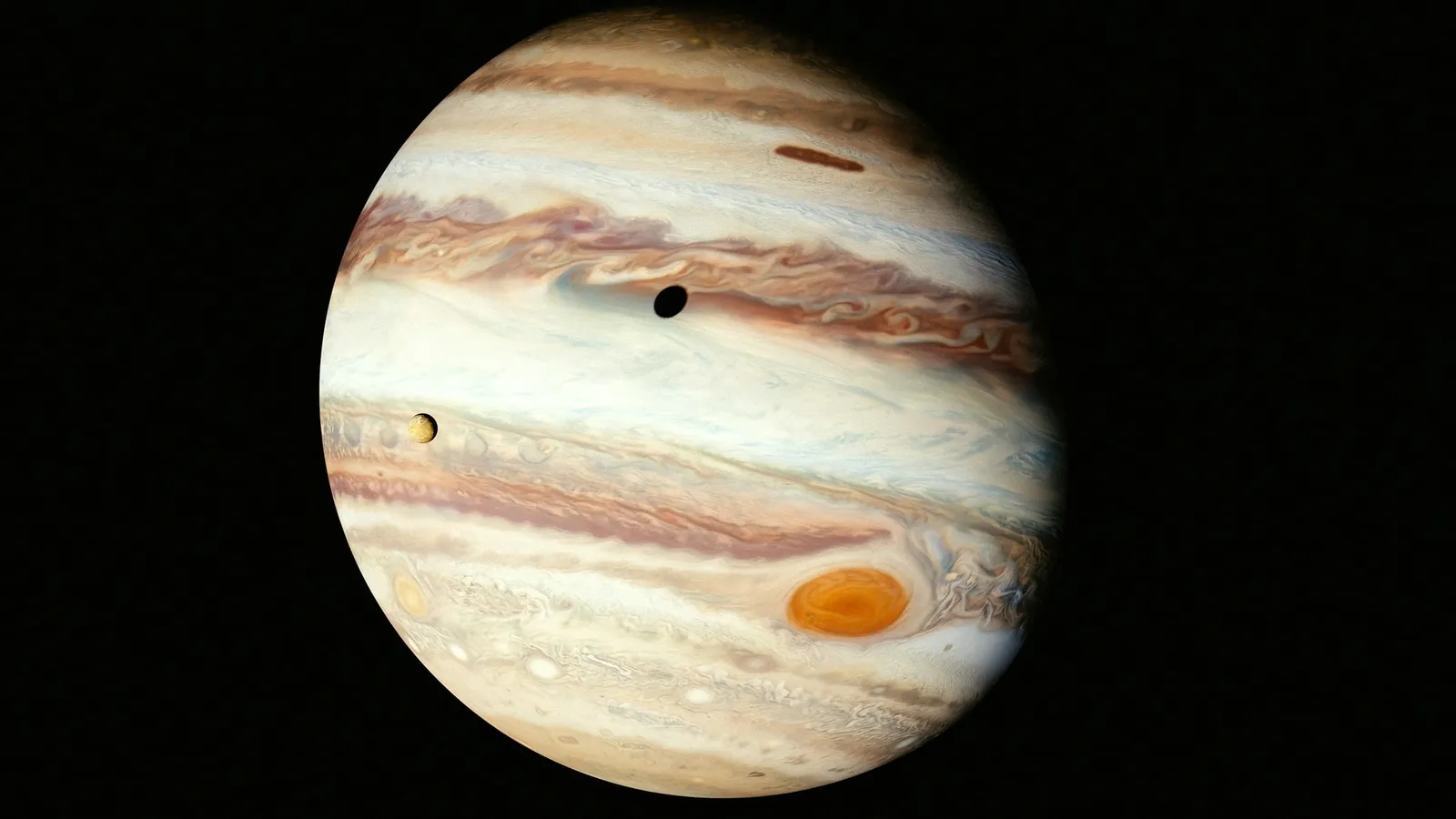
Jupiter's first satellite, the moon now called Io, goes round Jupiter in about 42½ hours and disappears into Jupiter's shadow on every orbit. Astronomers can time the moment it enters the shadow (an immersion) or comes out of it (an emersion). If light took no time, those moments would arrive like clockwork.
Rømer's point was this. When Earth is moving away from Jupiter, each new emersion has to travel a little further to reach us, so the orbits seem longer. When Earth is moving towards Jupiter, they seem shorter. Over a single orbit the difference is too small to notice. Over forty orbits it adds up.
The report says the effect had been confirmed by eight years of observations at the Academy and the Observatory. Then came the test. Rømer told the Academy from the beginning of September that the emersion of 9 November would come later than predicted from the August timings, when Earth was much nearer to Jupiter. It came at 5 h 35 min 45 s at night, as the report puts it, 10 minutes late. He also showed that the known irregularities of the moon's orbit could not explain the delay.
How do you turn 22 minutes into a speed?
The report says light needs about 22 minutes for the whole width of Earth's orbit, which is twice the distance from Earth to the Sun. Rømer gave a time, not a speed, but you can work one out.
Distance. Earth's average distance from the Sun is about 149.6 million km, according to NASA's Earth fact sheet. The orbit's diameter is 2 × 1.496 × 10¹¹ m = 2.99 × 10¹¹ m.
Time. 22 minutes = 22 × 60 = 1,320 s.
Speed. c = 2.99 × 10¹¹ / 1,320 = 2.27 × 10⁸ m/s.
Now run it backwards with today's exact value of 299,792,458 m/s: 2.99 × 10¹¹ / 3.00 × 10⁸ = 998 s, about 16.6 minutes. Rømer's time was too long by roughly a third, but the conclusion that light has a finite speed was right.
Here is a second check, on why one orbit was not enough. Earth moves at about 29.8 km/s (same NASA sheet). In 42.5 hours, or 153,000 s, it can move at most about 29.8 × 153,000 = 4.6 million km further from Jupiter. Light needs 4.6 × 10⁹ / 3.0 × 10⁸ ≈ 15 s to cover that. A 15-second drift is hard to spot in one eclipse, but forty of them add up to about 10 minutes, which matches what Rømer saw.
Common mistakes:
Using one Earth-Sun distance with the full 22 minutes. The 22 minutes is for the diameter of the orbit, two Earth-Sun distances.
Forgetting the direction. The delay grows only while Earth moves away from Jupiter; when Earth approaches, the timings run early.
Treating a historical number as exact. Rømer's timings and the orbit size known in his day both carried errors.
The next step in the story came in 1849, when light was timed on Earth for the first time; see Fizeau and the first Earth-based speed of light.
What can a student learn from Rømer's way of working?
Look for small effects that add up. One eclipse showed nothing; forty showed the answer. When a result is tiny, collect more cycles rather than staring harder at one.
Rule out other explanations. He checked the moon's orbital irregularities before claiming light was the cause.
Make a prediction you could get wrong. Announcing the November delay in September put his idea at real risk.
Keep careful records. His findings rested on eight years of timings. Your own log of solved and missed questions works the same way.
If a long multi-step calculation like this is where you lose marks, the Fermi Problem Library has worked problems with a step-by-step solver that explains the reasoning rather than printing an answer.
Try this today: redo the speed calculation using 16.6 minutes, then work out how many minutes Rømer's 22 would mean for light to travel from the Sun to Earth.