On this page
In 1963 an astronomer at Caltech looked at the spectrum of a "star" called 3C 273 and realised it was nothing of the sort. Maarten Schmidt had found the first quasar: the blazing core of a galaxy so far away that its light has travelled for billions of years to reach us. Here is what a quasar is, why it shines so fiercely, and how to redo the arithmetic behind Schmidt's discovery yourself.
What is a quasar?
A quasar is a ferociously bright, faraway object powered by a supermassive black hole, as Caltech puts it in its obituary of Maarten Schmidt. Those black holes sit at the hearts of galaxies: most large galaxies have supermassive black holes at their centres, says NASA.
The name is short for "quasi-stellar", meaning star-like, because in a telescope a quasar looks like a single point of light; NASA calls 3C 273 the first quasar (quasi-stellar object) ever discovered.
Quasars can emit hundreds or even thousands of times the entire energy output of our galaxy, according to ESA/Hubble. The same page says 3C 273 is the brightest quasar in our skies, and that its light has taken about 2.5 billion years to reach us.
How can a black hole outshine a whole galaxy?
The black hole itself gives out no light. The light comes from gas around it. Black holes can be surrounded by rings of gas and dust called accretion discs, which emit light across many wavelengths, including X-rays. As gas spirals inward it moves faster and faster, rubs against neighbouring gas and heats up until it glows.
The trick is efficiency. Accretion into a black hole can turn about 10 percent of the infalling mass into radiation, as astrophysicist M. J. Rees wrote in Accretion and the Quasar Phenomenon. Compare that with the process that powers stars: a helium nucleus has 0.7% less mass than four hydrogen nuclei, so fusion releases only 0.7% of the fuel's mass as energy.
Put numbers in using E = mc², with c = 3 × 10⁸ m/s:
1 kg of gas falling into a black hole at 10%: 0.1 × 1 × (3 × 10⁸)² = 9 × 10¹⁵ J.
1 kg of hydrogen fused into helium at 0.7%: 0.007 × 9 × 10¹⁶ = 6.3 × 10¹⁴ J.
Ratio: 10 ÷ 0.7, so about 14 times more energy per kilogram from falling than from fusing.
Feed a supermassive black hole enough gas and that extra energy per kilogram lets one small region outshine every star in its galaxy combined.
See how the first black hole image was taken, and who coined the term black hole.
What did Maarten Schmidt discover in 1963?
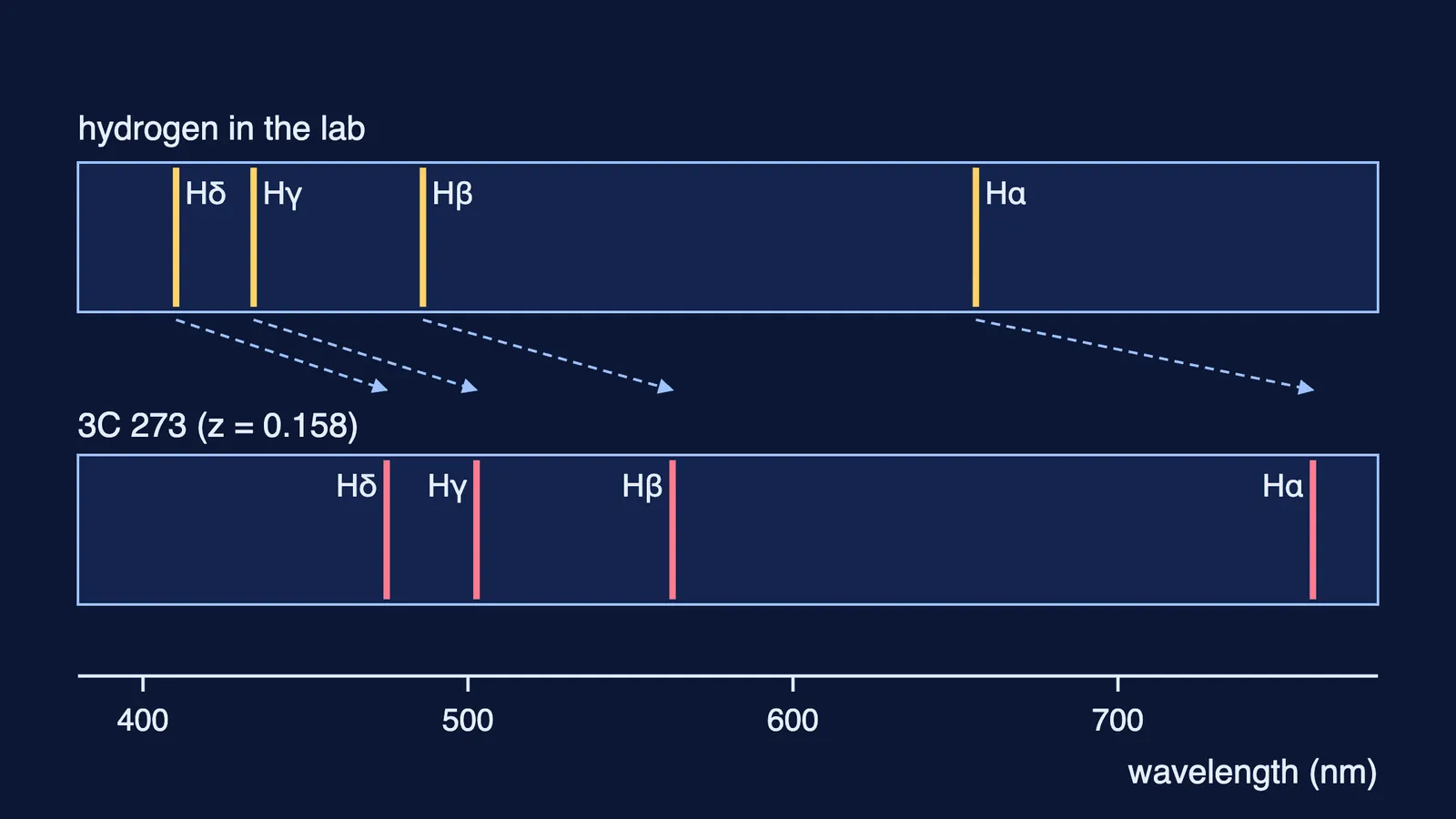
Schmidt spent a couple of nights pointing Caltech's 200-inch Hale Telescope at 3C 273 and captured its spectrum, according to Caltech. The object appeared to be a star but was much brighter. Then he saw what its lines really were: the spectral signature of hydrogen, shifted towards the red, from an object travelling away from us at 30,000 miles per second.
He published the result in Nature as 3C 273: A Star-Like Object with Large Red-Shift on 16 March 1963. The redshift was z = 0.158, which showed the object was at a cosmological distance and had an extremely large luminosity, as the Max Planck Institute for Extraterrestrial Physics summarised. For how earlier galaxy redshifts revealed the expanding universe, read Milton Humason's story. Schmidt died on 17 September 2022, aged 92.
How do you calculate a redshift like Schmidt's?
Redshift is defined as z = (λ observed − λ rest) ÷ λ rest, so λ observed = λ rest × (1 + z). You can check the arithmetic with the hydrogen wavelengths listed by NIST: Hβ at about 486.1 nm and Hα at about 656.3 nm.
Hβ: 486.1 × 1.158 = 562.9 nm. A blue-green hydrogen line now sits in the green-yellow, where nobody expected hydrogen.
Hα: 656.3 × 1.158 = 760.0 nm, pushed to the very edge of what the eye can see.
Check the pattern: 656.3 ÷ 486.1 = 1.350 and 760.0 ÷ 562.9 = 1.350. Every line moves by the same factor, so the ratios survive, and that fingerprint still says hydrogen.
Speed: for small z, v ≈ cz = 0.158 × 300,000 km/s ≈ 47,400 km/s. Caltech's 30,000 miles per second is about 48,000 km/s, so the two agree.
This one calculation uses three topics from your syllabus: the Bohr model's hydrogen lines, the Doppler effect and E = mc². If you get stuck choosing which formula applies, the Fermi Problem Library has worked problems with a step-by-step solver that explains the reasoning rather than printing an answer. For wave shifts that are easier to see than to read, try the Fermi Simulation Lab.
Next time you read "z = 0.158", multiply one hydrogen line by 1.158 and you will have done the arithmetic at the heart of Schmidt's 1963 result.