On this page
On 10 April 2019, the Event Horizon Telescope collaboration published the first image of a black hole: a lopsided bright ring around a dark centre, in the galaxy M87. Radio telescopes thousands of kilometres apart were made to behave like one dish the size of Earth.
How was the first black hole image taken?
The Event Horizon Telescope (EHT) linked eight existing radio telescopes on high sites in Hawaii, Arizona, Mexico, Spain, Chile and Antarctica, according to the ESO press release. The black hole is 55 million light-years away and has a mass 6.5 billion times that of the Sun, the release says.
The telescopes watched M87 during a campaign on 5 to 11 April 2017 (EHT Paper III).
Each recorded radio waves at a wavelength of 1.3 mm, time-stamped by a hydrogen maser atomic clock (ESO).
Each telescope produced roughly 350 terabytes of data per day on hard drives, which were flown to supercomputers called correlators at the Max Planck Institute for Radio Astronomy in Germany and MIT Haystack Observatory in the US (ESO).
The correlators combined the recordings, and computational tools developed by the collaboration turned the result into an image (ESO).
Why did it need an Earth-sized telescope?
Angular resolution is roughly wavelength divided by telescope diameter, θ ≈ λ/D, the same λ/D behind the width of the single-slit central maximum.
The EHT's angular resolution at 1.3 mm is about 25 micro-arcseconds (EHT Paper II). A micro-arcsecond is a millionth of an arcsecond, and an arcsecond is 1/3600 of a degree.
The ring around M87's black hole measures 42 ± 3 micro-arcseconds across (EHT Paper I).
How big would a single dish need to be?
Take λ = 1.3 × 10⁻³ m and 1 radian = 206,265 arcseconds.
A 30 m dish, the size of the IRAM telescope in Spain that took part (ESO): θ = 1.3 × 10⁻³ / 30 = 4.3 × 10⁻⁵ rad, about 9 arcseconds. Its blur is more than 200,000 times wider than the 42-micro-arcsecond ring (EHT Paper I).
A dish 10,000 km across: θ = 1.3 × 10⁻³ / 10⁷ = 1.3 × 10⁻¹⁰ rad, about 27 micro-arcseconds. Now the ring shows.
Run it backwards and 25 micro-arcseconds needs D ≈ 10,700 km, close to the width of Earth. Nobody can build that dish, so the EHT spread its telescopes over distances comparable to Earth's diameter (EHT Paper II).
How can separate dishes act as one telescope?
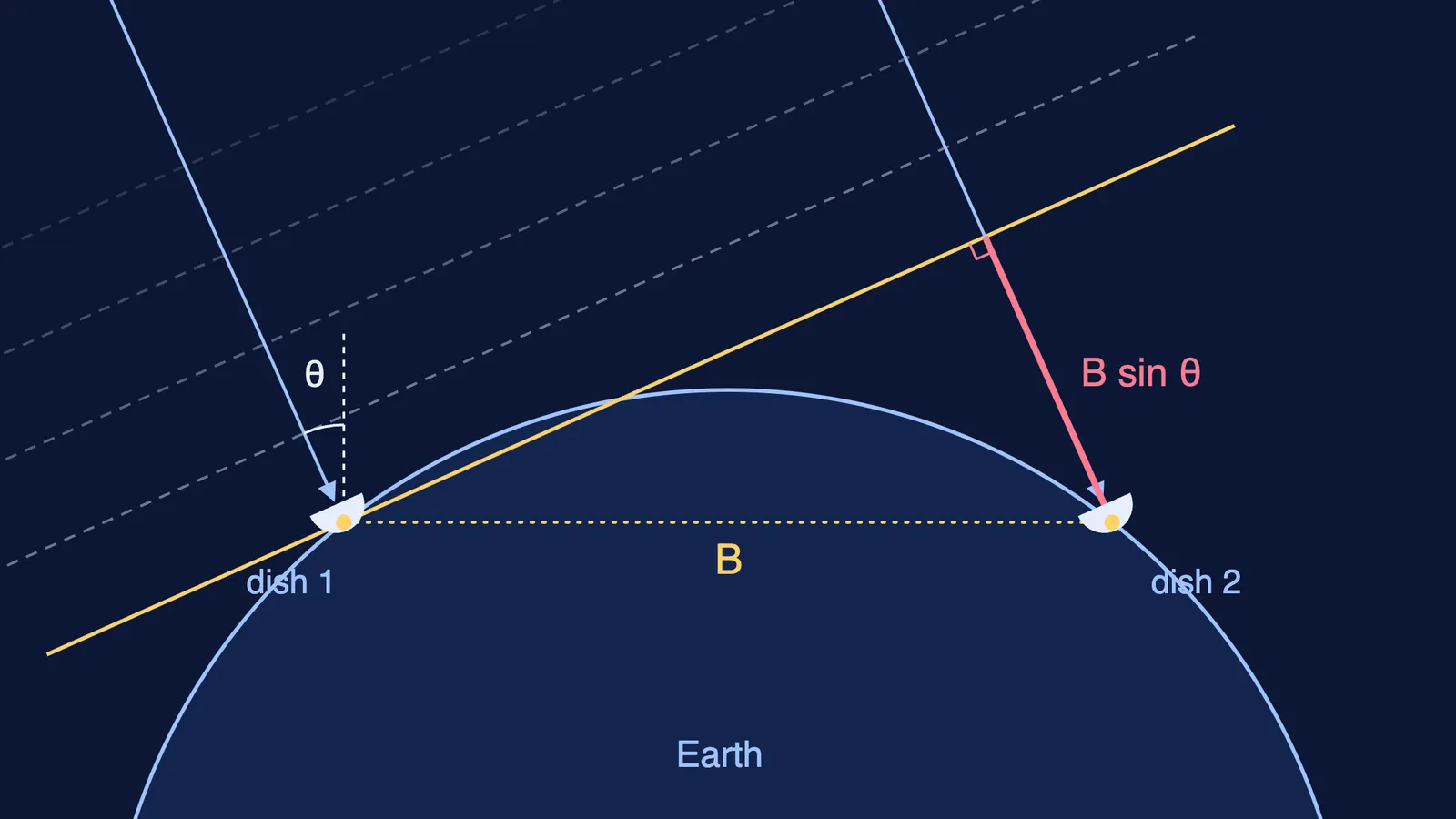
The technique is called very long baseline interferometry. A wave from M87 reaches two telescopes at slightly different times. If they are a distance B apart and the source sits at angle θ from the line perpendicular to the baseline, the wave travels an extra B sin θ to reach the farther one.
Once that delay is removed, how strongly they reinforce or cancel carries information about the source's shape, just as constructive and destructive interference depend on path difference. Each pair of telescopes measures one piece of the picture; longer baselines hold finer detail.
With B = 10,000 km and θ = 30°, the extra path is 5,000 km, a delay of about 17 milliseconds. Yet one cycle of a 1.3 mm wave lasts about 4 picoseconds. To keep recordings from distant sites coherent, the array deployed hydrogen maser frequency standards (EHT Paper II).
Eight telescopes make 28 pairs. The EHT also uses the rotation of the Earth to build its Earth-size telescope (ESO): as the planet turns, each pair's baseline seen from M87 changes and samples new pieces. The team checked that the ring appeared with different calibration and imaging methods and stayed stable across four observations on different days (EHT Paper I).
What does the black hole image actually show?
You are not seeing the black hole itself. According to EHT Paper I, the dark centre is a shadow caused by gravity bending light and the event horizon capturing photons. The ring is radio emission, and the centre is at least ten times dimmer than it. The paper says the brighter side can be explained by relativistic beaming from plasma rotating close to the speed of light. The image is consistent with general relativity's prediction for the shadow of a spinning black hole.
How can you use this in your physics prep?
Try these, comparing each answer with the 42-micro-arcsecond ring (EHT Paper I):
Visible light at 500 nm through a 2.4 m mirror: θ = 2.1 × 10⁻⁷ rad, about 0.04 arcseconds, still about 1,000 times coarser than the ring.
Two telescopes 6,000 km apart, source 45° from the line perpendicular to the baseline: extra path about 4,240 km, delay about 14 milliseconds.
In Young's double slit, fringes crowd closer as the slits move apart. Why does that match longer baselines seeing finer detail?
If waves adding and cancelling still feels abstract, the Fermi Simulation Lab has interactive simulations for ideas that are easier to see than to read. For more λ/D numericals, the Fermi Problem Library has a step-by-step solver that explains the reasoning rather than printing an answer.