On this page
In short
Milton Humason dropped out of school at 14 and worked as a mule driver and janitor at Mount Wilson before being promoted to the scientific staff. His painstaking redshift observations of faint galaxies provided the data Edwin Hubble used to prove the universe is expanding.
Many of the greatest breakthroughs in physics come from people who followed an unusual path. Milton Humason is perhaps the finest example. He did not have a university degree, yet his astronomical observations fundamentally changed our understanding of the cosmos.
If you are a student studying for competitive exams like JEE Main or NEET-UG, the pressure to follow a rigid, perfect timeline is immense. A single bad semester or a low mock test score can feel like the end of the road. Humason's story proves that meticulous skill, practical competence, and extreme patience matter far more than where you start.
Who was Milton Humason?
Milton Humason dropped out of school at the age of 14 (Wikipedia). Drawn by a love for the mountains, he moved to California and took a job as a mule driver. He spent his days leading teams of pack animals that carried heavy steel components and delicate optical equipment up the steep, treacherous trails of Mount Wilson to build the new observatory.
After the observatory was constructed, he briefly left to work on a ranch, but the pull of the mountain was too strong. Humason returned to Mount Wilson in 1917, accepting a job as a janitor. Fascinated by the massive telescopes, he began volunteering as a night assistant. His natural mechanical talent, steady hands, and meticulous nature quickly became apparent.
He was so skilled at handling the complex instruments that the observatory director, George Ellery Hale, noticed him. In 1919, Hale made a decision that shocked many of the formally educated astronomers: he appointed the former janitor to the scientific staff. Humason had no high school diploma and no Ph.D., but he was about to make history.
What is redshift in astronomy and how is it measured?
In the 1920s, Humason began working with Edwin Hubble. While Hubble is famous for the law that bears his name, it was Humason who did the gruelling observational work.
Humason used the 100-inch Hooker telescope to photograph the spectra of incredibly faint, distant galaxies. Because the galaxies were so dim, a single photographic plate could not capture enough light quickly. Humason had a real talent for keeping the massive instrument perfectly centered on a tiny smudge of light for the duration of the long exposures (Linda Hall Library).
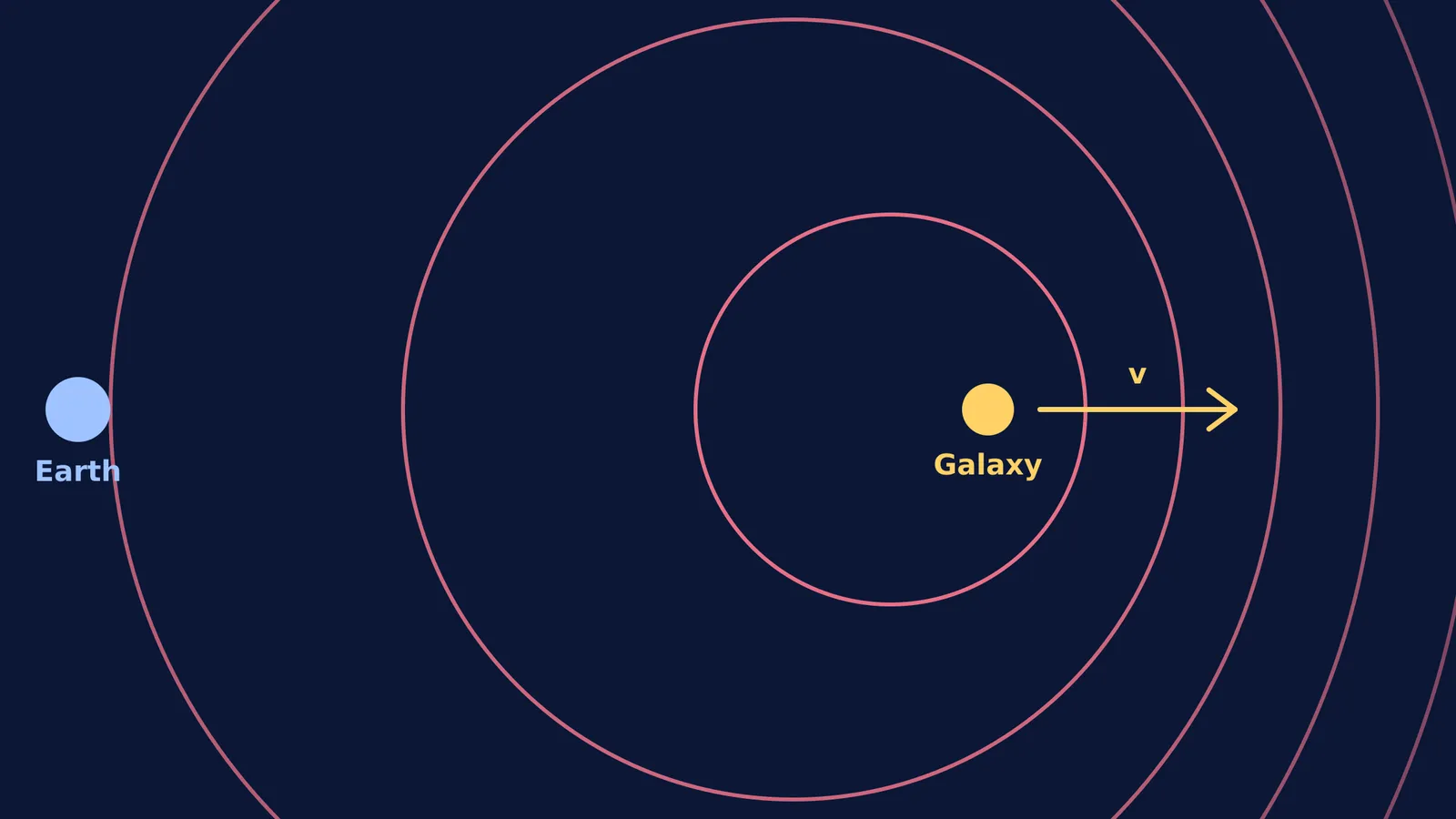
He was specifically looking for the "redshift" in the light from these galaxies. When a light source moves away from an observer, its light waves stretch out, shifting their patterns towards the red end of the electromagnetic spectrum. By measuring exactly how far these dark absorption lines had shifted from their normal positions, he could calculate how fast the galaxies were receding from Earth.
Humason found that all the dimmer galaxies he observed had red shifts, and the dimmer they were, the greater the red shift. These precise, hard-won measurements gave Hubble the foundation he needed to formulate Hubble's Law. The data proved a one-to-one relationship: the further away a galaxy is located, the faster it is moving away from us. This provided the empirical evidence that the universe is actively expanding.
How to picture the physics of moving light?
Visualising how light behaves across astronomical distances can be difficult. Static textbook images often fail to show how waves compress and stretch in real time. If you find it hard to picture these ideas, the Fermi Simulation Lab has interactive simulations where you can watch waves stretch as a source moves.
For a deeper dive into the theory, the Fermi Concept Library offers step-by-step lessons on every concept in physics, including the electromagnetic spectrum and the Doppler effect. You can also explore related topics, such as reading our guide on the Doppler effect simulation: what to predict before you press play or Understanding planetary orbits with a gravity simulation.
What we can learn from Humason's career path?
Humason's journey from a high school dropout to an astronomer with an honorary doctorate from Lund University offers a powerful lesson. If your own career path or exam preparation feels like it has fallen off the standard track, you can still find a way into the room.
Here is a three-step framework for building a career from an unconventional start, inspired by Humason's life:
Get close to the work: Humason returned as a janitor just to be near the telescopes. If you want to enter a new field, find a way into the environment. Take a junior role, do an internship, or shadow someone. Just get into the room.
Volunteer to solve hard problems: Humason did not just clean floors; he volunteered as a night assistant and mastered the equipment. Look for the tedious, difficult tasks that others avoid and become exceptionally good at them.
Commit to the gruelling work: Taking long exposures over multiple nights requires immense discipline and focus. Real skill takes time to build, and there is no shortcut for doing the work carefully.
Your starting point does not dictate your final contribution. Meticulous effort, practical curiosity, and a willingness to learn can bridge almost any gap.