

On this page
When you dissolve ordinary table salt in water, it breaks apart into sodium and chloride ions. But what happens when a compound is made of multiple salts joined together? In chemistry, we divide these addition compounds into two groups: double salts and complex salts.
While both types are formed by crystallising two or more simple salts together in a specific stoichiometric ratio, they behave very differently in solution. The primary difference between a double salt and a complex salt is their degree of dissociation when dissolved in a solvent like water.
What is a double salt?
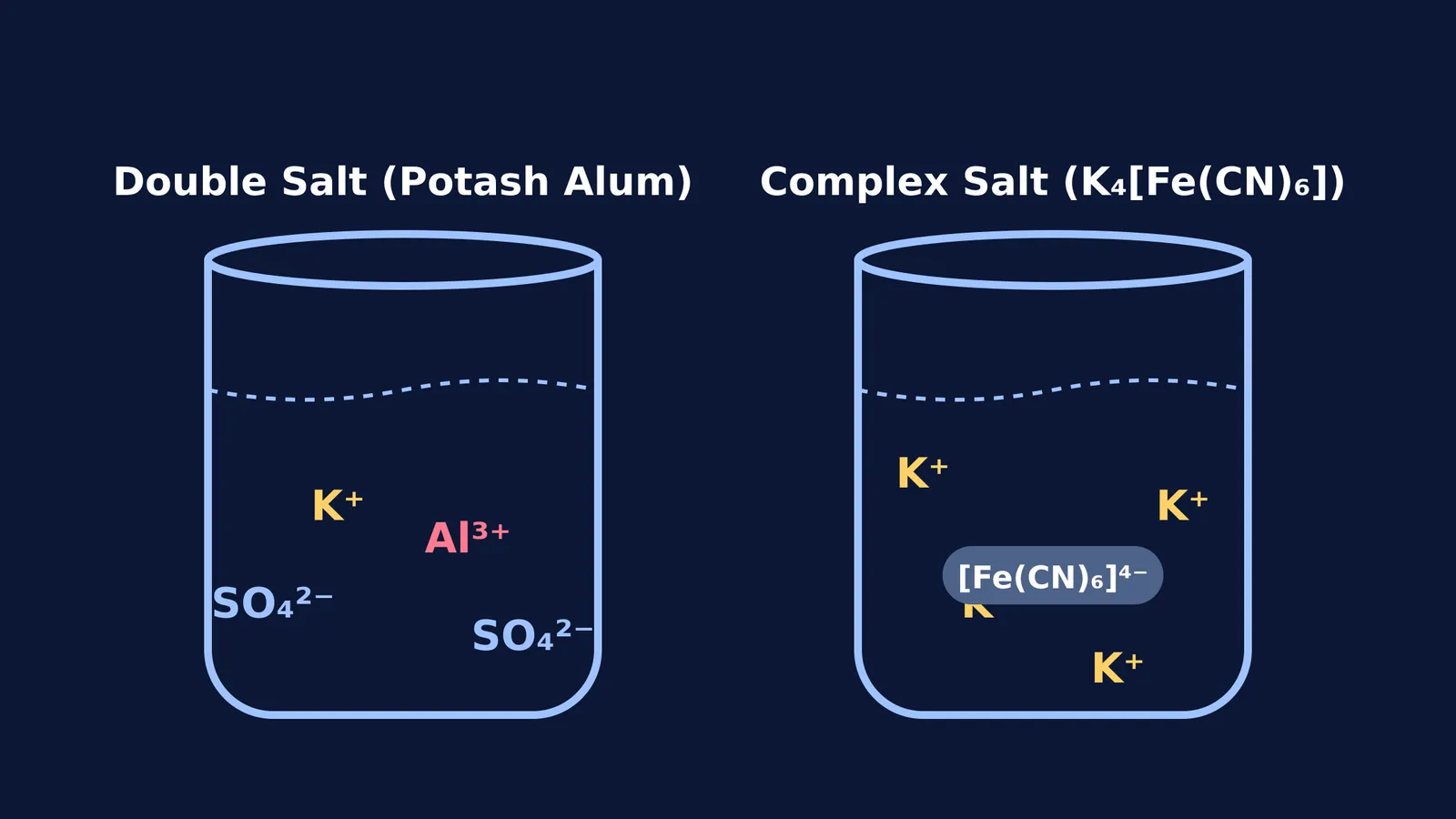
A double salt is a chemical combination that contains more than one distinct cation or anion. Crucially, a double salt exists only in the solid state. When dissolved in water, it completely dissociates into its constituent simple ions (Double salt - Wikipedia).
Because a double salt breaks down entirely, the resulting solution will give a positive chemical test for every single ion that was originally present in the solid crystal lattice. The physical and chemical properties of the resulting aqueous solution are identical to those of a mixture of the individual simple salts.
Common examples of double salts include:
Mohr's salt: (NH₄)₂Fe(SO₄)₂ · 6H₂O
Potash alum: KAl(SO₄)₂ · 12H₂O
Carnallite: KMgCl₃ · 6H₂O
If you drop a crystal of potash alum into water, it breaks apart completely into potassium (K⁺), aluminium (Al³⁺) and sulfate (SO₄²⁻) ions. There are no remaining bonds holding these different metals together once they enter the aqueous phase.
What is a complex salt?
A complex salt, or coordination complex, consists of a central metal ion surrounded by a bound array of molecules or ions known as ligands. Unlike double salts, a complex salt exists in both the solid state and in solution (Coordination complex - Wikipedia).
When a complex salt dissolves in water, it does not completely dissociate. The coordinate covalent bonds between the central metal and its ligands are exceptionally strong, meaning the complex ion remains entirely intact in the solvent. If you need a refresher on how coordinate covalent bonds form, you can review the topic in the Fermi Concept Library. You can also explore the historical background by looking into Werner's coordination complexes, which explains how the secondary valency holds these ligands tightly in place.
A classic example is potassium ferrocyanide, K₄[Fe(CN)₆]. When dissolved in water, it dissociates into four potassium ions (K⁺) and one ferrocyanide complex ion ([Fe(CN)₆]⁴⁻). The central iron atom and the surrounding cyanide ligands do not separate further (Potassium ferrocyanide - Wikipedia). Because the complex ion stays whole, the solution will not give a positive qualitative test for individual iron(II) or free cyanide ions.
What is the difference between double salt and complex salt examples?
If you need to distinguish between the two types of addition compounds in a laboratory setting or a written exam, these are the key practical differences:
Dissociation: Double salts dissociate completely into their individual simple ions. Complex salts dissociate into simple counter-ions and at least one complex ion that stays fully intact.
Identity in solution: A double salt completely loses its unique chemical identity in water. A complex salt retains the identity of its complex ion.
Chemical testing: A double salt will test positive for all its constituent ions. A complex salt will only test positive for the counter-ions that sit outside its coordination sphere.
Bonding: Double salts are held together primarily by electrostatic ionic bonds. Complex salts contain coordinate covalent bonds within the complex ion, which do not break apart in water.
Identifying salts in exam problems
Questions about addition compounds are common in JEE Main and NEET-UG qualitative analysis. A typical problem will describe an unknown crystalline solid dissolving in water and failing to give a positive test for one of its transition metals. That missing test result is your vital clue that the metal is trapped inside a coordination sphere, identifying the compound as a complex salt rather than a simple double salt. Before attempting these problems, ensure you are comfortable writing the electron configuration of transition metal ions like Fe²⁺ and Cu²⁺.
If you get stuck applying these rules to numericals or complex reaction sequences, you can work through similar questions in the Fermi Problem Library, which features a step-by-step solver that explains the reasoning rather than printing an answer.


