

On this page
If you mix up Benedict's and Fehling's solutions, you are in good company: both are deep blue and both turn red with glucose. The difference fits in one line: same copper reaction, different helper molecule and alkali, and those decide whether the reagent keeps in one bottle.
What is the difference between Benedict and Fehling solution?
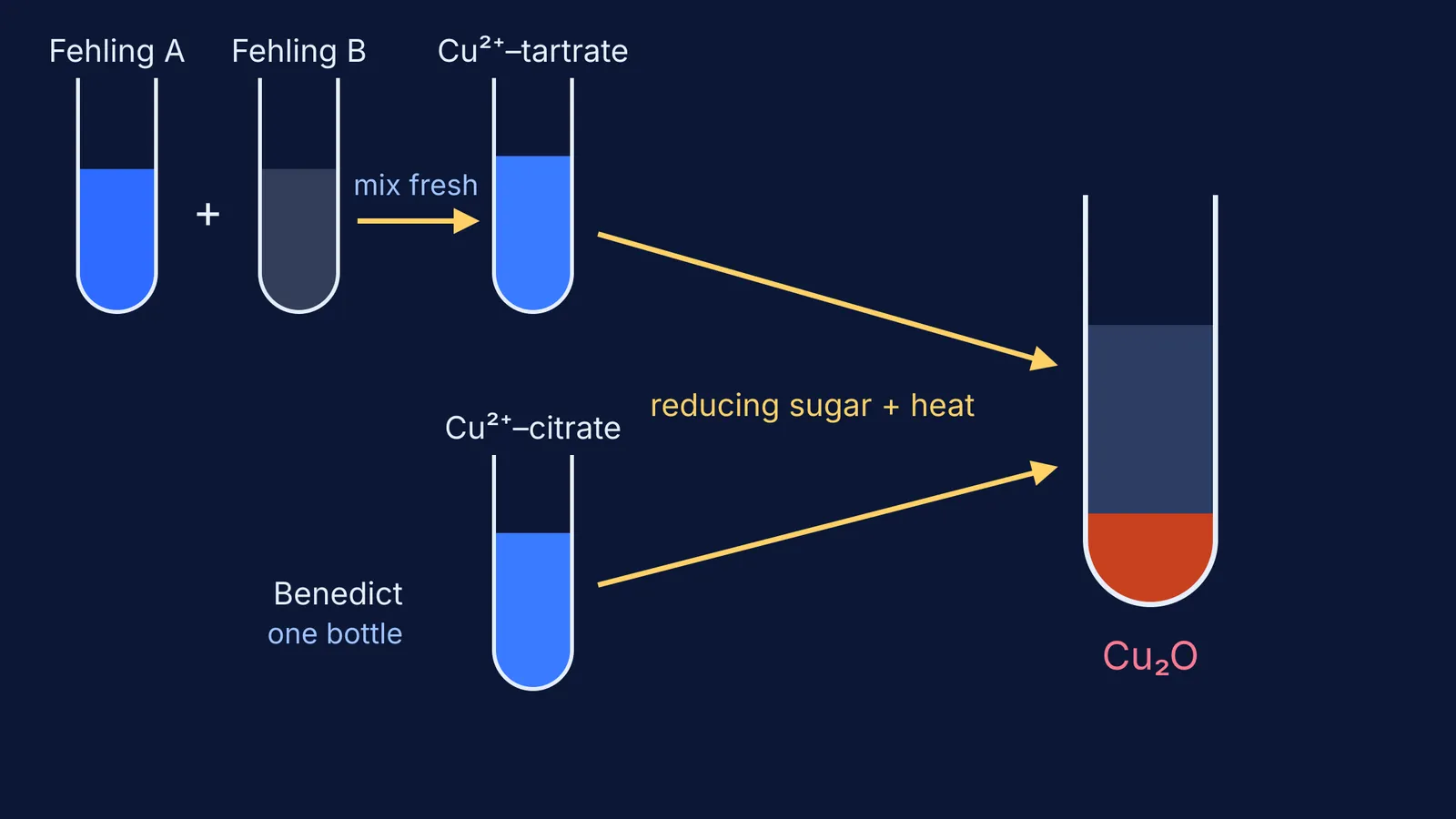
Fehling's solution is two solutions kept apart until use. According to the Fehling's solution reference page, Fehling's A is a deep blue solution of copper(II) sulfate, and Fehling's B is a colourless solution of potassium sodium tartrate (Rochelle salt) made strongly alkaline with sodium hydroxide. The same page explains why they are stored separately: the copper(II) complex formed when they are combined is not stable and slowly decomposes into copper hydroxide in the alkaline conditions. The test was developed by Hermann von Fehling, whose 1849 paper on measuring sugar with copper sulfate appeared in the Annalen der Chemie, the journal now called Justus Liebigs Annalen der Chemie.
Benedict's reagent is a single solution. Each litre contains 17.3 g copper sulfate, 173 g sodium citrate and 100 g anhydrous sodium carbonate, according to the Benedict's reagent reference page. That page also states that sodium citrate acts as a complexing agent which keeps Cu2+ in solution, since it would otherwise precipitate. Stanley Benedict published it in 1909 as A Reagent for the Detection of Reducing Sugars91645-5) in the Journal of Biological Chemistry.
The practical result, per this lab guide to Benedict's test: the mild carbonate alkali and citrate complex let Benedict's be stored as one ready-to-use solution, while Fehling's must be mixed fresh from two solutions just before use.
Side by side:
Copper source: copper(II) sulfate in both.
Complexing agent: tartrate in Fehling's, citrate in Benedict's.
Alkali: sodium hydroxide (strong) in Fehling's, sodium carbonate (milder) in Benedict's.
Storage: Fehling's as A and B, mixed just before use; Benedict's as one bottle.
Positive result: red copper(I) oxide, Cu2O, in both.
What reaction happens in both tests?
In both, a reducing sugar or aldehyde is oxidised and the blue copper(II) complex is reduced to copper(I), which falls out as insoluble red Cu2O (Benedict's reagent). For Fehling's, the net ionic equation given on the Fehling's solution page is RCHO + 2 Cu(C4H4O6)2(2-) + 5 OH- gives RCOO- + Cu2O + 4 C4H4O6(2-) + 3 H2O.
The same page notes three exam-friendly facts. Aldehydes give a positive result, but ketones do not react unless they are alpha-hydroxy ketones. Ketose sugars such as fructose still test positive, because the base converts them to aldoses. And formic acid also gives a positive result, as it does with Tollens' reagent, because it is readily oxidised to carbon dioxide (see why formic acid gives the silver mirror test). Sucrose, by contrast, is a non-reducing sugar that does not react with Benedict's reagent (Benedict's reagent).
Why is Benedict's solution used for urine sugar?
Benedict applied his reagent to clinical work: in 1911 he published The Detection and Estimation of Glucose in Urine in the Journal of the American Medical Association. A single, stable bottle is easier to keep on a lab shelf than two solutions that must be mixed each time.
It is also semi-quantitative. The Benedict's reagent page gives the colour scale: a greenish precipitate indicates about 0.5 g%, yellow 1 g%, orange 1.5 g%, and red 2 g% or higher. We walk through the school-lab version in how to test urine for sugar and albumin.
One limit matters. A positive Benedict's test shows that a reducing substance is present, not that it is glucose; confirming glucose needs a glucose-specific method such as a glucose oxidase strip (lab guide). This is classroom chemistry, not a health check: any real urine or blood result should be read by a doctor.
How do you remember the difference for exams?
Use this three-line hook:
Benedict = Bottle: one solution, Citrate and Carbonate (two Cs).
Fehling = Fresh mix: two solutions, tartrate and hydroxide.
Both = blue to brick red: Cu2+ to Cu2O.
Then test yourself on this worked example. Which of these give a red precipitate with Fehling's solution: glucose, fructose, sucrose, acetone, formic acid?
Glucose: yes, it has a free aldehyde group.
Fructose: yes, the base converts it to an aldose.
Sucrose: no, it is non-reducing.
Acetone: no, it is a simple ketone.
Formic acid: yes, it is readily oxidised to carbon dioxide.
Our post on telling glucose and fructose apart with chemical tests covers the test that does separate them. You can also look up reducing sugars and aldehyde oxidation in the Fermi Concept Library. For more practice, the Fermi Problem Library has worked problems with a step-by-step solver that explains the reasoning rather than printing an answer.
Next time you see a blue reagent turning red in a question, ask one thing first: one bottle or two?


