

On this page
NCERT's Class XI biology lab manual has you test a urine sample for sugar and for albumin. Both tests use heat and a visible change: a colour in one, cloudiness in the other. Here is each method, how to read it, what a positive result means and how to record it.
How do you test urine for sugar with Benedict's test?
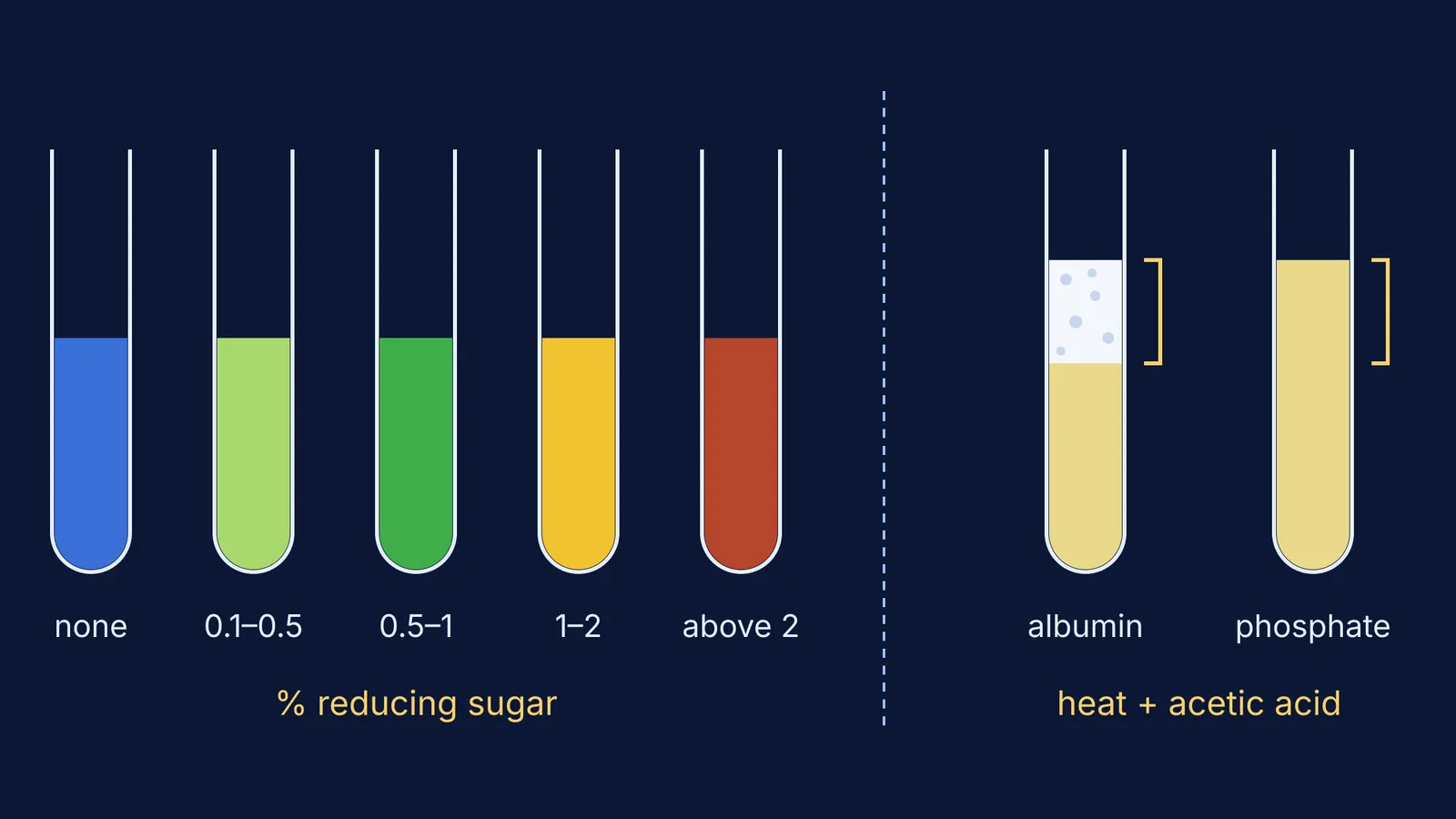
NCERT's Exercise 30: test for sugar in urine states that normal urine has practically no glucose, and that glucose in urine is called glucosuria. The test works because the copper sulphate in Benedict's reagent is reduced on boiling by reducing sugars such as glucose and fructose, forming a coloured precipitate of cuprous oxide.
The procedure in the manual:
Take 5 mL of Benedict's reagent in a test tube.
Add 0.5 mL (8 drops) of freshly passed urine.
Boil for 2 minutes, holding the tube firmly in a holder, tilted near the flame and shaken, because the contents tend to spurt out.
Note the colour of the precipitate.
The reagent is named after Stanley R. Benedict, whose paper A Reagent for the Detection of Reducing Sugars appeared in the Journal of Biological Chemistry in 1909. Our post on why Stanley Benedict invented his reagent tells that story.
How do you read the Benedict's colours?
The same NCERT exercise links the colour of the precipitate to a rough concentration of reducing sugar:
Light green: 0.1 to 0.5%
Green: 0.5 to 1.0%
Yellow: 1.0 to 2.0%
Brick red: above 2%
How do you test urine for albumin by heat coagulation?
NCERT's Exercise 31: detecting albumin in urine explains that albumin coagulates when heated. Heat alone can mislead you, because phosphates can also turn urine cloudy. Acetic acid is the check.
Take about 6 to 8 mL of urine in a test tube.
Hold the tube at an angle and heat only the upper third with a low flame.
Look for turbidity (white cloudiness) in the heated part.
Add 1% acetic acid drop by drop and boil again, or add a single drop of 33% acetic acid.
If the turbidity persists, albumin is present. If it disappears, the cloudiness was phosphates.
The same exercise gives two other tests you may meet in a viva: the nitric acid ring test, where a white ring forms where urine meets concentrated nitric acid, and the sulphosalicylic acid test, where a cloudy precipitate shows albumin.
What does a positive result indicate?
NCERT's Class XI textbook says the presence of glucose (glycosuria) and ketone bodies (ketonuria) in urine indicates diabetes mellitus (Chapter 16, section 16.6). The US National Library of Medicine's MedlinePlus guide to the glucose in urine test adds that sugar in urine can also come from pregnancy or rare kidney conditions, and that blood tests are now more commonly used to diagnose and monitor diabetes because urine glucose testing is less accurate.
For protein, NCERT's Exercise 31 says normal urine carries a trace of under 250 mg in 24 hours, too little for these simple tests to detect, while albumin is significantly high in kidney disturbance and high blood pressure. The MedlinePlus guide to protein in urine says a large amount may mean a kidney problem, but that strenuous exercise, dehydration, stress and pregnancy can also raise it, and a provider may suggest further tests to see whether it stays high. For the disorders themselves, read our explainer on uremia, renal calculi and glomerulonephritis.
How do you write these tests in your practical record?
Examiners want three things for each test: what you did, what you saw, and what you concluded. A worked example, using NCERT's colour ranges:
Benedict's test. Observation: green precipitate after boiling for 2 minutes. Inference: reducing sugar present, roughly 0.5 to 1.0%.
Heat coagulation test, sample A. Observation: white turbidity in the heated upper third that stays after adding 1% acetic acid. Inference: albumin present.
Heat coagulation test, sample B. Observation: turbidity in the heated part that clears with acetic acid. Inference: phosphates present, albumin absent.
NCERT prints these questions after Exercise 31:
Name the disorder in which glucose level is high in urine.
Which reagents will demonstrate presence of protein in urine?
What is the significance of appearance of different colours while performing Benedict's test?
What is the significance of performing Seliwanoff's test?
If the chemistry behind the colours is the shaky part, the Fermi Concept Library covers every concept in physics, chemistry, biology, mathematics and computing, each with its own lesson. For practice, the Fermi Problem Library has worked problems with a step-by-step solver that explains the reasoning rather than printing an answer.


