On this page
Sucrose turns plane-polarised light to the right; after acid hydrolysis, the solution turns it to the left. That swing is a clean way to measure how fast the reaction goes, and it is a common Class 12 kinetics numerical. Below we derive the formula, then work a full data table to a rate constant and half-life.
Why is the inversion of cane sugar a first-order reaction?
The reaction is C12H22O11 + H2O → C6H12O6 (glucose) + C6H12O6 (fructose), catalysed by H+. Water is a reactant, but it is present in such large excess that its concentration barely changes. The NCERT Class 12 Chemistry chapter on chemical kinetics calls this a pseudo first-order reaction and writes the rate as k[C12H22O11].
The same chapter gives the first-order integrated rate equation, k = (2.303/t) log([R]0/[R]), and the half-life, t½ = 0.693/k (NCERT, equations 3.15 and 3.17).
One caution: k depends on acid concentration and temperature. A University of Scranton lab handout notes the rate is influenced by the hydrogen-ion concentration and runs every group at 30 °C. Always quote k with its conditions.
Why can a polarimeter reading replace concentration?
You can read optical rotation without disturbing the reaction. Sucrose is dextrorotatory. Of its products, fructose is laevorotatory (−92.4°) and glucose dextrorotatory (+52.5°). Fructose's rotation is the larger of the two, so the equimolar mixture ends up laevorotatory, which is why it is called invert sugar (NCERT Class 12 Biomolecules chapter). For the background on the name, see our explainer on why sucrose hydrolysis is called inversion of sugar, and for the instrument itself, how a polarimeter measures optical rotation.
The observed rotation is a sum: each optically active substance contributes in proportion to its concentration.
How do you derive k = (2.303/t) log[(r0 − r∞)/(rt − r∞)]?
Let a be the starting sucrose concentration and x the amount inverted by time t. Let s be the rotation per unit concentration of sucrose and p the rotation per unit of the glucose-fructose mixture it forms.
At the start, only sucrose is present: r0 = s·a.
At time t: rt = s(a − x) + p·x.
At completion, all sucrose is gone: r∞ = p·a.
Subtract step 3 from step 1: r0 − r∞ = (s − p)a.
Subtract step 3 from step 2: rt − r∞ = (s − p)(a − x).
Divide: (r0 − r∞)/(rt − r∞) = a/(a − x), the same ratio as [R]0/[R].
Put this into the first-order equation: k = (2.303/t) log[(r0 − r∞)/(rt − r∞)].
The constants s and p cancel, so you never need the specific rotations or the concentration. The Scranton handout uses the natural-log form of this relation and takes k as the slope of the straight line.
Worked example: from a polarimeter table to k and half-life
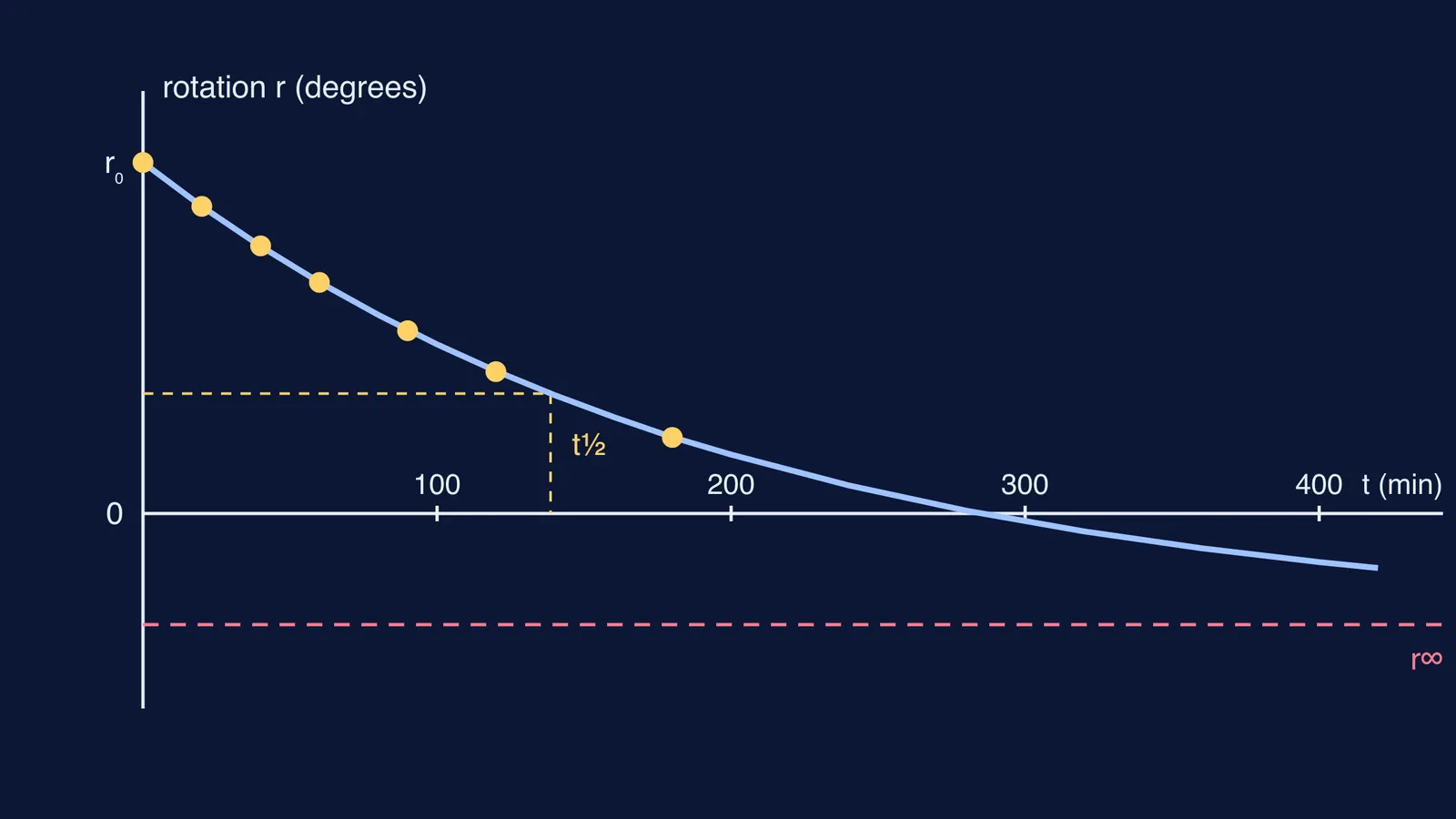
The readings below are a practice set we made for this post, not a published experiment: r0 = +24.0°, r∞ = −7.6°, so r0 − r∞ = 31.6° throughout.
t = 20 min, rt = +21.0°: rt − r∞ = 28.6°, ratio 1.105, log 0.0433, k = 4.99 × 10⁻³ min⁻¹
t = 40 min, rt = +18.3°: rt − r∞ = 25.9°, ratio 1.220, log 0.0864, k = 4.97 × 10⁻³ min⁻¹
t = 60 min, rt = +15.8°: rt − r∞ = 23.4°, ratio 1.350, log 0.1305, k = 5.01 × 10⁻³ min⁻¹
t = 90 min, rt = +12.5°: rt − r∞ = 20.1°, ratio 1.572, log 0.1965, k = 5.03 × 10⁻³ min⁻¹
t = 120 min, rt = +9.7°: rt − r∞ = 17.3°, ratio 1.827, log 0.2616, k = 5.02 × 10⁻³ min⁻¹
t = 180 min, rt = +5.2°: rt − r∞ = 12.8°, ratio 2.469, log 0.3925, k = 5.02 × 10⁻³ min⁻¹
The steady values confirm first-order behaviour. Their mean is k ≈ 5.0 × 10⁻³ min⁻¹, or about 8.3 × 10⁻⁵ s⁻¹.
Half-life: t½ = 0.693/k = 0.693/(5.0 × 10⁻³ min⁻¹) ≈ 139 min.
Check it: at the half-life, rt − r∞ should be 15.8°, so rt = +8.2°. The table passes +9.7° at 120 min and +5.2° at 180 min, so that fits. The rotation crosses zero, the moment the solution actually inverts, at t = (2.303/k) log(31.6/7.6) ≈ 285 min.
What mistakes cost marks in this numerical?
Writing log(r0/rt), which ignores the products' rotation.
Dropping the minus sign on r∞.
Mixing minutes and seconds between k and t½.
Trusting one reading instead of checking that k stays steady.
Any property that changes linearly with concentration works the same way. The titration version is worked in our post on the rate constant of ester hydrolysis from V0, Vt and V∞ titres. For more practice, the Fermi Problem Library has worked kinetics problems with a step-by-step solver that explains the reasoning rather than printing an answer. If pseudo first order or half-life still feels shaky, the Fermi Concept Library gives each concept its own lesson.