On this page
A titration run on methyl acetate leaves you with a column of burette readings: V0, several Vt values and V∞. Here's why those readings alone give the rate constant, with a full data table worked the way a JEE numerical expects.
Why does the titre rise as methyl acetate hydrolyses?
The reaction is CH3COOCH3 + H2O → CH3COOH + CH3OH, and each ester molecule that reacts makes one molecule of acetic acid (University of Szeged practical notes). The HCl is only a catalyst, so its amount never changes. NaOH neutralises both acids, but only the acetic acid share grows:
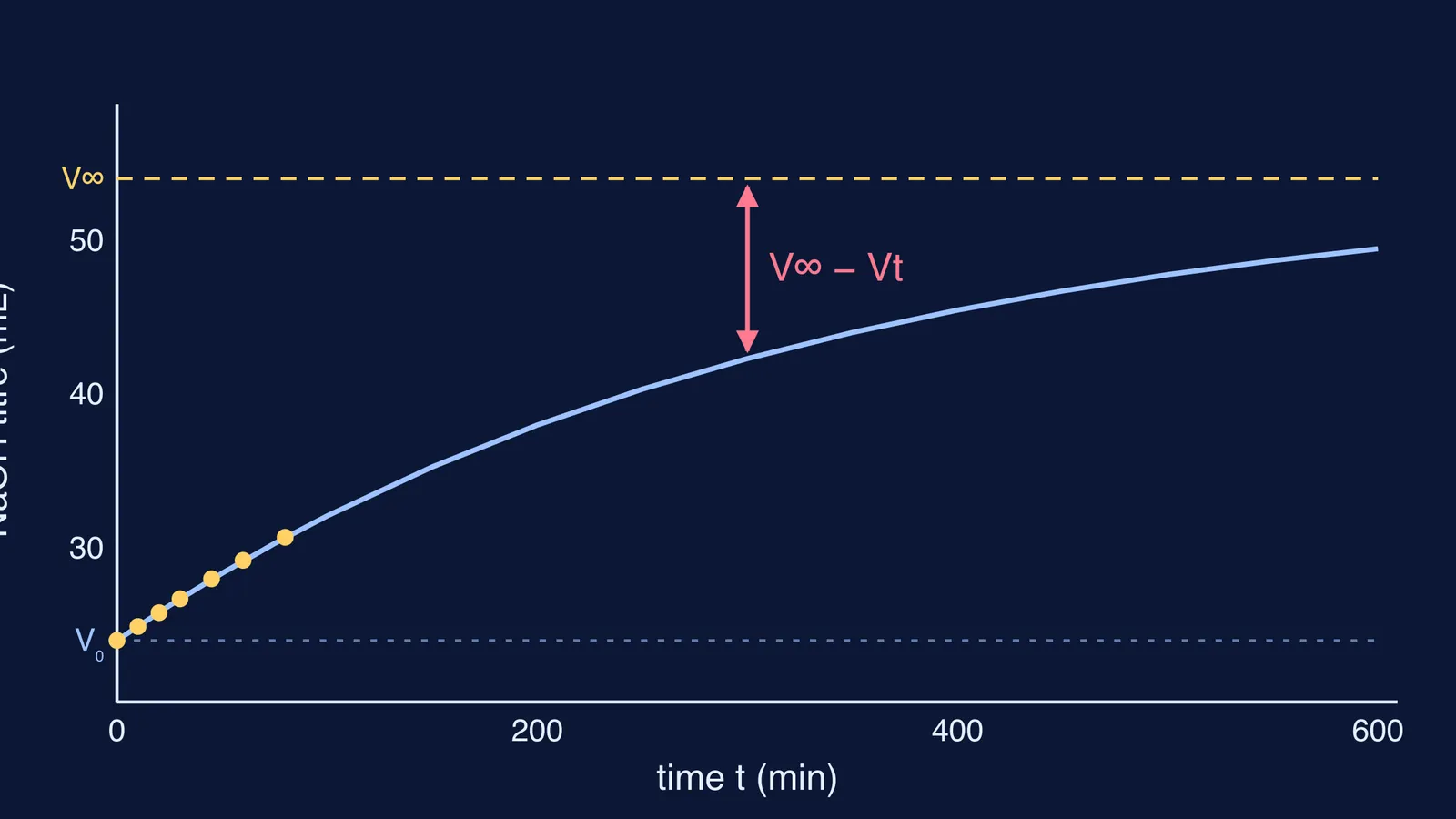
V0, taken at t = 0, neutralises the HCl alone.
Vt neutralises the HCl plus the acetic acid formed by time t.
V∞ neutralises the HCl plus the acetic acid from all of the ester.
In the University of Malaya lab manual, each 5 mL sample goes into 25 mL of icy water to stop the reaction. For V∞, you heat the remaining mixture for about 10 minutes until it boils, then cool it and titrate twice.
Why is ester hydrolysis treated as pseudo-first order?
Water is a reactant, but in dilute solution it is in huge excess, about 55.5 M, so its concentration barely changes (Szeged notes). With the acid constant too, the rate depends only on the ester (see pseudo-first-order reactions).
How do you derive k from V0, Vt and V∞?
Start from the first-order integrated rate equation:
k = (2.303/t) log[a/(a − x)]
Here a is the starting ester concentration and x the amount hydrolysed by time t. Every millilitre of NaOH beyond V0 stands for ester that has reacted:
Starting ester: a ∝ V∞ − V0, because all of it ends up as acid.
Ester reacted by time t: x ∝ Vt − V0.
Ester left: a − x ∝ (V∞ − V0) − (Vt − V0) = V∞ − Vt.
The proportionality constant (NaOH molarity over sample volume) sits on top and bottom, so it cancels:
k = (2.303/t) log[(V∞ − V0)/(V∞ − Vt)]
So you need neither the HCl nor the NaOH concentration (Szeged notes).
Worked example: how do you solve a titration data table?
These illustrative readings follow the University of Malaya procedure: 5 mL of methyl acetate in 100 mL of 0.5 M HCl, with 5 mL samples titrated against 0.1 M NaOH at 10, 20, 30, 45, 60 and 80 minutes. Take V0 = 24.0 mL and V∞ = 54.0 mL, so V∞ − V0 = 30.0 mL.
t = 10 min, Vt = 24.9 mL: V∞ − Vt = 29.1, log = 0.01323, k = 3.05 × 10⁻³ min⁻¹
t = 20 min, Vt = 25.8 mL: V∞ − Vt = 28.2, log = 0.02687, k = 3.09 × 10⁻³ min⁻¹
t = 30 min, Vt = 26.7 mL: V∞ − Vt = 27.3, log = 0.04096, k = 3.14 × 10⁻³ min⁻¹
t = 45 min, Vt = 28.0 mL: V∞ − Vt = 26.0, log = 0.06215, k = 3.18 × 10⁻³ min⁻¹
t = 60 min, Vt = 29.2 mL: V∞ − Vt = 24.8, log = 0.08267, k = 3.17 × 10⁻³ min⁻¹
t = 80 min, Vt = 30.7 mL: V∞ − Vt = 23.3, log = 0.10977, k = 3.16 × 10⁻³ min⁻¹
The values stay level, which shows the first-order model fits. The average is k ≈ 3.13 × 10⁻³ min⁻¹, or 5.2 × 10⁻⁵ s⁻¹, and the half-life is 0.693/k ≈ 221 minutes.
The 10-minute value is lowest because Vt − V0 is only 0.9 mL, so rounding to 0.1 mL shifts k. Points taken near the end of the reaction have the opposite problem: the Szeged notes warn that the logarithm of a small V∞ − Vt magnifies error. A graph of log(V∞ − Vt) against t uses every point at once: its slope is −k/2.303.
For a size check, the Szeged notes give the acid-catalysed coefficient as 1.1 × 10⁻⁴ M⁻¹ s⁻¹ at 25 °C. With about 0.48 M acid after mixing, you would expect k ≈ 5.2 × 10⁻⁵ s⁻¹. We built the table to match, so use this as a rough check: a k ten times off usually means a unit slip.
What mistakes cost marks in this calculation?
Putting Vt − V0 in the bottom of the ratio instead of V∞ − Vt.
Forgetting 2.303 with log base 10, or adding it with ln.
Mixing units: t in minutes gives k in min⁻¹.
Taking V∞ before the reaction is complete. A low V∞ makes k rise steadily down the table instead of staying level.
The same titre logic appears in following H2O2 decomposition by KMnO4 titration. If your k values drift, the Fermi Problem Library has worked problems with a step-by-step solver that explains the reasoning rather than printing an answer. To revise first-order kinetics itself, the Fermi Concept Library gives each concept its own lesson and its place in the map.
In your next practical, write V∞ − V0 at the top of the table before your first Vt.