On this page
Class 12 students learn that lab nitrogen comes from warming ammonium chloride with sodium nitrite, because ammonium nitrite is too unstable to keep. In 1912 three Presidency College chemists asked a sharper question. If you could get pure ammonium nitrite into the gas phase, would its molecules stay whole, or would they break apart the way ammonium chloride's do? Prafulla Chandra Ray, his student Nil Ratan Dhar and Tincowry De answered it with a vapour density measurement. Their paper, "The vapour density of ammonium nitrite", is in the Journal of the Chemical Society, Transactions, volume 101, pages 1185 to 1189, and the full volume is free to read on the Internet Archive. Its typical experiment is a mole-concept problem you can solve yourself.
What did Ray, Dhar and De set out to measure?
The paper opens with Ray's earlier finding: "ammonium nitrite can be sublimed in a vacuum at a temperature of 37—40°". That property, they wrote, "suggested to us the possibility of the determination of its vapour density in Hofmann's apparatus under very reduced pressure". Neogi and Adhicary had tried in 1911 without "satisfactory results".
The sublimed salt "can be resublimed in a vacuum without any decomposition or residue of ammonium nitrate, provided the temperature of the bulb does not exceed 60°". Ammonium nitrate does not vaporise under the same conditions, so sublimation separated the two salts. For the wider story, see our profile of Prafulla Chandra Ray, the "Master of Nitrites".
Why does vapour density tell you whether a molecule splits?
Vapour density is the density of a gas compared with hydrogen at the same temperature and pressure, so vapour density = M ÷ 2.
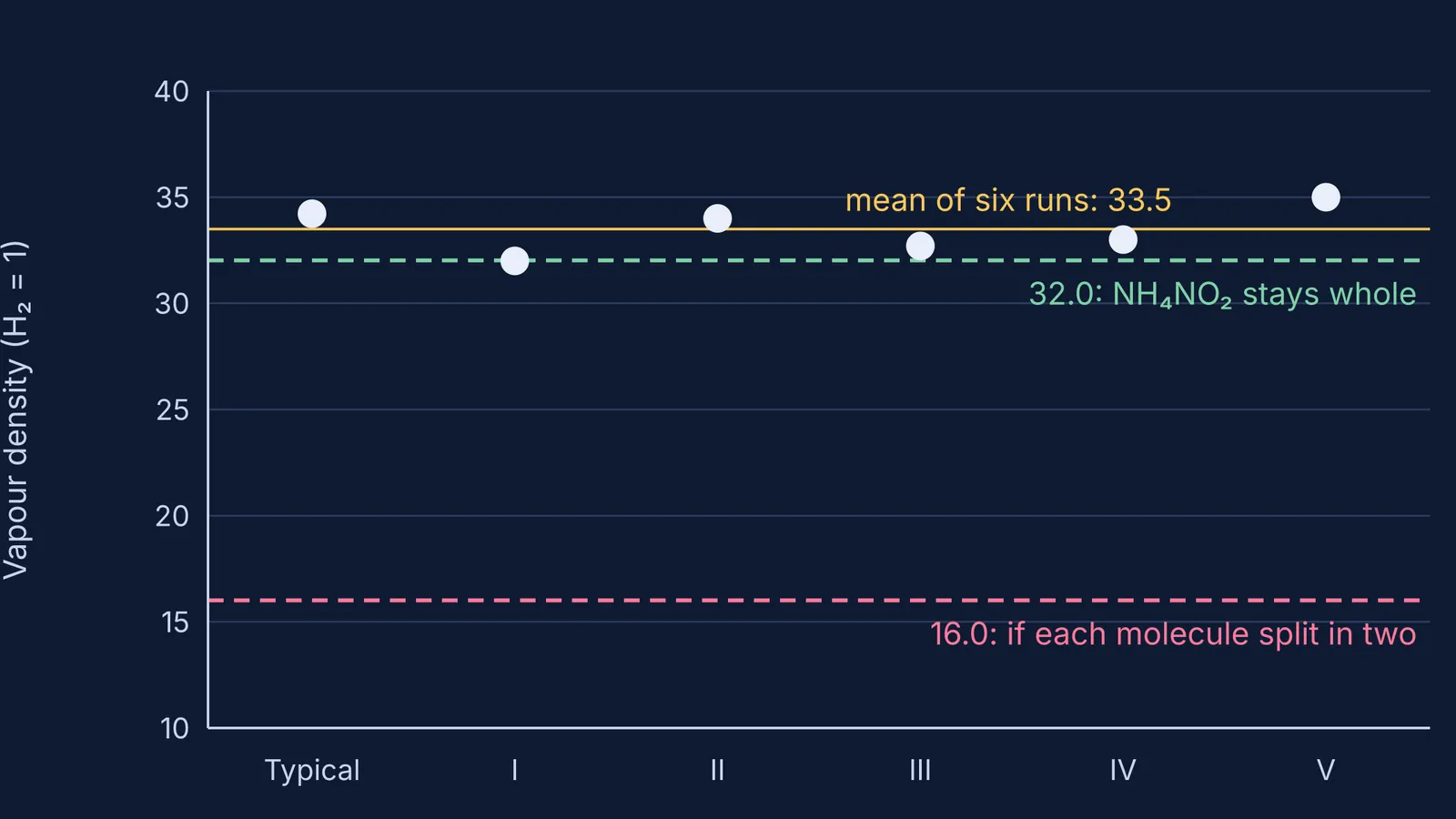
NH₄NO₂ has M = 64.04 g/mol, so its expected vapour density is 32.0.
If each molecule split into two gas molecules, the same mass would fill twice the volume, and the vapour density would fall to about 16.0.
Ammonium chloride is the classic example of the second case. NH₄Cl has M = 53.49, so an unsplit vapour would have a density of 26.7. Hot NH₄Cl vapour is largely NH₃ + HCl, so the density you measure is pulled down towards 13.4. The 1912 paper discusses H. B. Baker's finding that "the abnormal vapour density of ammonium chloride" becomes normal when the salt is perfectly dry. Ray's team found that, for ammonium nitrite, "the presence of moisture does not seem to affect the vaporisation". The same idea, a lower density meaning more particles, is how you find the degree of dissociation of PCl₅ from vapour density.
How did they measure it when the salt kept decomposing?
In Hofmann's method, a few milligrams of substance go into the vacuum above a mercury column, a vapour jacket heats the tube, and the vapour pushes the mercury down.
The problem was that ammonium nitrite did not only vaporise. Part of it decomposed in the hot tube, mainly by the familiar reaction
NH₄NO₂ → N₂ + 2H₂O
and a small part by a side reaction the paper writes as
3NH₄NO₂ → NH₄NO₃ + 2NO + 2NH₃ + H₂O
Both sides have 6 N, 12 H and 6 O.
They chose a jacket of ethyl alcohol vapour (78 °C) rather than steam, because blank runs showed ammonium nitrate has an appreciable vapour pressure at 100 °C. Each run took four to five hours to reach constant volume, and they made "some twenty experiments" in all. They measured the gas volume hot, then cold, then after absorbing NO in alkaline sodium sulphite and NH₃ in water. All volumes were reduced to NTP, which in 1912 meant 0 °C and 760 mm, with 22,400 mL per mole.
Worked example: their typical run, step by step
Sample. 0.014 g was taken. Analysis showed 0.013 g of it was real nitrite.
Air. 0.45 mL of air entered with the sample. NO took up its oxygen (one-fifth), leaving 0.36 mL of nitrogen.
Nitrogen from decomposition. After NO and NH₃ were absorbed, 3.82 mL was left. Subtract the air: 3.82 − 0.36 = 3.46 mL of N₂. One mole of N₂ comes from one mole of salt, so the salt decomposed = 3.46 ÷ 22,400 × 64.04 = 0.0099 g.
Side reaction. The cold volume was 4.439 mL. The paper subtracts 3.826 mL to get 0.613 mL of NO + NH₃, which come in equal amounts, so 0.306 mL each. Three moles of salt give two moles of NO, so salt used = 0.306 ÷ 22,400 × 1.5 × 64.04 = 0.0013 g.
Undecomposed salt. 0.013 − 0.0099 − 0.0013 = 0.0018 g.
Its volume. The hot volume was 12.104 mL. Take away 3.46 mL N₂, 0.36 mL air nitrogen, 6.93 + 0.153 mL water vapour (two per N₂ and one per two NO), and 0.306 mL each of NH₃ and NO. That leaves 0.589 mL of ammonium nitrite vapour.
Molar mass. M = 22,400 × 0.0018 ÷ 0.589 = 68.45 g/mol.
Vapour density. 68.45 ÷ 2 = 34.2. Unsplit NH₄NO₂ would give 32.0; split into two molecules would give 16.0.
A whole molecule fits: split in two, 0.0018 g would have filled about 1.26 mL, not 0.589 mL.
To practise mole and gas-volume chains like this one, the Fermi Problem Library has a step-by-step solver that explains the reasoning at each stage.
What did the other runs show?
The paper tabulates five more runs, with densities of 32.0, 34.0, 32.7, 33.0 and 35.0. (The Internet Archive's text file misreads two of these as 84.0 and 82.7; the page scan shows 34.0 and 32.7.) With the typical run's 34.2, the mean is 33.5. Their conclusion: "The mean value therefore of the vapour density is 33·5, whereas the theoretical value is 32·0. It will thus be seen that ammonium nitrite vaporises without dissociation."
If you recompute run II from its own tabulated mass (2.30 mg) and volume (0.813 mL), you get 31.7, not the printed 34.0, so one figure in that row is probably a misprint. It does not change the answer. Every run sits near 32, and none is anywhere near 16.
Does this mean the textbook is wrong about ammonium nitrite?
No. The paper itself says that "when heated in the ordinary way, it decomposes mainly into nitrogen and water". That is exactly why the laboratory preparation of nitrogen makes the salt in solution and lets it decompose at once. Ray's result is narrower: under a vacuum, below about 60 °C, the pure dry salt can be moved into the vapour without breaking up, and the vapour holds whole NH₄NO₂ units. Nitrite salts and their decomposition are not something to try at home or in a school lab.
For exam practice on vapour density, molar volume and the N₂ preparation reaction, Fermi Test Prep is built for JEE Main and Advanced preparation, with an AI tutor.
Quick checklist
Vapour density = M ÷ 2. For NH₄NO₂ that is 32.0.
A molecule that splits in two halves the vapour density; NH₄Cl is the textbook case.
Ray, Dhar and De (1912) found a mean of 33.5, so the vapour is whole NH₄NO₂.
Subtract every other gas before you divide mass by volume.
Match 22.4 L to 1 atm and 22.7 L to 1 bar.
The lab still makes N₂ from NH₄Cl + NaNO₂; the vacuum result does not change that.