On this page
The bite of black pepper from Kerala and Karnataka comes mainly from one compound, piperine. Its structure is a good test of the most useful skill in geometrical isomerism: deciding which double bonds count, then multiplying. Piperine has two counting double bonds and two different ends, so it has four geometric isomers, and all four have their own names. Below you count them, see what light does, and use the same molecule for amide hydrolysis and moles.
What is piperine's structure?
PubChem's piperine record gives the IUPAC name (2E,4E)-5-(1,3-benzodioxol-5-yl)-1-piperidin-1-ylpenta-2,4-dien-1-one and the formula C₁₇H₁₉NO₃ (molar mass 285.34 g/mol). The name has three parts:
An aryl end (Ar): a benzene ring fused to a five-membered O–CH₂–O ring (1,3-benzodioxole).
A five-carbon chain with C=C at C2–C3 and C4–C5, ending in a C=O at C1.
A piperidine ring joined through its nitrogen to that C=O. So piperine is an amide, not an amine.
The same record lists a melting point of 129 °C and a water solubility of only 0.04 mg/mL at 18 °C, while it is soluble in ethanol. That fits a large, mostly non-polar molecule with no O–H or N–H.
How many geometric isomers does piperine have?
Use the three-step method from our guide to counting geometrical isomers with the 2ⁿ rule.
Find the stereogenic C=C bonds. Each carbon of a counting double bond must carry two different groups. At C2=C3, C2 has H and C(=O)N, and C3 has H and the rest of the chain. Both pass. At C4=C5, C4 has H and the chain, and C5 has H and Ar. Both pass. So n = 2.
Ignore bonds that do not count. The C=C bonds inside the benzene ring are locked in the ring and cannot be cis or trans at this level. The amide C–N bond has restricted rotation, but it is not counted as geometrical isomerism in JEE or NEET.
Compare the ends. One end is Ar, the other is the piperidine amide. They are different, so the chain is unsymmetrical and every E/Z sequence is a different compound.
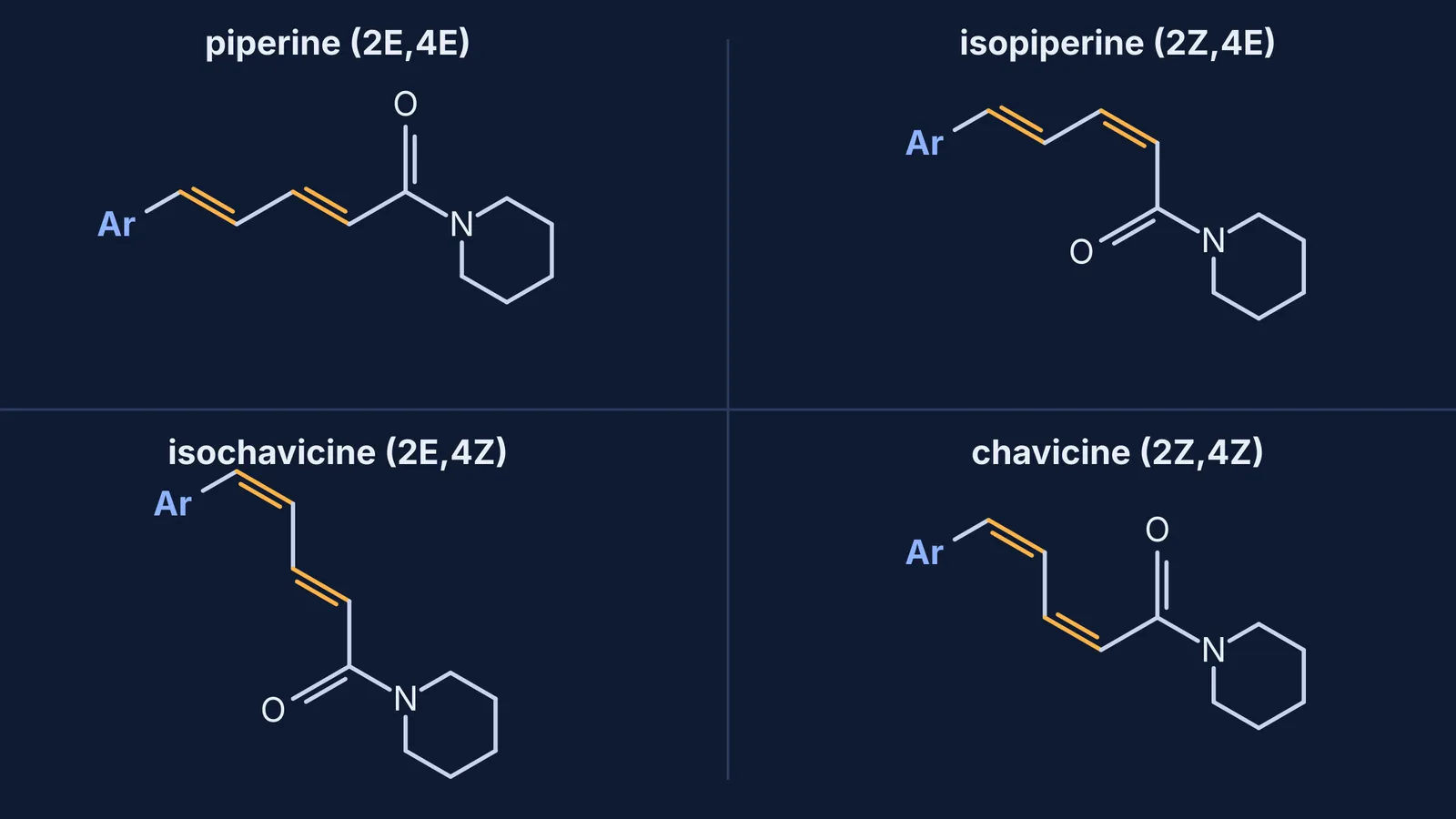
Answer: 2² = 4 geometric isomers. PubChem has a record for each:
piperine, (2E,4E)
isopiperine, (2Z,4E)
isochavicine, (2E,4Z)
chavicine, (2Z,4Z)
Compare hexa-2,4-diene, CH₃–CH=CH–CH=CH–CH₃. It also has n = 2, but both ends are CH₃. Read from the other end, (2E,4Z) becomes (2Z,4E), so those two are one molecule and the count drops to 3. Piperine's ends differ, so (2E,4Z) and (2Z,4E) stay separate compounds: isochavicine and isopiperine.
Each of these carbons carries one H, so E here simply means the two non-hydrogen groups are on opposite sides, the same as trans.
What does light do to piperine?
The four isomers can turn into one another: absorbed light weakens a C=C π bond for a moment, the chain twists, and the bond can re-form either way round. Kozukue and co-workers (J. Agric. Food Chem., 2007) developed an HPLC method that separates all four, then exposed them to fluorescent light, sunlight and 254 nm UV. According to the paper's abstract, isomerisation increased with light intensity and exposure time and then levelled off at photostationary phases, where the mixture stops changing. In the four commercial ground peppers they analysed, piperine was by far the main isomer and the other three were small fractions.
The practical lesson is modest: light changes which isomers are present in ground pepper, so a closed, dark container keeps the piperine as piperine. The abstract does not say how much the taste changes, so this post does not claim it.
How much piperine is in Indian pepper varieties?
It depends on the variety. ICAR-IISR's appraisal of its released spice varieties in Indian Horticulture (July–August 2025) lists piperine for each black pepper variety. A few values:
IISR Thevam: 1.7 %
IISR Girimunda: 2.2 %
Sreekara: 4.2 %
IISR Malabar Excel: 4.9 %
IISR Chandra: 5.10 %
So the highest variety in the table has three times the piperine of the lowest (5.10 ÷ 1.7 = 3.0).
Worked example: hydrolysis and moles of piperine
Treat each table value as grams of piperine per 100 g of dried pepper. Take 10 g of pepper of each variety.
Step 1: mass and moles of piperine.
Thevam: 10 × 0.017 = 0.17 g. Moles = 0.17 ÷ 285.34 = 0.000596 mol, or about 0.60 mmol.
Sreekara: 10 × 0.042 = 0.42 g, which is 1.47 mmol.
Chandra: 10 × 0.0510 = 0.51 g, which is 1.79 mmol.
Step 2: hydrolyse the amide. Heating an amide with aqueous acid or alkali breaks the C–N bond. Overall:
C₁₇H₁₉NO₃ + H₂O → C₁₂H₁₀O₄ + C₅H₁₁N
The products are piperic acid (218.21 g/mol) and piperidine (85.15 g/mol). Check atoms: C 17 = 12 + 5; H 19 + 2 = 21 = 10 + 11; N 1 = 1; O 3 + 1 = 4. Check mass: 285.34 + 18.02 = 303.36 = 218.21 + 85.15.
Step 3: product masses from Chandra's 10 g. 1.79 mmol of each product forms (1:1:1 ratio). Piperic acid: 0.001787 × 218.21 = 0.39 g. Piperidine: 0.001787 × 85.15 = 0.152 g. These are ideal values.
Step 4: separate the products.
Dilute HCl takes piperidine. It is a secondary amine with a free lone pair: C₅H₁₁N + HCl → C₅H₁₂NCl, piperidinium chloride, which is a water-soluble salt. Piperine itself is not basic like this; our post on why amides are less basic than amines explains why the amide lone pair is tied up with C=O.
NaHCO₃ takes piperic acid. A carboxylic acid is stronger than carbonic acid, so it releases CO₂: C₁₂H₁₀O₄ + NaHCO₃ → C₁₂H₉O₄Na + CO₂ + H₂O. Check: C 13 = 13, H 11 = 11, O 7 = 7, Na 1 = 1. The fizz is the test.
Step 5: degree of unsaturation. DU = (2C + 2 + N − H) ÷ 2 = (34 + 2 + 1 − 19) ÷ 2 = 9. Account for it: benzene ring 4 (one ring plus three C=C), dioxole ring 1, piperidine ring 1, chain C=C 2, C=O 1. Total 4 + 1 + 1 + 2 + 1 = 9.
The Fermi Problem Library has more stereo-counting and hydrolysis problems, with a step-by-step solver that explains the reasoning at each stage.
What should you write in the exam?
Isomer count: two stereogenic C=C, unsymmetrical ends, 2² = 4: (2E,4E), (2Z,4E), (2E,4Z), (2Z,4Z).
Why not 3: the ends differ, so (2E,4Z) and (2Z,4E) are different compounds.
Hydrolysis: amide + H₂O → carboxylic acid + secondary amine; piperic acid dissolves in NaHCO₃ with effervescence, piperidine in dilute HCl.
Chapters: Class 11 Organic Chemistry (geometrical isomerism, E/Z), Class 11 mole concept, Class 12 Amines (basicity, amide vs amine), Class 12 Carboxylic Acids (NaHCO₃ test).
If the reason a C=C counts or not still feels shaky, the Concept Library has a lesson on each idea. For another natural product with a stereo count, see menthol's eight stereoisomers.
Quick checklist
Check both carbons of every C=C for two different groups.
Skip ring C=C bonds and the amide C–N bond.
Different ends: 2ⁿ. Piperine gives 4.
Balance the hydrolysis and check the masses add up to 303.36.
Piperidine goes into HCl; piperic acid fizzes with NaHCO₃.