

On this page
A typical Class 12 or JEE Main question shows a benzene ring with three groups hanging off it and asks you to name them. Most mistakes here come from looking at one atom and stopping, when the answer depends on what sits next to it.
What is a functional group, and why does it matter?
A functional group is "a group of atoms within a molecule that has a characteristic chemical behavior", in the definition used by the open textbook OpenStax Organic Chemistry. The same section says a given functional group "behaves in nearly the same way in every molecule it's a part of." So once you can name the groups, you can predict the reactions, even in a molecule you have never seen. The carbon skeleton is mostly background; the action is at the heteroatoms (mostly O and N in school chemistry) and at multiple bonds.
How do you find the functional groups in a complex molecule?
Use the same four-step scan every time, in this order.
Circle every O and N. In a skeletal drawing these stand out, because carbons are not written as letters. Count them.
For each O or N, look at the carbon next to it. Ask one question: does that carbon also carry a C=O? This one check settles the most common mix-ups.
Check what is on the other side of the O or N. A hydrogen, a chain carbon or a benzene ring changes the name.
Mark what is left: C=C, C≡C, halogens and aromatic rings.
Then check your answer: every O and N you circled should sit inside exactly one named group.
How do you tell an ester from an ether, or an amide from an amine?
Both pairs trip students up for the same reason. They share an atom and differ only in whether a C=O sits beside it. OpenStax section 3.1 describes an ether as "two carbon atoms bonded to the same oxygen", an ester as "an ether-like oxygen bonded to the C=O" and an amide as "an amine-like nitrogen bonded to the C=O".
Ether: C–O–C, and neither carbon on the oxygen has a C=O. Pattern R–O–R.
Ester: C–O–C where one of those carbons is part of a C=O. Pattern R–CO–O–R.
Amine: nitrogen bonded to carbon (and perhaps H), with no C=O on the carbon beside it. Pattern R–NR2.
Amide: nitrogen bonded directly to a C=O carbon. Pattern R–CO–NR2.
Alcohol or phenol: both have –OH. In an alcohol it sits on a saturated (sp3) carbon; in a phenol it sits on an aromatic ring (OpenStax, chapter 17).
Worked example: aspirin, paracetamol and vanillin
Try each one on paper before reading the answer. The formulas and IUPAC names below are from the PubChem database.
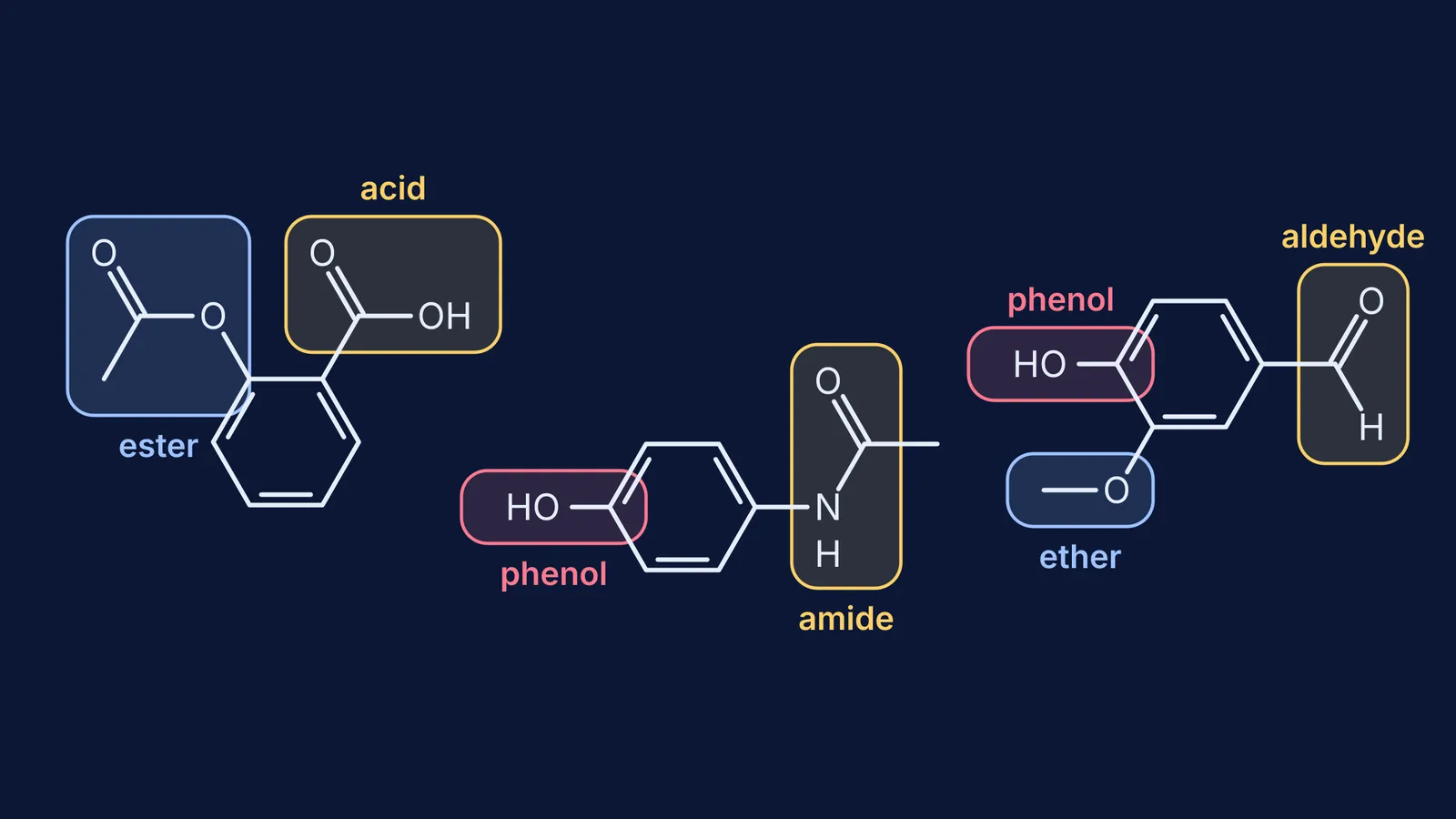
Aspirin. PubChem lists aspirin as C9H8O4, named 2-acetyloxybenzoic acid. That gives you four oxygens to circle.
Two oxygens share one carbon: a C=O and an –OH. Together they are a carboxylic acid (–COOH).
The third oxygen joins the ring to a carbon, and that carbon carries the fourth oxygen as a C=O. Ring–O–C(=O)–CH3 is an ester, not an ether.
The six-membered ring is an aromatic ring (arene).
A common slip is calling that ring–O–C link an ether. Step 2 of the scan catches it. To see how this ester is made, read our walk-through of making aspirin from salicylic acid.
Paracetamol. PubChem's entry for paracetamol (also called acetaminophen) gives C8H9NO2 and the name N-(4-hydroxyphenyl)acetamide. Circle one nitrogen and two oxygens.
The nitrogen is bonded to the ring and to a carbon that has a C=O: amide, not amine. That is why the name ends in "-amide".
One oxygen is that C=O, already counted.
The other oxygen is an –OH directly on the benzene ring: phenol, not alcohol.
Vanillin. Vanillin on PubChem is C8H8O3, named 4-hydroxy-3-methoxybenzaldehyde. Three oxygens to circle.
–CHO on the ring: a C=O carbon that also carries an H, so an aldehyde.
–OCH3: an oxygen between the ring and a methyl, with no C=O on either side, so an ether (a methoxy group).
–OH on the ring: phenol.
The name lists all three (hydroxy, methoxy, benzaldehyde), a quick check. Vanillin is the useful contrast to aspirin: both have an oxygen joined to the ring and to another carbon, but only in aspirin does that carbon carry a C=O.
What should you practise next?
Run the scan on ten textbook structures and write each answer as "atom, neighbour, name", for example "O, next to C=O, ester". Then practise naming what you found: our guides to naming esters, amides and acid chlorides and naming ethers as alkoxyalkanes pick up where this post stops.
If one group keeps confusing you, the Fermi Concept Library has a lesson for every concept in chemistry, each with its place in the map. When you are ready to test yourself, the Fermi Problem Library has worked problems with a step-by-step solver that explains the reasoning rather than printing an answer.


