

On this page
A 2025 study published in the *Journal of General Education and Humanities* on IUPAC nomenclature difficulties found that chemistry students often manifest misconceptions in identifying the parent carbon chain and struggle to make sense of functional groups and substituents.
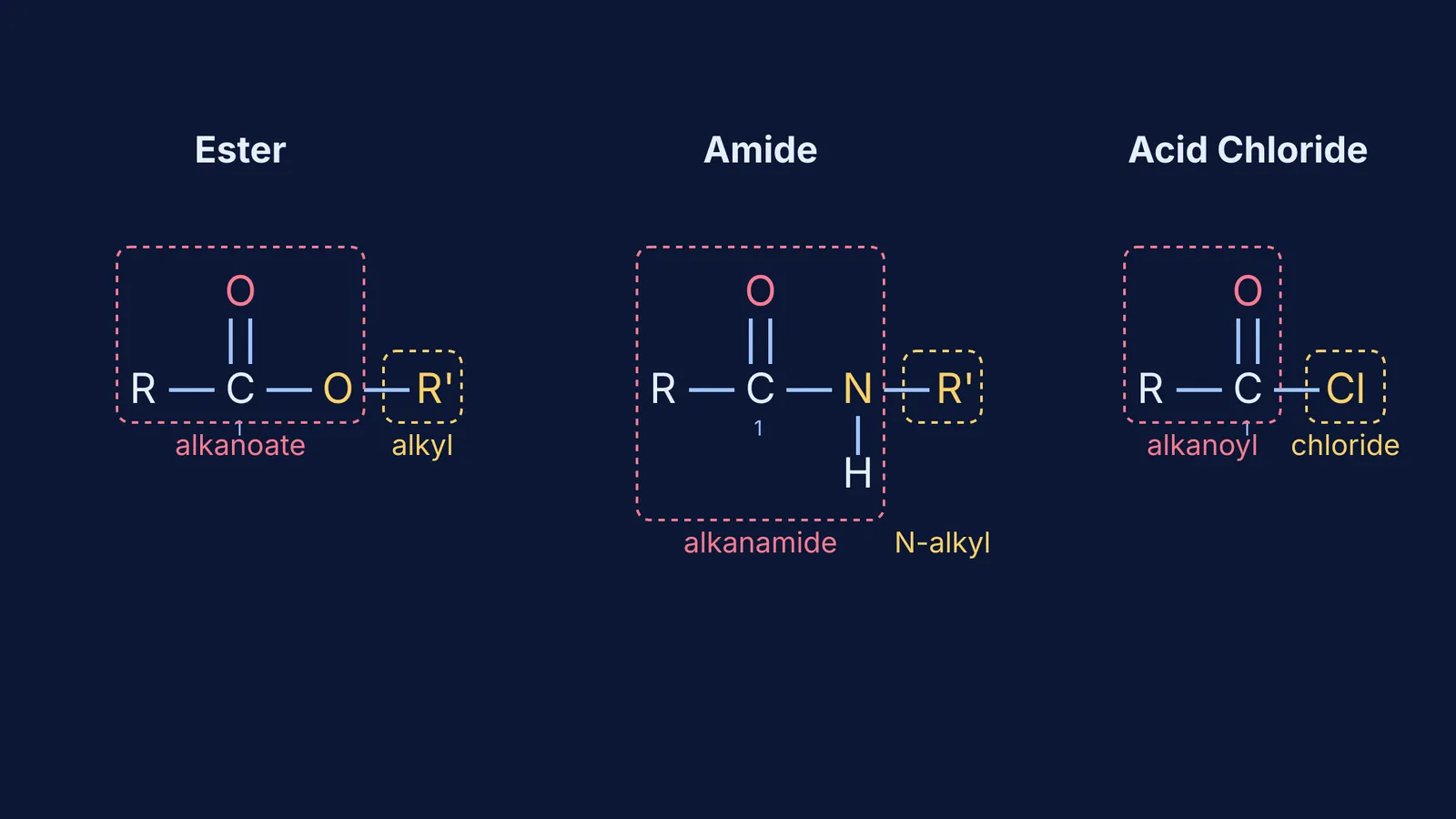
These errors multiply when students meet carboxylic acid derivatives. When you move beyond naming carbon compounds in Class 10, these derivatives require a solid grasp of priority rules. Esters, amides, and acid chlorides all share a carbonyl group (C=O) bonded to another electronegative atom. The trick is to treat the carbonyl carbon as the anchor. Because it sits at the start of a chain, it is almost always assigned position 1.
How do you name esters (alkyl alkanoate)?
Esters are typically formed through Fischer esterification, where a carboxylic acid and an alcohol react. They are named in two parts: the alkyl group and the alkanoate chain.
Identify the alkyl group attached to the single-bonded oxygen. This gets named first (e.g., methyl, ethyl).
Count the continuous carbon chain starting from the carbonyl carbon. This is the parent chain. Replace the "-ic acid" suffix of the original carboxylic acid with "-ate" (e.g., ethanoate, propanoate).
A common slip is reading the molecule from left to right instead of looking at the bonds. For example, in CH₃COOCH₂CH₃, the ethyl group (CH₂CH₃) is attached to the oxygen, and the carbonyl side has two carbons (ethanoate). The correct name is ethyl ethanoate. Do not confuse it with methyl propanoate.
If you are struggling to tell these derivatives apart, the Fermi Concept Library breaks down the priority rules, and Fermi's AI tutor can work out what you already know and build a plan for the session so you practice the right structures.
How do you name amides and use N-substituents?
Primary amides have a -NH₂ group attached to the carbonyl carbon.
Find the longest chain containing the carbonyl carbon, marking it as position 1.
Drop the "e" from the parent alkane and add "-amide" (e.g., ethanamide, propanamide).
The difficulty jumps when the nitrogen atom itself has alkyl groups attached to it, forming secondary or tertiary amides. Instead of numbering these substituents as part of the main carbon chain, you must use the locant "N-".
For example, if a methyl group is attached to the nitrogen of ethanamide, the name is N-methylethanamide. A frequent mistake is numbering the N-substituent as if it were on the parent chain (like "2-methylethanamide"), which is incorrect.
How do you name acid chlorides?
Acid chlorides (or acyl chlorides) feature a chlorine atom directly bonded to the carbonyl carbon.
Count the longest chain starting with the carbonyl carbon.
Replace the "-ic acid" ending of the parent carboxylic acid with "-oyl chloride".
For example, a three-carbon acid chloride is propanoyl chloride. The most common slip here is forgetting to count the carbonyl carbon in the parent chain, leading students to name it "ethanoyl chloride" by mistake. Remember, the carbon double-bonded to the oxygen is always C-1.
A simple checklist for naming derivatives
When faced with a molecule containing a C=O group:
Find the atom attached to the carbonyl carbon. If it is -OR, you have an ester. If it is -N, you have an amide. If it is -Cl, you have an acid chloride.
Label the carbonyl carbon as C-1.
Count the longest carbon chain extending away from the C=O group.
Name any substituents on that main chain with numbers (2, 3, 4...).
Name any substituents on the oxygen (for esters) or nitrogen (for amides) first, using "N-" for amides.
Once you know the rules, try a few examples in the Fermi Problem Library to make them stick.


