

On this page
Drop a steel katori and the whole house hears it. Drop a plastic one and you get a dull knock. The difference is what each material does with the energy afterwards: steel gives it back, flexing to and fro for thousands of cycles, while plastic turns it into heat within about a hundred. That is damped oscillation, on your dining table.
Why does a steel plate ring when you tap it?
A tap bends the plate very slightly. Steel is stiff, so it springs back hard, overshoots, and keeps flexing back and forth at its natural frequencies, pushing the air around it into sound waves.
Steel's elastic modulus is about 210 GPa, according to a table compiled by Tom Irvine of Vibrationdata from Cremer and Heckl's textbook Structure-Borne Sound (Irvine, Damping Properties of Materials). The same document lists Plexiglas at about 5.6 GPa, so steel is roughly 37 times stiffer. Plexiglas is a trade name for PMMA, a transparent thermoplastic usually just called acrylic (PMMA overview)).
But stiffness alone does not decide how long the sound lasts. Energy loss per vibration does.
Why does a plastic plate thud instead?
When anything vibrates with damping, energy is removed every cycle, usually as thermal energy, and the amplitude shrinks (OpenStax University Physics, damped oscillations).
Engineers measure how much energy a material itself loses with a number called the loss factor (η); Irvine gives its link to the damping ratio ξ as η = 2ξ (Irvine). A bigger loss factor means the vibration dies faster.
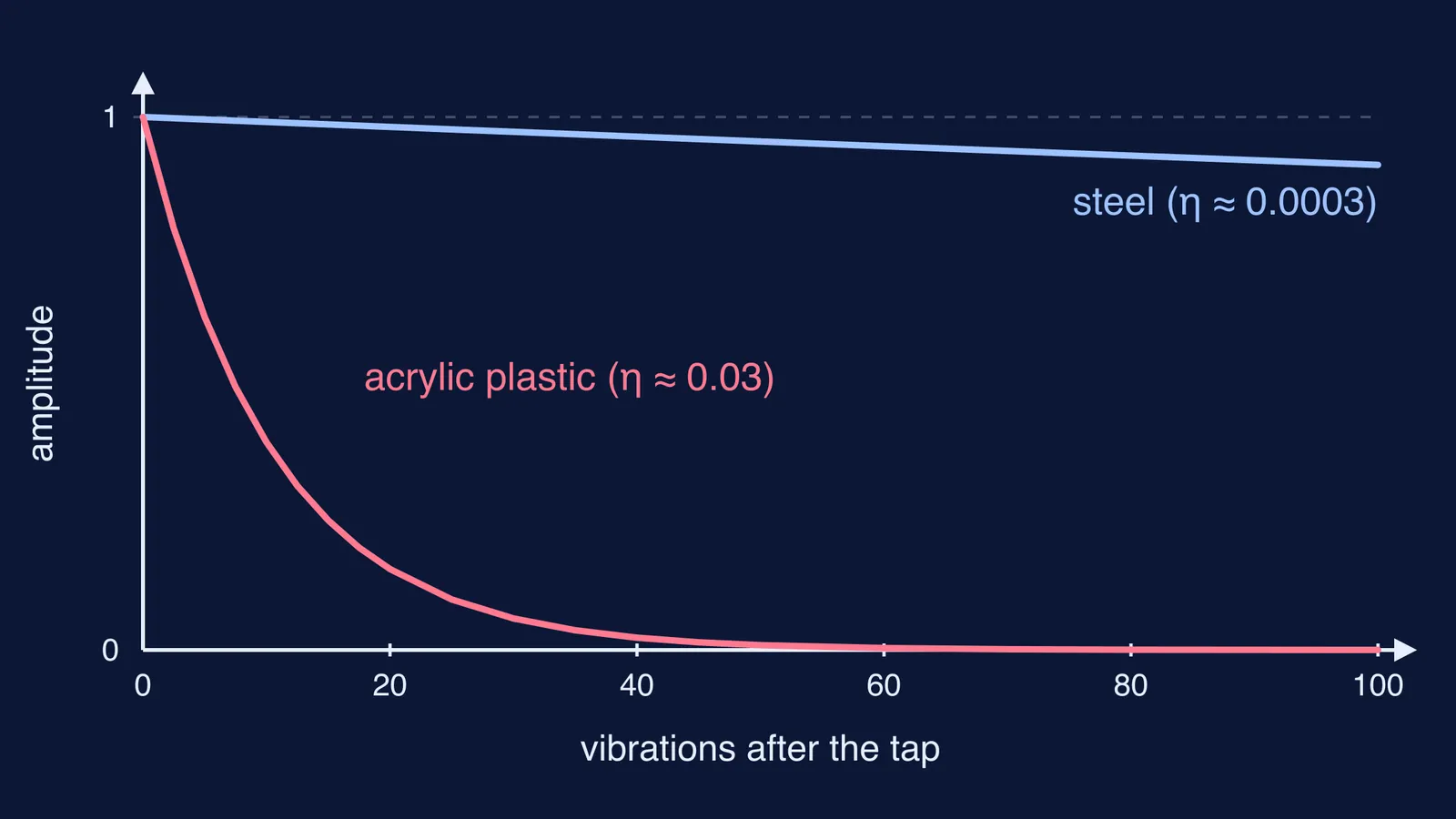
In Irvine's table, steel's loss factor is 0.2 to 3 × 10⁻⁴, that is 0.00002 to 0.0003. Acrylic's is 2 to 4 × 10⁻², or 0.02 to 0.04. Even the lossiest steel against the least lossy acrylic gives a gap of about 70 times; typical values differ by 100 times or more.
How long does each one keep vibrating?
For light damping the amplitude falls by the same factor every cycle; with η = 2ξ, that factor is about e^(−πη) per cycle (OpenStax writes the decaying motion as x = A₀e^(−bt/2m)cos(ωt + φ) in the damped oscillations chapter).
Choose a target: the amplitude falls to 1/1000 of its start. Sound energy goes as amplitude squared, so that is a millionth of the energy, 60 decibels quieter.
Cycles needed: n = ln(1000) ÷ (πη) ≈ 6.91 ÷ (πη).
Steel, using the top of its range from Irvine's table, η = 0.0003: n ≈ 6.91 ÷ 0.00094 ≈ 7,300 cycles.
Acrylic, middle of its range, η = 0.03: n ≈ 6.91 ÷ 0.094 ≈ 73 cycles.
At an illustrative 1,000 vibrations per second, steel would ring for about 7 seconds and acrylic for about 0.07 seconds. Your ear hears the second as a knock, not a note.
A real thali stops sooner, because it also loses energy to the air (the sound itself), your hand and the table; Irvine notes that boundaries and acoustic coupling add damping beyond the table values. Those losses shorten both sounds, but the material gap remains.
If the decay is easier to see than to calculate, the Fermi Simulation Lab has interactive simulations for ideas that are easier to see than to read. For the exam version of this calculation, read how to find the amplitude of a damped oscillation after n oscillations.
Why is the steel note clearer and higher?
Clearer: the less the damping, the narrower the resonance, so a lightly damped object responds strongly only very close to its natural frequencies (OpenStax, forced oscillations). Steel's energy sits in a few sharp tones; plastic's is smeared out.
Higher: in Irvine's table, a longitudinal wave travels through a steel rod at about 5,100 m/s and through acrylic at about 2,200 m/s. For objects of the same shape and size, natural frequencies scale with this wave speed, so an acrylic copy of a steel bowl would sound roughly 2.3 times lower. Size and shape matter too, which is why wind chimes of different lengths ring different notes.
Try it at home: a 10-minute kitchen test
Write down your predictions first: which will ring longest, and which highest?
Collect a steel thali, a steel tumbler, a plastic plate and a plastic cup.
Hang each from a loop of thread, or balance it on two fingertips, so your hand damps it as little as possible.
Tap each once with a steel spoon and time, on a phone stopwatch, how long you can still hear it. Repeat three times and take the average.
Tap the thali again and press a fingertip on it while it rings. The sound dies at once: you have added a lossy material, which is what plastic does from the inside.
Rest the thali on a folded towel and tap once more: extra damping at the boundary.
If a younger sibling asks, try: "Steel keeps wobbling after you hit it, so it sings. Plastic turns the wobble into a little warmth, so it goes thud."
For another prediction-first experiment with the same ingredients, try whether a fuller glass rings higher or lower.


