

On this page
In the real world, no spring bounces forever and no pendulum swings infinitely. Systems lose energy to non-conservative forces like air resistance or internal friction, causing their movements to slowly die out. This process is called damped harmonic oscillation. Whether you are looking at a car's shock absorbers or a playground swing, damping is what brings the system back to rest.
How does the amplitude of a damped oscillation decay over time?
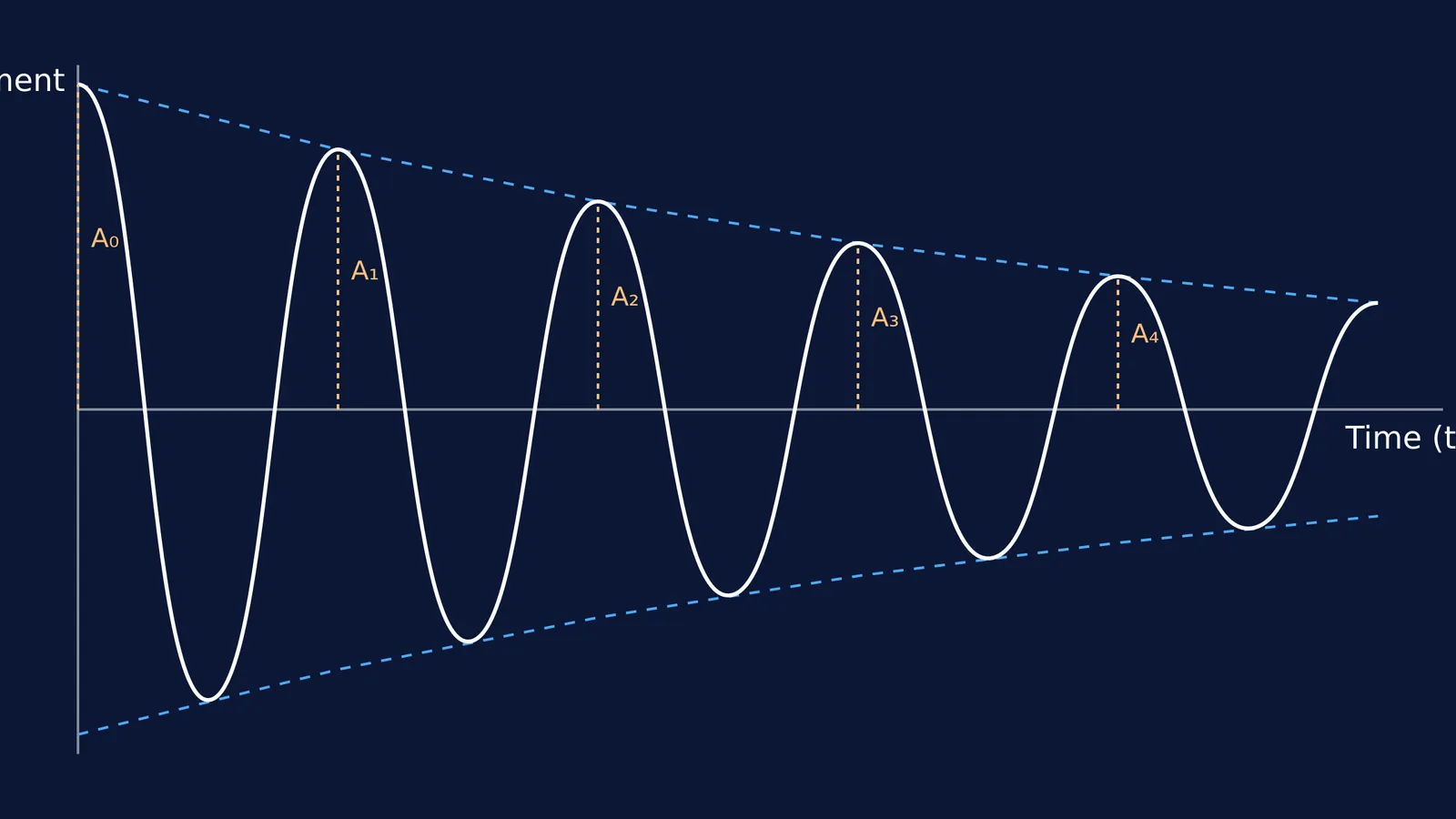
For a lightly damped oscillator, the period and frequency remain almost exactly the same as they would be in ideal simple harmonic motion (SHM). However, the maximum displacement—the amplitude—gradually decreases. The position of the object at any given time is an oscillating cosine wave bounded by a decaying exponential envelope.
According to OpenStax's *University Physics*, the amplitude A(t) at time t follows this mathematical rule:
A(t) = A₀ e^(-bt / 2m)
In this equation, A₀ is the initial amplitude at t=0, b is the damping constant which depends on the fluid or friction involved, and m is the mass of the oscillating object (OpenStax, 2016). The larger the damping constant b, the faster the amplitude decays toward zero.
What are the different types of damping?
While the exponential rule applies to lightly damped systems, the physical behaviour changes if the resistive forces are very strong. Physicists classify these scenarios into three main categories:
Underdamped: The damping constant is small, so the system oscillates back and forth multiple times, with the amplitude slowly dropping according to the exponential formula.
Critically damped: The damping is just strong enough to stop the system from crossing the equilibrium point. The object returns to rest in the shortest possible time without oscillating.
Overdamped: The damping is so severe (like a pendulum moving through thick honey) that the system slowly creeps back to equilibrium without ever crossing it.
Most exam questions focus on the underdamped case, where we can track the amplitude cycle by cycle.
What is the amplitude of a damped oscillation after n oscillations?
Because the period T of an underdamped system is essentially constant, the elapsed time after n complete oscillations is exactly t = nT. If we substitute this time into our amplitude formula, we get:
Aₙ = A₀ e^(-bnT / 2m) = A₀ [e^(-bT / 2m)]ⁿ
Notice that the term inside the bracket is a constant ratio for any given system. This means the amplitude after n oscillations drops by the exact same fraction every cycle, forming a geometric progression.
Let's look at a common problem structure. Suppose an oscillator's amplitude halves in 10 oscillations. What is its amplitude after 30 oscillations?
After 10 oscillations, the amplitude is A₁₀ = A₀ / 2. This means our multiplier for 10 cycles is 1/2.
We want to find the amplitude after 30 oscillations, which is exactly three sets of 10 cycles.
Therefore, the amplitude halves three times in a row: A₃₀ = A₀ × (1/2) × (1/2) × (1/2) = A₀ / 8.
If you find yourself stuck on wrong-method mistakes in similar questions, the Fermi Problem Library has worked problems with a step-by-step solver that explains the reasoning rather than printing an answer.
How much energy is left after n oscillations?
In standard simple harmonic motion problems, the total mechanical energy of a spring-mass system is directly proportional to the square of its amplitude: E = 1/2 kA².
This relationship still holds for the instantaneous amplitude of a lightly damped oscillator. Because the energy depends on the square of the amplitude, if the amplitude drops by a factor of x, the stored energy drops by a factor of x².
Using our previous example, if the amplitude after 30 oscillations is 1/8 of its original value (A₀ / 8), the energy left is:
E₃₀ = 1/2 k(A₃₀)² = 1/2 k(A₀ / 8)² = 1/64 (1/2 kA₀²) = E₀ / 64
This result means the oscillator has lost 63/64 of its original mechanical energy to the environment. You can see how kinetic and potential energy are exchanged during these cycles by looking at SHM energy graphs. By remembering that amplitude decays geometrically and energy decays as the square of that amplitude, you can solve these problems in seconds without complex integration.


