

On this page
Before you read on, write down two predictions. You tap a glass with a spoon, add water, and tap again: does the note go up or down? You blow across a bottle, add water, and blow again: up or down?
Why does a glass with more water ring lower?
When you tap a glass, the sound comes from the glass itself. The rim flexes into a slight oval and back, hundreds of times a second. Researchers who imaged this motion with holographic interferometry reported that "the liquid clearly lowers the resonance frequencies" while leaving the shape of the vibration almost unchanged (Jundt et al., Journal of the Acoustical Society of America, 2006).
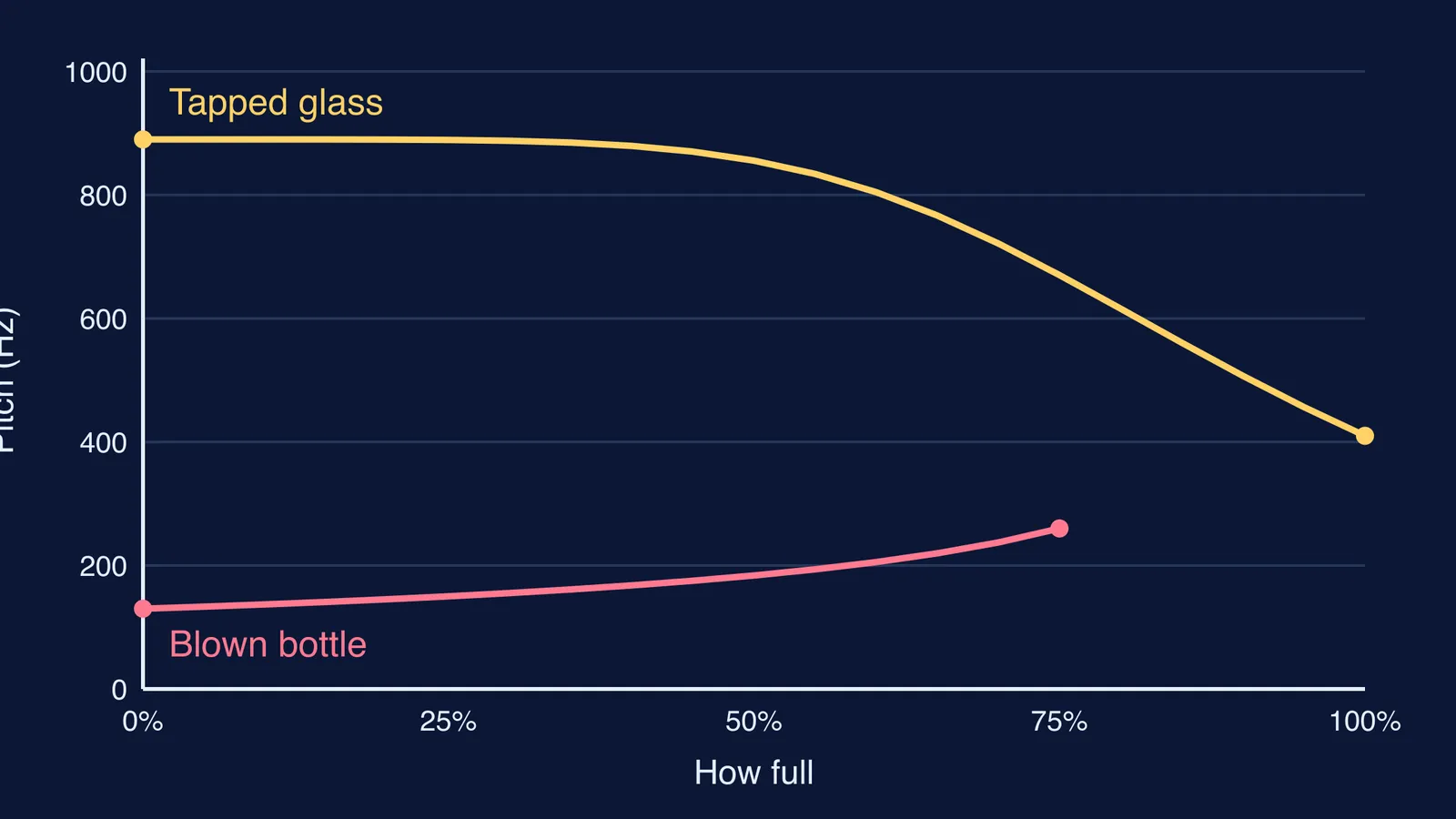
In their glass, the main note was about 890 Hz when empty and about 410 Hz when filled to roughly 10 cm, read from the measured curve in the full paper.
Water touching the wall gets pushed in and out with it, so it adds moving mass, but it does not make the glass any stiffer. Same spring, more mass, slower vibration.
They tested this by swapping liquids: dichloromethane (1.32 kg/l), water (1 kg/l) and isopropanol (0.79 kg/l). The fitted added-mass factors came out in the ratio 1 : 0.80 : 0.59, close to the density ratio of 1 : 0.75 : 0.60 (Jundt et al., 2006). Heavier liquid, bigger drop in pitch.
Why does the pitch barely change at first?
In the researchers' model, the cup is fixed at the stem, so the bottom of the wall hardly moves and the rim moves most. Water low down sits where the wall barely moves and the bowl is narrow, so it adds little moving mass.
Jundt and colleagues captured this with a simple model: frequency equals the empty frequency divided by the square root of (1 + αhⁿ), where h is the water depth and n came out at about 5.5 for their glass (Jundt et al., 2006). In their measurements the pitch stayed almost flat for the first few centimetres, then fell steeply.
A worked example with their numbers: at full depth, 1 + αhⁿ = (890 ÷ 410)², which is about 4.71. At half that depth, the αhⁿ part shrinks by a factor of 0.5 raised to the power 5.5, or about 0.022. So 1 + αhⁿ is about 1.08, and the pitch is 890 ÷ √1.08, roughly 856 Hz. In this model, water to half the depth lowers the note by only about 4%. The top half does most of the work.
Why does blowing over a bottle make the pitch go up?
When you blow across a bottle, the air is the instrument. The plug of air in the neck acts as a mass, and the air trapped in the body acts as a spring. This is a Helmholtz resonator, and its frequency is f = (c ÷ 2π) × √(S ÷ VL), where c is the speed of sound, S the neck's area, L its length and V the air volume (UNSW Music Acoustics).
The same page works an example: a 1 litre bottle with a 3 square centimetre neck 5 cm long gives about 130 Hz (UNSW Music Acoustics). Pour in water and V shrinks, so the air spring gets stiffer and the pitch rises. Since f depends on 1 ÷ √V, half a litre of air gives 130 × √2, about 184 Hz, and a quarter litre gives 260 Hz, one octave up. This holds while the water stays below the bottle's shoulder. More on this half of the experiment in blowing over a bottle as you add water.
A bottle can do both. In a Penn State acoustics demonstration, tapping a beer bottle's neck gave its most prominent peaks at 3200 Hz and above, from the bottle's own vibration modes, plus a faint 192 Hz peak matching the note you get by blowing over the empty bottle (Penn State Acoustics and Vibration Animations).
How do you test it at home?
You need a thin glass or a steel tumbler, an empty glass bottle, water, a metal spoon and a ruler. A phone tuner app shows the pitch in hertz; your ears also work.
Write your two predictions and one reason for each.
Tap the empty glass gently near the rim and note the pitch.
Add water in 2 cm steps, tapping at the same spot. Note where the pitch starts to fall clearly.
Blow across the empty bottle, then add water in steps and blow again, keeping the water below the shoulder.
Tap the part-filled bottle with the spoon. Which way does that note move?
Explain each result in one sentence using the words mass and spring.
Tap gently. A wrong prediction is the useful part: it shows which object you assumed was vibrating.
If you like to see an idea move before testing it, the Fermi Simulation Lab has interactive simulations for ideas that are easier to see than to read. For the air-column side, try our resonance tube simulation on the speed of sound, then build a straw oboe to hear pitch change with your own breath.


