On this page
A plastic drinking straw and a pair of scissors are enough to make a working reed instrument. It takes a few minutes, sounds a bit like a beginner on the oboe, and every snip turns it into a small lesson on vibration, frequency and pitch.
How do you make a musical instrument from a drinking straw?
The steps below follow the Exploratorium's Straw Oboe activity and the Naked Scientists' version.
Flatten one end. Bite down on the last 2-3 cm with your front teeth and pull the straw out, several times, until that end stays flat with sharp creases.
Cut the reed. Snip equal pieces off both corners of the flat end so it comes to a point about 1.5 cm long. The two flaps are your reed.
Blow. Put the pointed end in your mouth with your lips just past the cut, press gently and blow steadily.
Adjust. Try blowing harder or softer and squeezing more or less until the straw buzzes.
Use your own straw, and keep the scissors well away from your face.
Why does a straw oboe make a sound?
The two cut flaps act as a reed, much like the double reed of a real oboe. The Exploratorium explains the cycle: when you blow, air rushes through the straw and the pressure inside drops, so the higher pressure outside pushes the flaps together and closes off the flow. Pressure then builds up again and pops the reed open. This repeats very fast, sending pulses of compressed air down the straw.
Those pulses set the air in the straw vibrating. When the reed vibrates at the straw's natural frequency, waves travelling each way overlap into a standing wave and the air vibrates strongly. That build-up is resonance, and it turns a faint flutter into a loud buzz.
For a refresher, see our explainer on frequency and time period in sound.
Why does a shorter straw give a higher note?
Pitch is how your ear reads frequency: HyperPhysics puts it simply as "for most practical purposes the pitch is just the frequency". The Exploratorium notes that a shorter straw holds a shorter standing wave, so its pitch is higher.
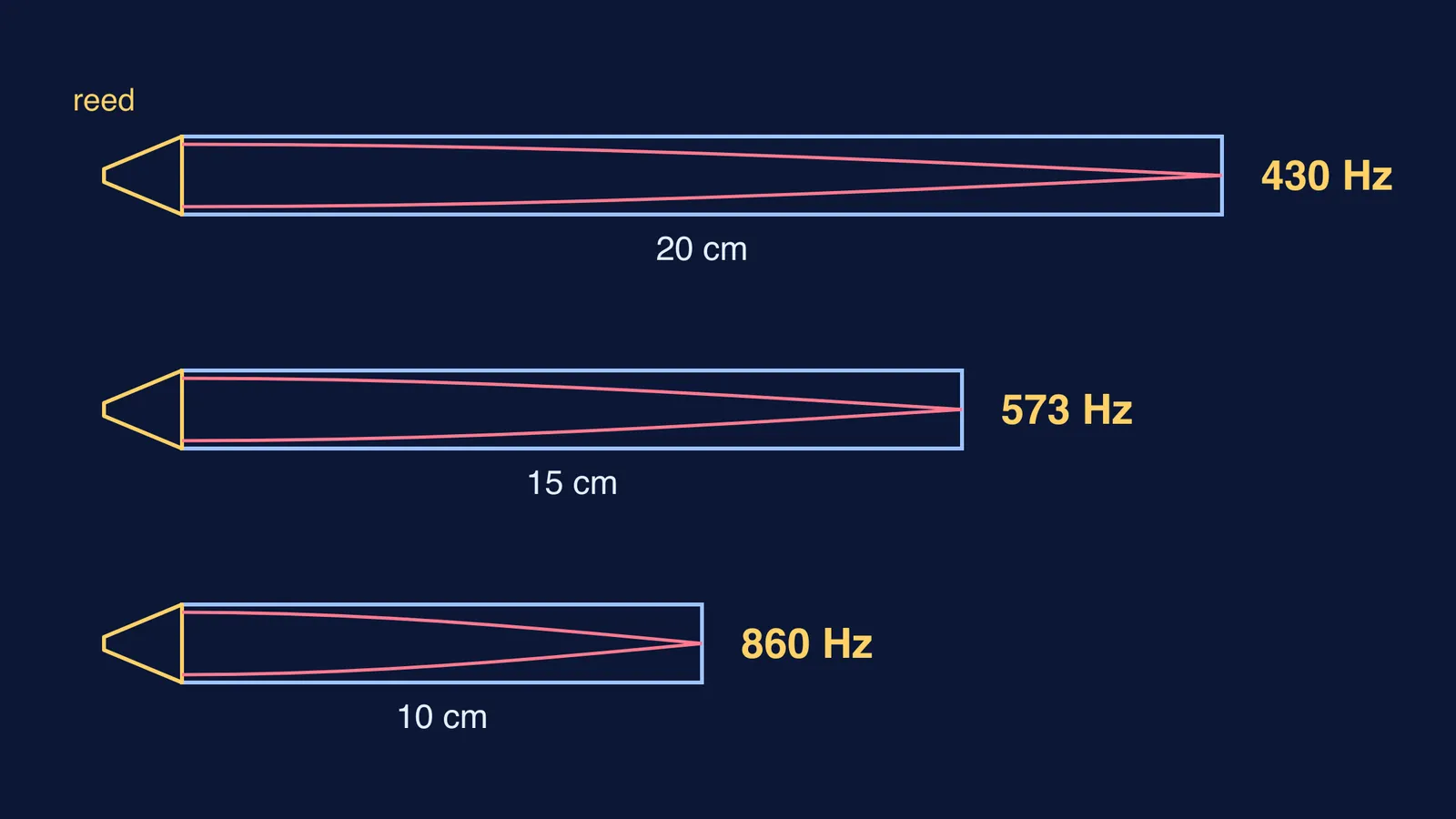
You can put a number on it. At a reed, the air pressure swings the most, so the reed end behaves like a closed end; the University of New South Wales clarinet acoustics page describes the same thing for the clarinet's reed. The far end is open. For a pipe closed at one end, the longest standing wave is four times the pipe's length, so the lowest note is f = v/4L, according to HyperPhysics on closed air columns. The speed of sound in air at 20 C is about 344 m/s, per HyperPhysics.
To predict your notes, use f = 344 / (4 x L), with L in metres:
20 cm straw: 344 / 0.80 = 430 Hz
15 cm straw: 344 / 0.60 = about 573 Hz
10 cm straw: 344 / 0.40 = 860 Hz
Halve the length and the frequency doubles. Treat these as estimates. HyperPhysics adds an end correction of about 0.6 times the radius at the open end, so a straw of 3 mm radius acts about 2 mm longer and sounds slightly lower. Your lips shift the note too; the Naked Scientists note that moving your mouth along the straw gives different notes.
What experiment can you do with a straw oboe?
Turn the toy into an investigation with a ruler and a free tuner app on a phone. UNSW's woodwind page notes that you can tune a straw reed by cutting pieces off the other end.
Measure the straw from the base of the reed to the open end.
Play a steady note and record the frequency the app shows.
Take the straw out of your mouth, cut 2 cm off the open end and repeat, down to about 8 cm.
Tabulate length, measured frequency and the f = v/4L prediction.
Plot frequency against 1/L. If the closed-pipe model holds, the points lie close to a straight line through the origin.
Write one sentence on where measurement and prediction differ, and why.
The Exploratorium suggests more: cut finger holes and play it like a recorder, slide a slightly larger straw over the end like a trombone, or make a paper bell to make it louder. Finger holes work as on a bansuri; see how flute holes change the note. To tune a pipe with water instead of scissors, try blowing over a bottle as the water level changes.
You can hear the standing wave but never see it. The Fermi Simulation Lab has interactive simulations for the ideas that are easier to see than to read.