

On this page
If you have ever played a flute or recorder, you know the basic rule: covering more holes makes the note deeper, and opening them makes it higher. But what exactly is the air doing inside the instrument?
In Class 11 physics, this real-world instrument is modelled as an open-open cylindrical pipe. By looking at how sound waves behave when they meet an open hole, we can see exactly why the pitch changes and how to calculate the new frequency.
How do flute holes change the musical note?
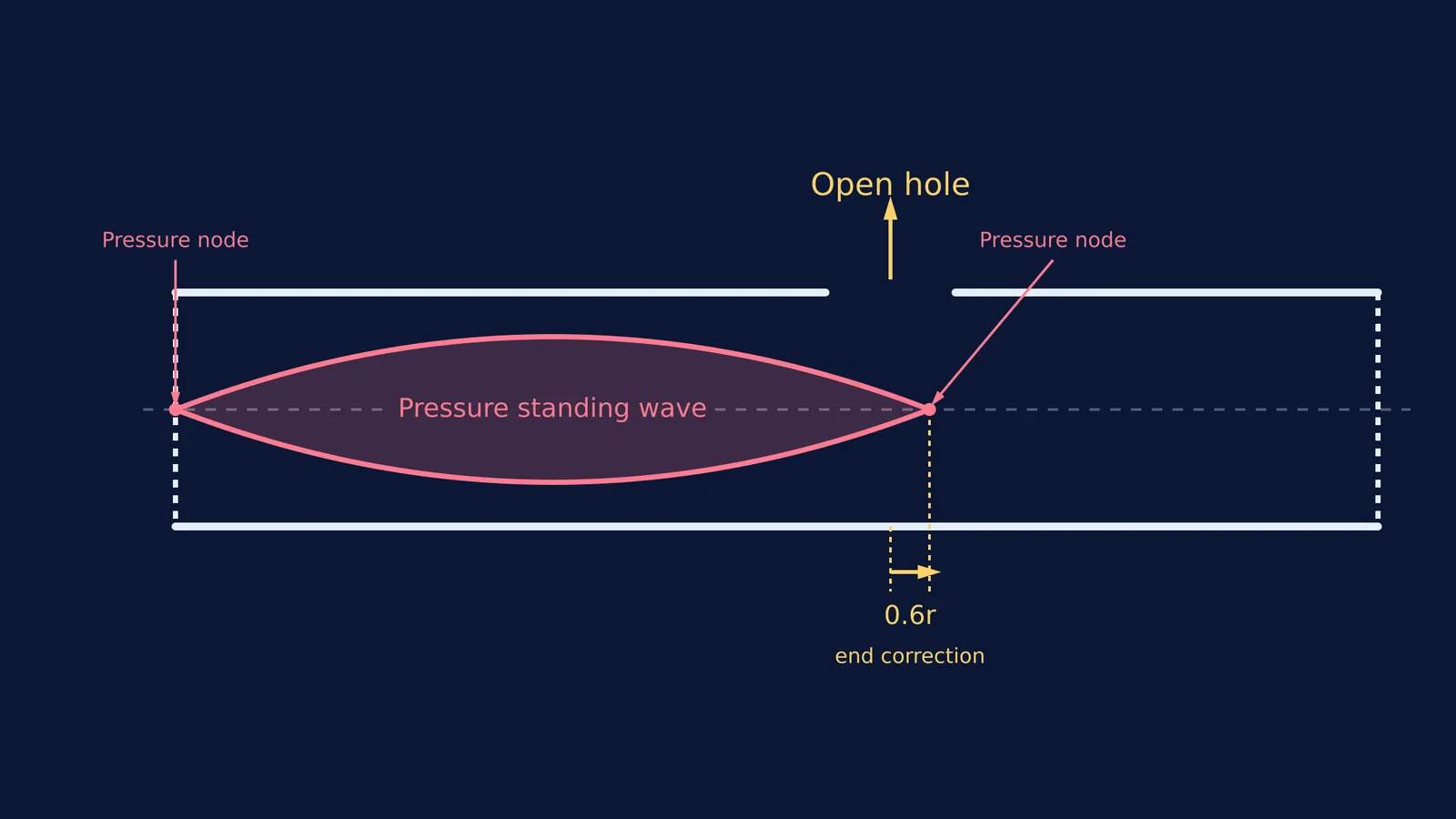
A flute produces sound through standing waves. When you blow across the embouchure (mouthpiece), you create a vibration that travels down the tube. Because the flute is open to the atmosphere, the air pressure at any open end is forced to match the room's atmospheric pressure. This creates a pressure node—a point where the pressure does not change.
When all the keys are pressed and the holes are closed, the sound wave travels the full length of the flute before it hits the open end at the bottom. But when you lift a finger to open a tone hole, you give the vibrating air a much earlier exit.
Opening a hole creates an acoustical short circuit to the outside air, forcing a new pressure node to form near that hole. Because the wave effectively stops and reflects at this new node, the vibrating air column is cut short (Wikipedia, Flute).
The frequency (f) of the fundamental note in an open pipe depends on its effective length (L) and the speed of sound (v ≈ 343 m/s at a 20 °C room temperature, Wikipedia):
f = v / 2L
Because the length L is in the denominator, shortening the air column increases the frequency. A higher frequency means a higher-pitched note.
Why doesn't the hole act like a clean cut?
If the formula f = v / 2L were perfectly literal, opening a hole halfway up the flute would instantly double the frequency (an octave jump). In reality, it is more complicated.
The air does not stop vibrating exactly at the physical boundary of the hole. The vibrating air inside the pipe pushes against the still air just outside the hole, which has mass and takes energy to move. This acoustical inertance means the wave "overshoots" slightly into the surrounding air before the pressure fully drops to zero.
Physicists account for this with an end correction. For a simple unflanged open end, the vibrating column extends past the physical pipe by a distance of 0.6r, where r is the radius of the hole (Wikipedia, End correction).
This means the effective acoustic length (L) is always slightly longer than the physical distance to the hole. Flute makers have to calculate this carefully: a small hole adds more resistance and creates a larger end correction, making the note sound flatter than if the pipe were simply sawn off at that point.
What happens if you close holes further down?
You might assume that once a hole is open, everything past it is irrelevant. But musicians often use cross-fingering—closing one or two holes *below* the first open hole on a traditional flute.
Because the open hole is not a perfect short circuit, some of the sound wave's energy leaks past it and travels further down the tube. Closing downstream holes increases the effective volume of the pipe, extending the standing wave slightly and lowering the pitch. This allows players to reach in-between chromatic notes and fine-tune specific harmonics.
How does this help with Class 11 physics?
When you study waves for JEE or NEET, the flute is the classic example of an open organ pipe. Exam questions often ask you to calculate the fundamental frequency or harmonics when a pipe is partially filled with water (making it a closed pipe) or when a hole is introduced.
To solve these quickly:
Identify the nodes: Any open end or open hole is a pressure node.
Count the loops: The distance between two adjacent nodes is always half a wavelength (λ / 2).
Add the end correction: If the question specifies a radius r, remember to add 1.2r to the total length of an open-open pipe (or 0.6r at one open hole, Wikipedia).
Visualising these invisible pressure changes can be tricky when you only have a textbook. In the Fermi Simulation Lab, you can change the length of a virtual pipe, open and close holes, and watch the standing wave adjust in real time, making the relationship between length and pitch completely clear.
Next time you are stuck on a phase difference vs path difference problem, remember the flute. The maths is not just abstract equations; it is the exact blueprint for making music.


