On this page
Before you read on, blow across an empty glass bottle until it hoots. Now predict: if you pour in water and blow again, will the note go higher or lower? And if you tap the side with a spoon instead? Most people get one right and assume the other must match. It doesn't.
Does pitch go up or down when you add water to a bottle?
Blow across the bottle and the pitch goes up as the water rises. Tap it and the pitch goes down. Science World puts the blowing case plainly: "more water results in a higher pitch, as opposed to tinkling the bottle." For tapping, the same page says "more water means slower vibrations and a deeper tone."
The two actions shake different things. Blowing vibrates the air inside; tapping makes the bottle and the water in it vibrate.
Why does less air give a higher note?
A bottle with a neck acts as a cavity resonator: the air in the neck bounces against the springy air in the body. According to HyperPhysics on cavity resonance, the resonant frequency depends on the speed of sound and on the square roots of three things: the area of the opening, the length of the neck and the volume of the cavity. A bigger volume gives a lower note. Pouring in water shrinks the volume of air, so the note rises.
A tall, narrow bottle behaves more like a pipe closed at one end, and the direction comes out the same. HyperPhysics on closed air columns gives the fundamental as f = v/4L, where L is the length of the air column, plus an end correction of about 0.6 times the radius at the open end. Sound travels at about 344 m/s in air at 20 °C, according to HyperPhysics on the speed of sound. So a 25 cm air column hums near 344/(4 × 0.25) = 344 Hz, ignoring the end correction. Fill it until only 12.5 cm of air is left and the note doubles to about 688 Hz, an octave higher. The two models differ in how fast the note climbs, but they agree on the direction: less air, higher pitch.
What did a real bottle measure?
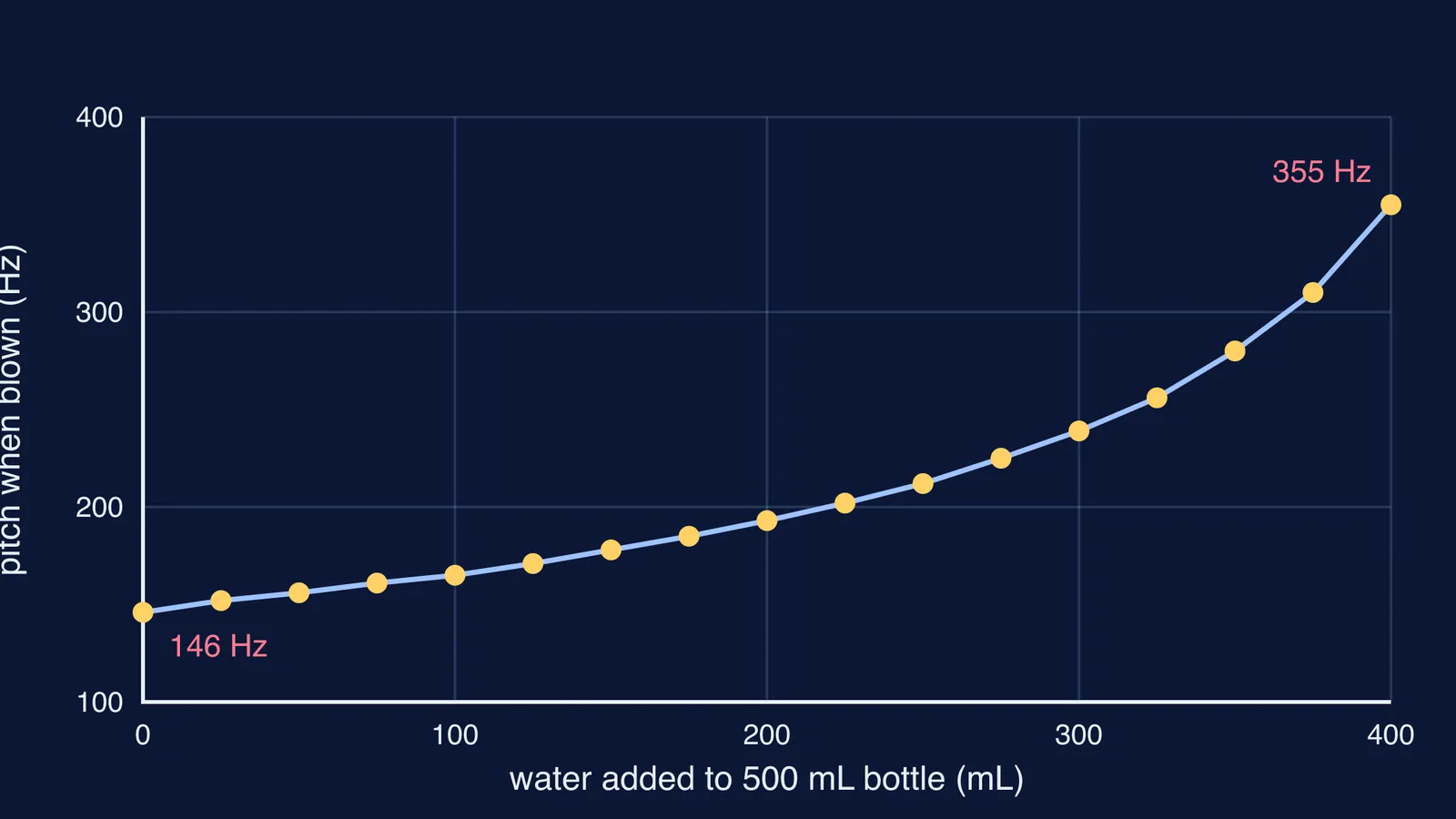
HyperPhysics recorded a 0.5 litre glass Coke bottle by blowing over it and reading the note with a microphone and a digital frequency counter. A few of its values:
500 cm³ of air (empty): 146 Hz
250 cm³ of air: 212 Hz
125 cm³ of air: 310 Hz
100 cm³ of air: 355 Hz
The page reports that frequency is proportional to the inverse square root of the volume, which gives you a way to predict before you measure. Try it with the same numbers:
Halve the air, from 500 to 250 cm³. The rule says multiply by √2, about 1.41. Prediction: 146 × 1.41 ≈ 206 Hz. Measured: 212 Hz.
Quarter the air, from 500 to 125 cm³. The rule says multiply by √4 = 2. Prediction: 292 Hz. Measured: 310 Hz.
The rule gets the direction and rough size right, though the measured notes run a little above this simple prediction, so treat it as a guide rather than an exact law. Notice too that the change is uneven: the first 250 cm³ of water raises the note by 66 Hz, but the next 150 cm³ raises it by 143 Hz. The last few pours make the biggest jump.
Why does tapping a bottle with more water sound lower?
When you tap, the glass rings, and the water touching it has to move with it. That extra moving mass slows the vibration, so a fuller bottle rings lower. The Science World classroom activity reports the same result: the bottle with the most water has the lowest pitch when tapped. It works much like a heavier mass on a spring bobbing more slowly, which you can test in our mass-spring simulation with five predictions.
How do you test it at home?
You need a glass bottle with a narrow neck, a measuring jug, a steel spoon and about 15 minutes.
Before you start, write predictions for blowing and tapping at three levels: empty, half full and nearly full.
Blow a thin stream of air across the mouth, not into it, with your lips close to the rim.
Add water in 100 mL steps. At each step, blow, then tap the same spot with the spoon.
Rank the notes by ear, or read them in hertz with a free tuner app on a phone.
Compare with your predictions. For every miss, write one line on what was vibrating: the air or the glass and water.
Parents, one question does most of the teaching: "What is vibrating right now?"
Where to go next
For the exam version of this experiment, read how a closed pipe partly filled with water changes frequency. Your bottle will sound slightly different on a hot afternoon than on a cold morning; how temperature and humidity change the speed of sound explains why.
Standing waves in an air column are hard to picture from a formula. The Fermi Simulation Lab has interactive simulations for ideas that are easier to see than to read.