

On this page
When a bell rings, a tuning fork is struck, or a guitar string is plucked, it vibrates back and forth. Every complete back-and-forth movement is one vibration (or cycle). Understanding how to measure these vibrations is a core part of the Class 8 chapter on sound. These measurements form the basis for everything we study about sound waves, from the pitch of a musical note to the functioning of the human ear.
What is the relation between frequency and time period of sound?
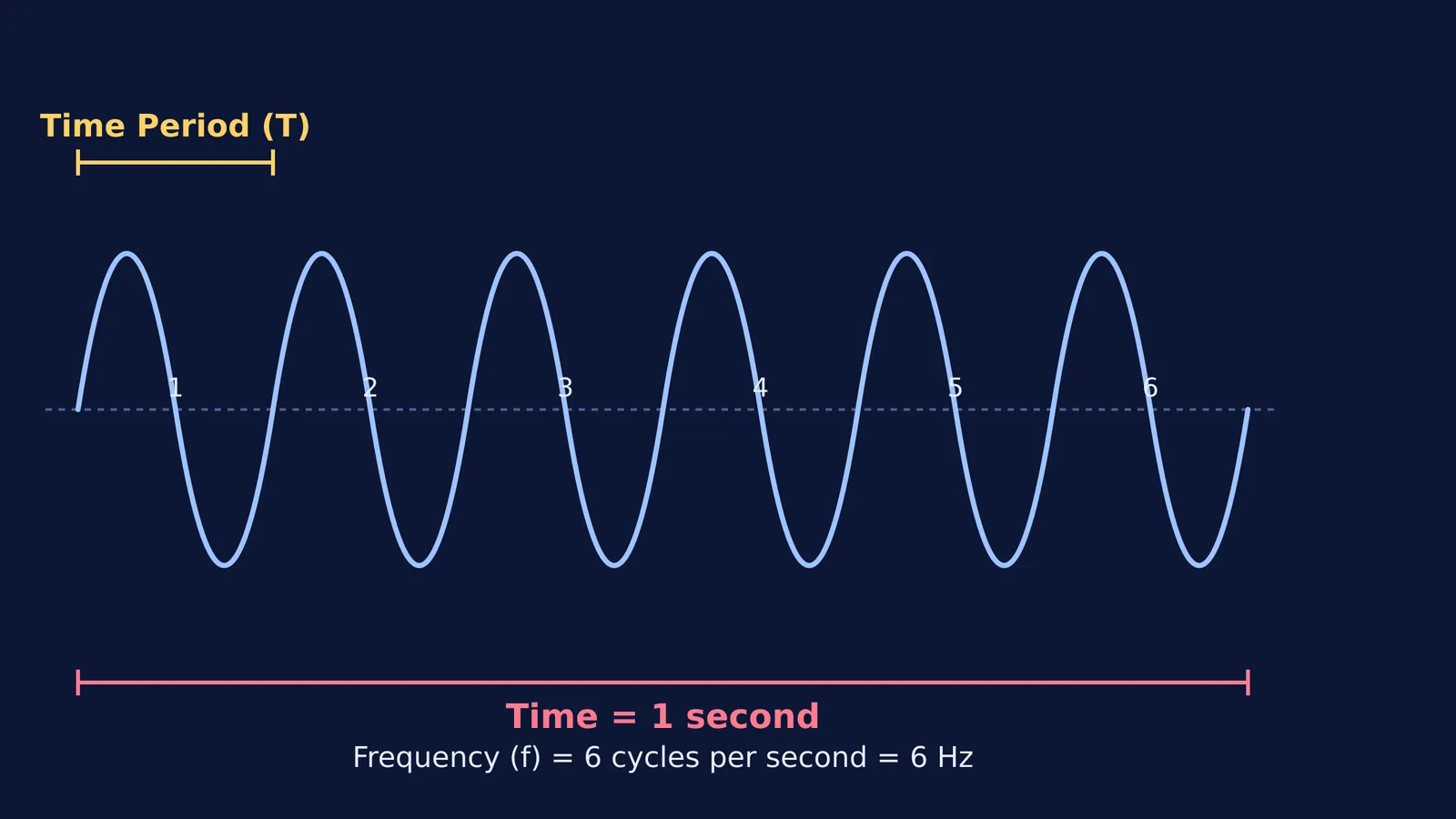
Frequency is the number of occurrences of a repeating event per unit of time [[1]](https://en.wikipedia.org/wiki/Frequency). In the context of sound, it is how many complete vibrations happen in exactly one second. The interval of time between these events—the time taken to complete just one full cycle—is called the period [[1]](https://en.wikipedia.org/wiki/Frequency).
Because frequency counts how many vibrations fit into one second, and the time period measures how many seconds one vibration takes, they are exact reciprocals of each other. The formula connecting them is:
f = 1 / T
(and therefore T = 1 / f)
Where f is frequency and T is the time period. If you pluck a string and it takes 0.1 seconds to complete one full vibration, its frequency is 1 / 0.1, or 10 vibrations per second. This inverse relationship means that if an object vibrates very quickly, its time period must be very short. Conversely, a slow vibration, like that of a seconds pendulum, takes a longer time to complete each cycle.
What does hertz mean in sound vibrations?
The unit of measurement of frequency in the International System of Units (SI) is the hertz, having the symbol Hz [[1]](https://en.wikipedia.org/wiki/Frequency). It is named after the physicist Heinrich Rudolf Hertz, and one hertz is equivalent to one cycle per second [[2]](https://en.wikipedia.org/wiki/Hertz).
So, a sound wave with a frequency of 50 Hz means the source is vibrating exactly 50 times every single second. The human hearing range is commonly given as 20 to 20,000 Hz, meaning we can detect sounds created by objects vibrating anywhere from 20 times to 20,000 times a second [[3]](https://en.wikipedia.org/wiki/Hearing_range). When a mosquito flies past your ear, the high-pitched whine is the sound of its wings beating hundreds of times a second.
When studying waves, distinguishing between the variables that change pitch (controlled by frequency) and loudness (controlled by amplitude) is a common hurdle. If you need to trace how these definitions connect to wave speed or wavelength, the Fermi Concept Library maps out every concept in physics, chemistry, biology, mathematics and computing, each with its own lesson and its place in the map.
How does frequency affect the pitch of a sound?
The brain interprets the frequency of a sound wave as pitch. A higher frequency means more vibrations reach our eardrums every second, which we hear as a higher pitch. A lower frequency means fewer vibrations per second, which sounds lower.
For instance, the lowest string on a standard bass guitar vibrates at around 41 Hz, creating a deep, rumbling sound. A small bird or a whistle might create vibrations at several thousand hertz, producing a sharp, piercing sound. Even though both sounds travel through the air to reach us, the difference in how rapidly the source was vibrating dictates entirely how they sound to human ears.
How do you calculate frequency from time period?
If you are given the time it takes for one vibration, or the total time for several vibrations, you can find both T and f. Here is a framework to solve these textbook problems:
Find total vibrations and total time: Read the question to see how many oscillations occurred in how many seconds.
Calculate time period (T): Divide the total time by the total number of vibrations. This gives seconds per vibration.
Calculate frequency (f): Use f = 1 / T, or divide the total vibrations by the total time. The result is in hertz.
Let us look at two worked examples.
Example 1: A vibrating bell A school bell vibrates 120 times in 3 seconds. What is its time period and frequency?
Total vibrations = 120
Total time = 3 s
Time period T = 3 / 120 = 0.025 s. Each vibration takes 0.025 seconds.
Frequency f = 120 / 3 = 40 Hz. The bell vibrates 40 times a second.
Example 2: A tuning fork or string A vibrating string has a time period of 0.01 seconds. What is its frequency?
Time period T = 0.01 s
Frequency f = 1 / 0.01 = 100 Hz.
These calculations are foundational before you move on to complex topics like pressure waves in sound, where you track how the air molecules themselves bunch up and spread apart. When setting up calculation steps for harder physics problems, the Fermi Problem Library has worked problems with a step-by-step solver that explains the reasoning rather than printing an answer.


